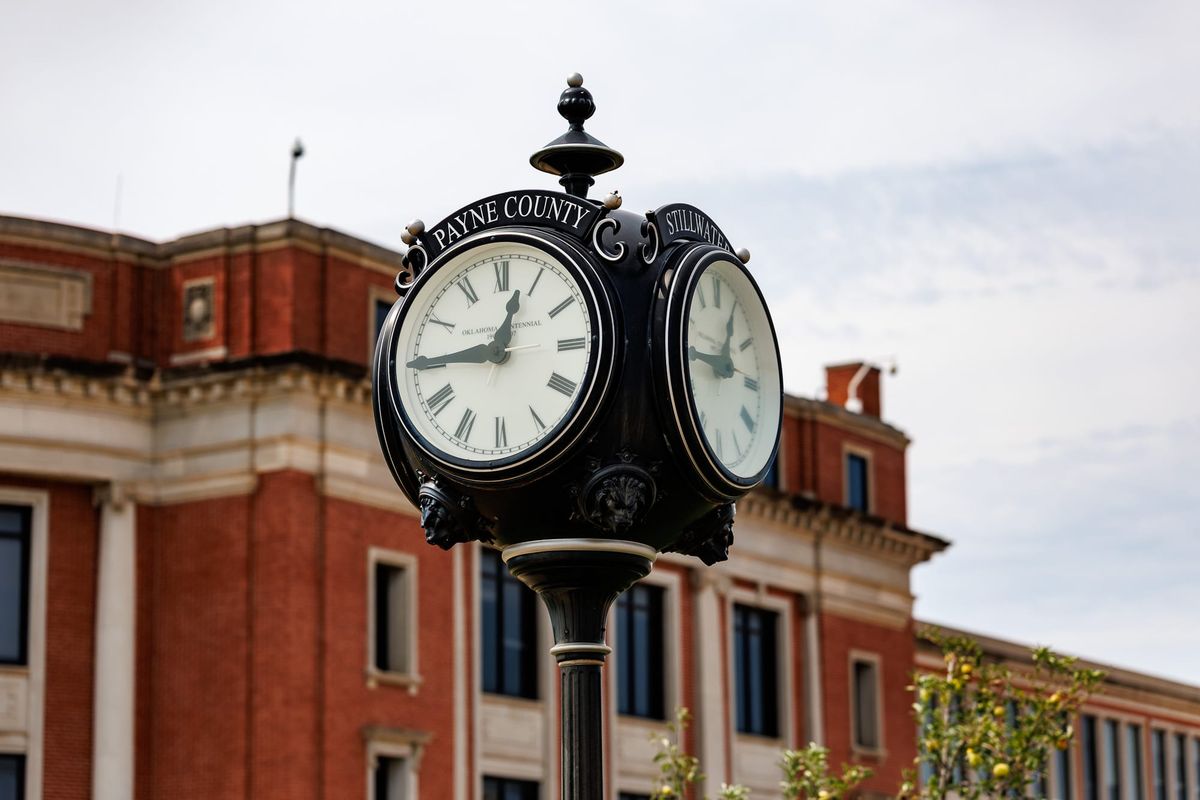
Payne County is home to about 2 percent of Oklahoma's population. Last year it received six thousandths of 1 percent of the state fund that repays local governments for property taxes manufacturers do not pay.

That fund is the subject of State Question 844, which Oklahoma voters decide Aug. 25.

The Ad Valorem Reimbursement Fund paid out $88,635,421 for tax year 2025, according to the Oklahoma Tax Commission. Payne County's share was $5,666 — the smallest claim among the 42 counties that received anything. Had the money been distributed by population, Payne County's share would have been about $1.79 million. Payne County has 81,646 residents out of 4,053,824 statewide, according to the 2020 census.

Meanwhile $35.6 million, or 40 percent of the fund, went to Mayes County. Nearly all of it — $34.2 million — went to Google's data center complex at the MidAmerica Industrial Park in Pryor.

The fund is not divided by county. Every Oklahoma taxpayer pays into a single statewide pot, and counties draw from it by filing claims for exemptions granted inside their borders. Payne County has filed very few.

PAID Advertisement
CTA Image

Have a project but can't find a contractor? Stillwater Building Center works with builders and tradespeople across the area — pick up our free 2026 Contractor Directory in-store to get connected. 📍Visit us at 4521 S. Perkins Rd., just south of Stillwater on Highway 177. Open Monday–Friday 7 a.m.–6 p.m., Saturday 8 a.m.–noon.
📞 405-372-5959

How the exemption works

A qualifying manufacturer pays no property tax for five years on a new, expanded or newly acquired facility. The schools, county, city, career tech, library and health department that would have collected that money lose it. The state then repays them out of the Ad Valorem Reimbursement Fund — in full, under the constitution as it reads today.

The exemption covers property tax only, and only on the new or expanded property. It is not negotiated: it is written into the state constitution, and a company that meets the requirements qualifies automatically. Local officials cannot grant or deny it. SQ 844 would end the guarantee of full repayment and let the Legislature set the amount and method instead.

What the records show

Under Article 10, Section 6B of the Oklahoma Constitution, approved by voters as State Question 588 in 1985, qualifying manufacturers and research and development facilities pay no property taxes on new, expanded, or acquired facilities for five years. Schools, counties, cities, career techs, libraries, and health departments are then repaid by the state for the revenue they gave up.

The Tax Commission publishes every claim by county and by company each year. The Stillwegian reviewed all 14 reports available on the agency's website, covering tax years 2012 through 2025. Over that period, five companies claimed a combined $6,599,810 in Payne County — about four-tenths of 1 percent of the $1.51 billion the state paid out statewide.

Two companies account for 94 percent of the county total.

ASCO Aerospace USA LLC drew $3.83 million across tax years 2014 through 2021, the largest total of any company in the county.

Source: Oklahoma Tax Commission, Ad Valorem Division, annual reports on exempt manufacturing reimbursements filed under 62 O.S. Section 193, reimbursement years 2013–2026. Figures exclude pending protests. Ranks are among the counties that filed a claim in a given year, not all 77 Oklahoma counties; between 42 and 56 counties claimed reimbursement in the years shown.
Tax year Companies claiming Payne County total Rank among counties claiming
2012Frontier Electronics; Stillwater Designs and Audio$51,20838th
2013Frontier Electronic System; Stillwater Designs and Audio$48,68744th
2014ASCO Aerospace USA; Frontier Electronic System$228,96030th
2015ASCO Aerospace USA$734,52724th
2016ASCO Aerospace USA; TOMPC LLC$1,253,82222nd
2017ASCO Aerospace USA; TOMPC LLC$1,144,24425th
2018ASCO Aerospace USA; TOMPC LLC$1,132,56227th
2019ASCO Aerospace USA; TOMPC LLC$991,77729th
2020ASCO Aerospace USA; TOMPC LLC$607,93830th
2021ASCO Aerospace USA; Frontier Electronic Systems$101,53838th
2022None$0No claim filed
2023USA Rare Earth Magnets$151,77333rd
2024USA Rare Earth Magnets$147,10834th
2025Frontier Electronic Systems Corp$5,66642nd of 42
14-year total$6,599,810

The second is TOMPC LLC, which drew $2.36 million between tax years 2016 and 2020. TOMPC was a subsidiary of Tall Oak Midstream, an Oklahoma City-area midstream company formed in 2014, and it built the Battle Ridge Plant — a cryogenic natural gas processing outside Cushing serving producers across Payne, serving producers across Payne, Creek, Logan, Lincoln, Noble, and Pawnee counties, according to company announcements at the time.

The remaining three claimants are more familiar. USA Rare Earth Magnets claimed $298,881 across tax years 2023 and 2024 for its Stillwater magnet plant. Stillwater Designs, the maker of Kicker audio equipment, claimed $89,206 in tax years 2012 and 2013. Frontier Electronic Systems, the Stillwater aerospace and defense electronics manufacturer founded in 1973, claimed $24,278 spread across six separate years — the longest run of any company in the county, and the only claimant in the most recent report.

Payne County's claims peaked at $1.25 million in tax year 2016, when the county ranked 22nd in the state. They have fallen in most years since. In tax year 2022, Payne County claimed nothing at all and did not appear in the state's ranking.

The plant that left

TOMPC's claims ran the full five years and stopped after tax year 2020.

The plant did not stay. Payne County Assessor land records list the site as owned by TOMPC LLC. Aerial imagery available through the assessor's property search shows the processing facility fully built in 2020, the final year TOMPC claimed the exemption. Satellite imagery from 2022 and 2023 shows the infrastructure being removed.

A few buildings remain on the site. The gas production infrastructure is gone.

ADVERTISEMENT
CTA Image

August is bursting with excitement in Stillwater! From the Payne County Free Fair and the return of Cowboy sports to the start of a new semester and can't-miss community events, there's something for everyone to enjoy.

View Events

What the measure would do, and what lawmakers have said

SQ 844 would remove the constitutional guarantee that the state repay local governments in full, and let the Legislature set the levels and methods of reimbursement instead. 

Lawmakers have not written that formula, and the state question does not specify one. House Speaker Kyle Hilbert, R-Bristow, who brought the measure forward with Senate President Pro Tempore Lonnie Paxton, R-Tuttle, has sketched the outlines.

In an interview published Aug. 18 by the Oklahoma news outlet NonDoc, Hilbert said his goal as speaker is to protect reimbursements on exemptions already granted, along with the local bonds and financing tied to them, and to apply any change only to future projects. Asked what a reduced rate might look like for a new development, he offered a figure — reimbursement "back at 80 percent instead of 100" — and argued a local jurisdiction would still collect more than it did when the parcel was pasture.

Hilbert has framed the problem as one of distribution. During legislative debate, he said the state is diverting money that could go to schools across Oklahoma toward a small number of districts that are already wealthy and off the state funding formula, according to an analysis published by the Oklahoma Council of Public Affairs, a conservative think tank.

Nothing binds a future Legislature to that approach. The Oklahoma Policy Institute, a progressive research organization, notes in its fact sheet on the measure that the state question sets no guidelines for what a new methodology would look like, and that the Legislature could reduce reimbursements substantially or vary them by county.

What voters decide

Supporters say the concentration is the problem, and that the money to cover it no longer exists.

The fund was built on a single dedicated stream: 1 percent of state income tax collections. That stream has been roughly flat for two decades. The obligation has not been. Reimbursements grew from a few million dollars in the program's early years to a peak of $161 million in tax year 2019 — driven largely by wind farms and data centers — before falling to $88.6 million once both were removed from the program.

The dedicated 1 percent has not covered the full cost since 2002, according to the Oklahoma Policy Institute. Last year it generated roughly $52 million against about $93 million owed, and lawmakers appropriated the difference. Changing the methodology by statute, supporters argue, would let the Legislature manage that gap and respond to swings in state revenue.

Opponents argue the state should meet an obligation it created. Counties and schools, they say, are following a law the state wrote when it granted the exemptions in the first place, and the Legislature could instead tighten how the Tax Commission verifies assessments without amending the constitution.

School officials have been the loudest voices against it. Oklahoma Watch reported in July that superintendents in districts with large exempt facilities view the measure as a funding cut. Wynnewood Superintendent Byron Mooney, whose district drew 16 percent of its general fund from the reimbursement last year, called it "defunding schools, county government, sheriffs, emergency services."

No Payne County district has depended on the reimbursement at anything approaching that scale in the years reviewed.

The Stillwegian's survey of local officials found nearly all respondents opposed SQ 844, and an unscientific reader poll opposed it as well.

Lawmakers have narrowed the field three times

Much of the story of this exemption over the past decade is about who lawmakers have taken out of it.

Wind, 2015. Senate Bill 498, by then Sen. Mike Mazzei, R-Tulsa, and Rep. Earl Sears, R-Bartlesville, ended the five-year exemption for new wind farms beginning Jan. 1, 2017. Mazzei, who is now running for governor said at the time the change would save roughly $500 million over 10 years. Wind generation remains barred today, though factories that build wind equipment still qualify — Arcosa Wind Towers claimed $56,378 in Rogers County in tax year 2025.

Data centers, 2021. Senate Bill 609, authored in the House by Hilbert, removed data centers going forward.

Solar and battery storage, 2026 — vetoed. Senate Bill 237, by Sen. Chuck Hall, R-Perry, and Rep. Mike Dobrinski, R-Okeene, would have barred solar generation and battery energy storage systems beginning in January 2028. Gov. Kevin Stitt pocket vetoed the bill May 29 by declining to sign it before the session adjourned. Hall represents Senate District 20, which includes Payne County.

Because solar remains eligible, it is now among the program's growing costs. Two solar projects in Kiowa County claimed a combined $2.7 million in tax year 2025, both in the first year of their exemptions.

Hilbert told NonDoc that solar farms need to come out of the program regardless of whether SQ 844 passes or fails, and that lawmakers will have to keep examining which industry codes qualify either way. Some industries, he said, are welcome in Oklahoma but should not be subsidized by taxpayers statewide, or should require local governments to carry part of the cost.

How Google was grandfathered in Pryor

The 2021 data center repeal came with an exception that still shapes the statewide numbers.

Google's data center at the MidAmerica Industrial Park was by then the single largest beneficiary of the program. An amendment Hilbert added to SB 609 eliminated future exemptions for data centers but allowed Google to keep claiming five-year exemptions on new equipment at its existing Mayes County facilities for an additional 15 years, through 2036, The Frontier reported in 2022. Hilbert told The Frontier the carve-out was a compromise needed to pass the bill, and that each new equipment purchase had let Google re-qualify indefinitely.

Source: Oklahoma Tax Commission, Ad Valorem Division, 2026 annual report, covering tax year 2025. Counties not listed in the report received no reimbursement that year. Statewide total: $88,635,421.
County Tax year 2025 reimbursement Largest claimant
Mayes$35,601,298Google LLC – Myall LLC
Kingfisher$1,416,487MarkWest Oklahoma Gas
Creek$1,391,956Ardagh Glass
Kay$306,431Dorada Foods
Noble$194,822Charles Machine Works
Payne$5,666Frontier Electronic Systems Corp
Logan$0No claim filed
Pawnee$0No claim filed
Lincoln$0No claim filed

That is why Mayes County still drew $34.2 million for Google in tax year 2025 — 38.6 percent of everything Oklahoma paid out — five years after data centers were removed from the program.

Stillwater's data center is a different deal

Stillwater's own largest industrial tax agreement does not appear in these reports at all.

As The Stillwegian has reported, the Google data center campus here was structured around a 25-year exemption from ad valorem taxes and special assessments, with the company making annual payments in lieu of taxes, known as PILOTs, directly to local entities.

That is a separate mechanism, and one that became the standard route after 2021. State law is explicit: a reimbursement claim "shall be disapproved to the extent that a county or school district has received any payment in lieu of ad valorem taxes from such facility," according to the Tax Commission's 2026 annual report.

SQ 844 would not change the Stillwater agreement. Local negotiators secured payments from the company rather than relying on the state to backfill the loss.

Those payments are set by contract, not by the Legislature. As The Stillwegian reported when the agreement came before the city council in January 2025, Phase 1 pays local entities a combined $1 million a year: $624,023 to Stillwater Public Schools, $135,599 to Meridian Technology Center, $89,985 to Payne County, $17,961 to the county health department, and $132,432 to the City of Stillwater as a community betterment payment. Payments rise 1 percent each year.

Across the full 25-year term, Phase 1 is scheduled to pay $28.2 million and Phase 2 another $30 million — a combined $58,223,925 through 2057. Stillwater Public Schools alone would receive $36.3 million from the first two phases.

The contrast with the state program is sharp. One phase of the Stillwater agreement delivers local taxing entities about $1 million in a single year. Payne County drew $5,666 from the state reimbursement fund for tax year 2025, and $6.6 million across the past 14 years combined.

Why the county's numbers are small

Part of the answer is written into the exemption's own rules.

To qualify, a manufacturer must show a net increase in annualized payroll. For counties with populations under 75,000, that threshold is $250,000. For counties at 75,000 or above, it is $1 million. Payne County is on the higher list, alongside Canadian, Cleveland, Comanche, Oklahoma, Rogers, Tulsa, and Wagoner counties, according to Form 929-XM, the affidavit the Tax Commission requires with each application.

A manufacturer expanding in Stillwater must add four times the payroll of a manufacturer doing the same thing in Perry, Guthrie, Pawnee, or Chandler to claim the same break.

The effect is visible in the region. In tax year 2025, Noble County — home to Charles Machine Works (Ditch Witch) in Perry — claimed $194,822, or 34 times Payne County's total. Kingfisher County claimed $1.4 million. Creek County claimed $1.39 million.

Logan, Pawnee, and Lincoln counties claimed nothing in any of the 14 years reviewed.

✏️
Clarification, Aug. 20, 2026: An earlier version of this story described industries as "barred" from the exemption and facilities as "exempted" without defining either term. An explainer describing how the exemption works, which entities lose revenue and how the state repays them has been added near the top. The story has been updated.
Share this article
The link has been copied!