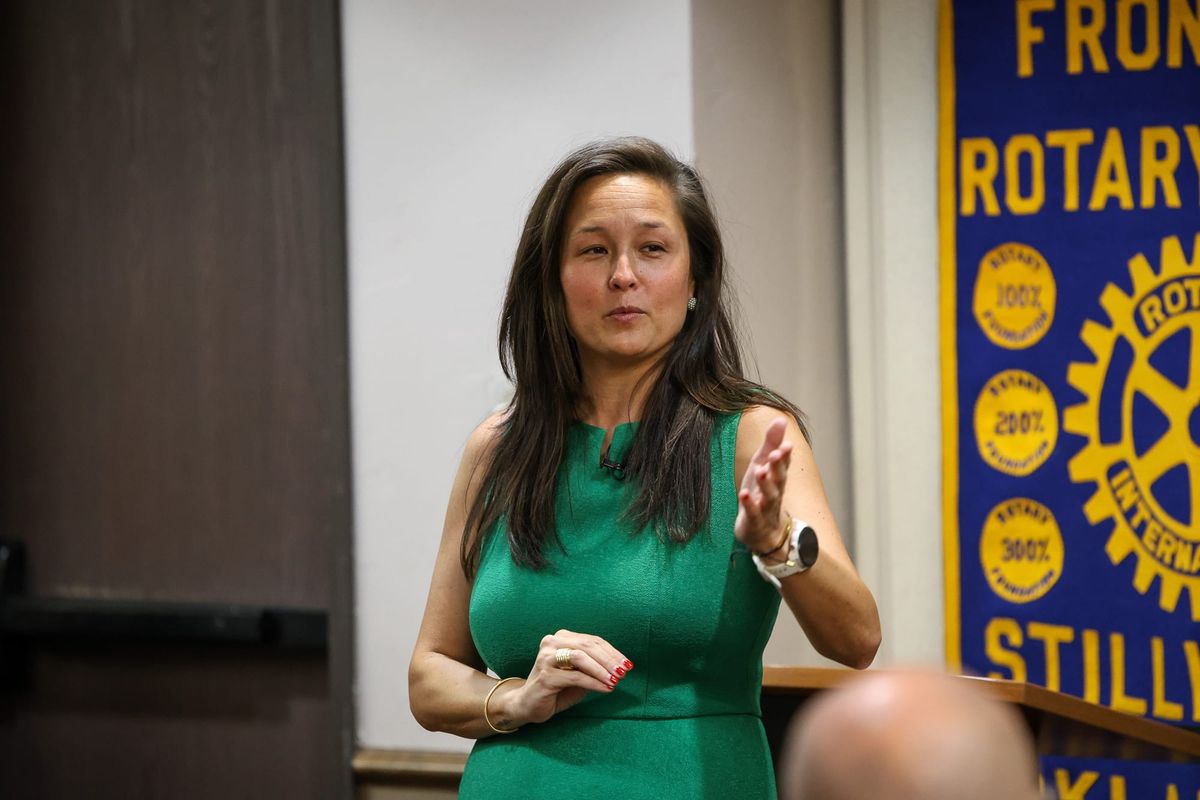
Democratic gubernatorial candidate Cyndi Munson said Thursday her proposed data center moratorium would pause future phases of Google's Stillwater campus but not undo phases already approved.
Munson, the Oklahoma House minority leader from Oklahoma City, spoke to the Stillwater Frontier Rotary Club on July 23 at the Best Western Plus Cimarron Hotel & Suites. She won the Democratic nomination outright in the June 16 primary, defeating Constance Johnson and a third candidate with 75.1% of the vote, and was the third gubernatorial candidate to address the club this month, following Republican runoff candidates Mike Mazzei on July 9 and Gentner Drummond on July 16. She will face the winner of the Aug. 25 Republican runoff in the Nov. 3 general election.
"I decided to run for governor because of my experience in the legislature," Munson said. "One party control is not working for Oklahoma."

Munson on data centers and the Inola smelter
Asked by The Stillwegian at the meeting how a day-one moratorium would affect a data center project already under construction in Stillwater, Munson said the pause would apply only to new projects.
"The statement that I put out was that on day one I would issue a moratorium to pause any new projects," Munson said. "And with that, I said that I wanted to issue a study specifically around water usage, utility rates, impacts, economic impacts in terms of property taxes and exemptions and we would do that through the Oklahoma Department of Environmental Quality. So there are contracts and different things that these data centers can work through the state that would be on pause until we have a better handle of what's going on across the state."
Google is building a $3 billion, six-phase data center campus on Stillwater's northeast side; the first two phases have been approved, while phases three through six await additional water infrastructure investment and have not yet gone before the city.
Munson pointed to House Bill 2992, which she said she pushed to bring Democratic lawmakers into a bipartisan effort led by Rep. Brad Boles, R-Marlow, alongside Reps. Amanda Clinton, D-Tulsa, and Mickey Dollens, D-Oklahoma City, to require large-load electric customers to cover their own infrastructure costs rather than passing them to residential ratepayers.
She said the Oklahoma Corporation Commission continues to consider rate increases tied to those costs, and that the attorney general has a role in those proceedings. She also said she has raised the idea of a standing advisory council with the Oklahoma Municipal League so local officials have more leverage as data center proposals move through their communities.
Have a project but can't find a contractor? Stillwater Building Center works with builders and tradespeople across the area β pick up our free 2026 Contractor Directory in-store to get connected. πVisit us at 4521 S. Perkins Rd., just south of Stillwater on Highway 177. Open MondayβFriday 7 a.m.β6 p.m., Saturday 8 a.m.βnoon.
π 405-372-5959
Munson said she was "the only one" of the three remaining candidates for governor to oppose the tax incentive behind a planned $4 billion aluminum smelter near Inola in 2025, before it became a campaign issue, citing concerns about whether the project's promised 1,000 jobs would go to Oklahomans and about the strain on housing and infrastructure in a town whose population could double.
Fact check: data center and smelter claims β
Munson on education
Munson said Oklahoma's core education problem is funding, not performance, pointing to the state's 50th-in-the-nation ranking and describing a friend who teaches in Oklahoma City Public Schools and is leaving for a private school position paying $84,000 a year rather than a public school cap she put at $69,000 after 35 years and a master's degree.
"You will hear my Republican colleagues say that we have increased funding. What they don't remind you of is the cuts that happened before," Munson said, pointing to state budget cuts in 2015 through 2017 and the 2018 teacher walkout. "All those cuts, we are still catching up from all of that."
She said the state increased education funding by about $240 million this year but attached mandates that don't address classroom needs, and renewed her call to scale back or eliminate the Parental Choice Tax Credit, the private-school tax credit program she said now diverts close to $300 million a year from the state budget.
"They are for diverting our public funds and putting them to private schools where there is no oversight, there is no transparency," Munson said of the tax credit program. "The more we do that and these types of programs balloon, the more it takes away from our public schools."
She said that money, along with $12.5 million Oklahoma is contributing toward the state's new Trump Accounts program β a $250 state top-up for children's accounts under the federal children's savings initiative, funded through House Bill 4071 β and $200 million seeded into a new state investment fund, could instead have covered priorities like a child care subsidy.
Fact check: education claims β
Munson on rural health care
Responding to a question from Michal Shaw, vice president of the Stillwater Medical Foundation, about federal funding cuts facing the hospital, Munson said the state's broader exposure could reach $6 billion and said 18 Oklahoma hospitals were already at risk of closing before the cuts.
She pointed to a proposed $218 million cut to Oklahoma Health Care Authority provider payments and said protecting Medicaid expansion in the state constitution, rather than moving it into statute, is her priority.
"In CD2 and CD3, Frank Lucas' district, has the highest recipients of Medicaid per capita than anywhere else in the country," Munson said. "So Oklahoma has the highest need of Medicaid dollars."
Fact check: rural health care claims β
Don't toss that Krazy Daze receipt. Every purchase through July 31 is an entry toward one of five $500 American Airlines gift cards, and Krazy Daze week purchases count double.
Munson on the state questions
Responding to a question about all four state questions on this year's ballots, Munson said she opposes the measures dealing with property taxes, arguing they lack a funding backup for schools and county services, and said she voted against the Legislature's voter identification proposal and favors keeping the Judicial Nominating Commission insulated from politics.
"Anyone who promises that they're going to cut property taxes for you, this highlights that we cannot just do that," Munson said.
Oklahoma voters will decide State Question 844, on reimbursing local governments for a manufacturing property tax exemption, and State Question 846, on a constitutional voter ID requirement, on the Aug. 25 runoff ballot. State Question 845, restructuring the Judicial Nominating Commission, and State Question 847, lowering caps on annual property value increases, will appear on the Nov. 3 general election ballot.
Fact check: state question claims β
Munson on tax dollars and priorities
Asked about a new state savings fund seeded with $200 million this year, Munson distinguished it from Oklahoma's constitutional Rainy Day Fund and said she supports saving for future needs β with a caveat.
"I'm not opposed to savings accounts and putting money away because we do need money for a rainy day, but we are having a stormy day," Munson said.
She said pairing an income tax cut with a new savings fund sends the wrong message when the state has unmet needs, and renewed her support for a state child tax credit and sales tax relief credit targeted at working families, along with full funding for the child care subsidy program and Rep. Trish Ranson's House Bill 1979 on early childhood coordination.
Munson on running as a Democrat
Munson, first elected in a 2015 special election to a district long held by Republicans, said national Democratic Party leadership has never pressured her.
"Never once has the Democratic Party picked up the phone and called me about anything, and that's fine with me," Munson said. "I am an Oklahoman. I'm focused on Oklahomans."
She said her record over 11 years in the Legislature, including bills signed by both Govs. Mary Fallin and Kevin Stitt, reflects working across the aisle rather than national party pressure.
"The reason why I elevated the district that I represent is because I could not win without Republican support," Munson said. "I would not continue winning, I would not continue increasing my performance in terms of how many people are voting for me if it wasn't because I was focused on them."
πΊ Watch Cyndi Munson's full presentation to the Stillwater Frontier Rotary Club
CANDIDATE FACT CHECKS
About this fact check: The Stillwegian checked claims against primary sources wherever possible β state agency records, official legislative and treasury documents, and published state data β and against original reporting by other newsrooms, linked where used. Claims we couldn't verify are attributed or omitted. Corrections to chris@thestillwegian.news.
Munson on data centers and the smelter fact checks:
1. A day-one executive order pausing new data center projects, with a study through DEQ. Consistent with her public record; the DEQ piece is partly within that agency's reach, partly not.
Her Rotary remarks match her prior statements: a June 3 Facebook post pledging a day-one executive order moratorium and a study of data centers' "true impact on your wallets and our resources," and a December 17 post on X making the same utility-rate and water-supply argument.
Her call also predates the country's only enacted statewide moratorium β New York Gov. Kathy Hochul's July 14 executive order pausing environmental permits for large data centers β by about six weeks; Newsweek counted governor candidates in at least a dozen states, from both parties, backing similar pauses.
On the mechanism: DEQ does issue permits a project this size needs β construction stormwater permits are required for any site disturbing more than an acre, along with water and wastewater construction permits. But utility rates sit with the Corporation Commission and property tax exemptions with county assessors and the Oklahoma Tax Commission, so the full study she described would span more than one agency's authority.
2. "The only one" of the remaining candidates to oppose the Inola smelter incentive, in 2025. Holds up against the public record for the three candidates still in the race.
The roughly $255 million incentive deal for the majority Emirati-owned smelter was struck in May 2025. Mazzei's public opposition didn't surface until a March 30, 2026 debate β about a year later β and he reversed it May 29, hours before receiving Trump's endorsement, a sequence also reported by Oklahoma Watch and addressed by Mazzei himself to News 9 and News On 6. Drummond's opposition has taken the form of a June lawsuit to block construction on pollution and nuisance grounds β not a stated position on the incentive package itself.
3. The attorney general has a role in utility rate proceedings. Confirmed β and it's currently Drummond's office.
Under state law, the attorney general's Utility Regulation Unit represents Oklahoma utility customers in rate matters before the Corporation Commission and in court, and the OCC's own rate-case guide lists the attorney general as a standard party to rate cases, representing all Oklahoma ratepayers.
Munson on education fact checks:
4. $12.5 million to state-sponsored Trump Accounts. Confirmed, and consistent with her record.
House Bill 4071, the Oklahoma Dream Accounts Investment Program Act, appropriates $12.5 million so the state treasurer can add a one-time $250 to qualifying federal Trump Accounts β children's savings accounts seeded with $1,000 federally for children born 2025-2028. The treasurer's office estimates roughly 50,000 eligible Oklahoma children. Munson debated against the bill on the House floor in April, citing the same $12.5 million figure β the Rotary claim is her established position, not a one-off.
Munson on rural health care fact checks:
5. $6 billion in state exposure; 18 hospitals already at risk of closing. Both figures run below published estimates; we could not match either exactly.
The Center for Healthcare Quality and Payment Reform's count, reported by Oklahoma Watch, puts Oklahoma at 47 rural hospitals at risk of closing, 23 at immediate risk; CHQPR's May 2026 update shows similar Oklahoma numbers. No published count matches her "18."
On dollars, KFF's analysis puts Oklahoma's federal Medicaid reduction at $8 billion to $13 billion β above, not below, her $6 billion. Her figures are conservative relative to published estimates, but we could not locate her specific source.
6. Oklahoma's 2nd and 3rd congressional districts have the highest Medicaid enrollment per capita in the country. Plausible, not verified.
Both districts fit the profile β OK-02 is among the most rural districts in the country with a large Native American population, and OK-03 is Oklahoma's largest and most rural β but we could not locate a published ranking placing them first and second nationally, and district-level enrollment data we reviewed did not settle it.
Munson on the state questions fact checks:
7. Four state questions, two per ballot; she voted against the voter ID measure. Confirmed.
SQ 844 and SQ 846 appear on the Aug. 25 runoff ballot, SQ 845 and SQ 847 on Nov. 3. SJR 47, which became SQ 846, passed the House 80-13, with the special-election timing provision passing 78-15 β near-party-line votes in a chamber where Democrats hold few seats.
Munson is on record in Oklahoma Watch criticizing the August placement: "They are strategically working really hard to undo the will of the people." The official roll call on LegiScan shows Munson voted no on SJR 47 twice during the 2026 regular session, matching what she told Rotarians.