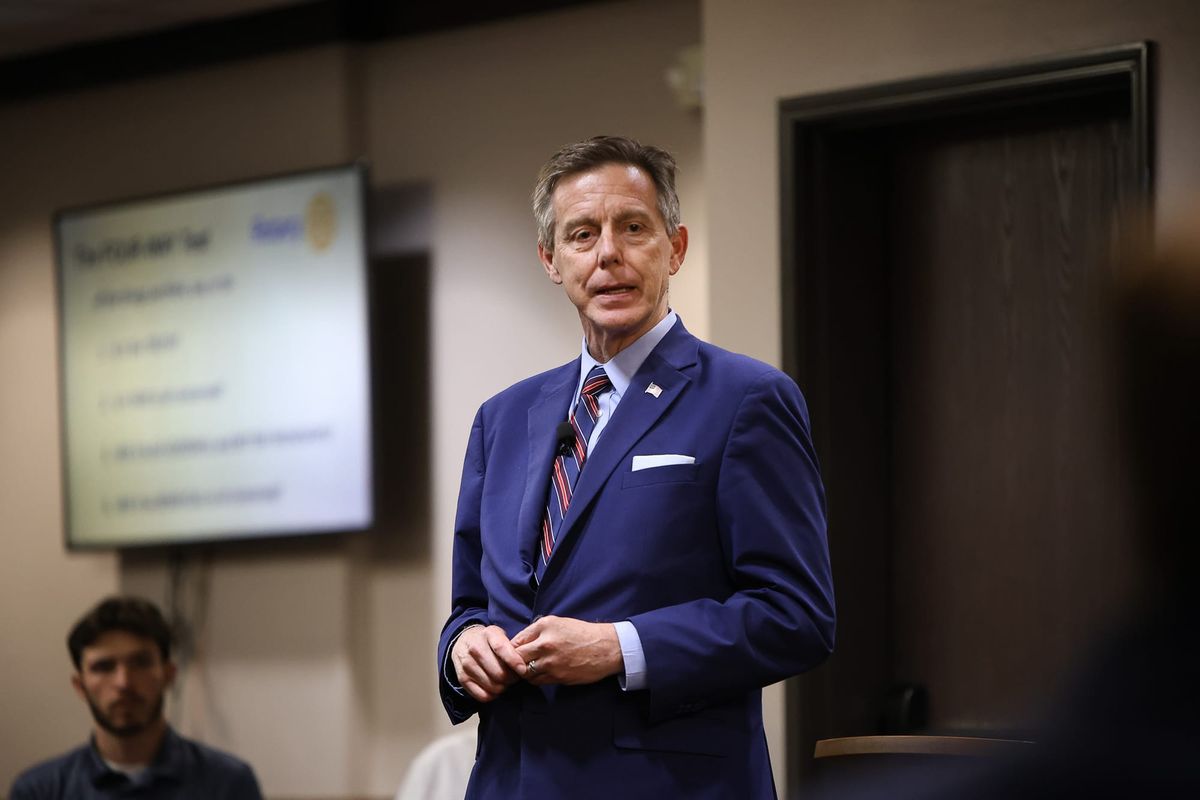
Republican gubernatorial candidate Mike Mazzei pitched his plan to eliminate Oklahoma's personal income tax, phase out property taxes for seniors and launch a Mississippi-style literacy program during an appearance before the Stillwater Frontier Rotary Club on Thursday, July 9, at the Best Western Plus Cimarron Hotel & Suites.

Mazzei, a Tulsa financial planner who served 12 years in the Oklahoma Senate and as Gov. Kevin Stitt's secretary of budget from 2019 to 2020 — the first person to hold that cabinet position — faces Attorney General Gentner Drummond in the Aug. 25 Republican runoff. The winner will face Democrat Cyndi Munson, the minority leader of the Oklahoma House of Representatives, in the Nov. 3 general election.

Mazzei told the club he expects to win the nomination and cited President Donald Trump's endorsement of his campaign.

"When the true conservatives unite and choose faith and freedom and unite around a solid plan, together we can launch a wave of growth, prosperity, and opportunity for our kids and our grandkids," Mazzei said.

Mazzei is the first of three gubernatorial candidates scheduled to address the club over three consecutive weeks. Drummond is scheduled to speak July 16 and Munson on July 23. Both appearances will be livestreamed on the club's YouTube channel.

Mike Mazzei stands in front of the Stillwater Frontier Rotary Club banner during the club's meeting Thursday, July 9, 2026, at the Best Western Plus Cimarron Hotel & Suites in Stillwater. – Photo by Chris Peters

Mazzei on taxes

Mazzei outlined a three-step plan to make Oklahoma the nation's 10th no-income-tax state, modeled on Tennessee, which he said has seen far more economic growth than Oklahoma over the past decade.

The first two steps, he said, involve eliminating roughly $2.5 billion in deductions, exemptions and rebates from the tax code — about half of the $5 billion the state collects in personal income taxes — to fund a revenue-neutral cut in the state's top income tax rate from 4.5 percent to 3 percent.

The third step would require a vote of the people to eliminate the income tax entirely and shift toward taxing consumption, he said.

"It's much better to tax activity than it is your 8, 10, 12 hours of work," Mazzei said.

To illustrate, he pointed to Oklahoma City Thunder tickets, which carry no sales tax, while fans attending a Memphis Grizzlies game in no-income-tax Tennessee pay sales tax on theirs. Extending sales taxes to purchases like game tickets wouldn't stop fans from showing up, he argued, and unlike income, spending can't be hidden.

"You literally will pick up $200-500 million dollars in tax collections because you can't hide the activity," Mazzei said.

He separately proposed phasing out homestead property taxes for Oklahomans 65 and older, and for veterans, over two to three years in urban counties and longer in rural ones. Using Oklahoma County figures, Mazzei said senior homesteads account for about 10 percent of the county's roughly $1 billion in annual property tax collections, and that collections growing 7 percent a year would absorb the phase-out while still producing net annual increases.

"You shouldn't have to pay rent to the government for your entire life," he said.

Club members pressed Mazzei on the specifics. One asked how communities could grow their property tax base while the state eliminates two major revenue streams. Another raised the regressive nature of sales taxes, asking how the plan would avoid shifting the burden onto low-income Oklahomans. Mazzei pointed to the state's earned income tax credit and sales tax relief credit, saying his plan would keep both and potentially increase them, though he acknowledged he did not know what the new amounts would need to be.

Fact check: tax claims
PAID Advertisement
CTA Image

Have a project but can't find a contractor? Stillwater Building Center works with builders and tradespeople across the area — pick up our free 2026 Contractor Directory in-store to get connected. 📍Visit us at 4521 S. Perkins Rd., just south of Stillwater on Highway 177. Open Monday–Friday 7 a.m.–6 p.m., Saturday 8 a.m.–noon.
📞 405-372-5959

Mazzei on education

Citing Oklahoma's bottom-five national education rankings and a reading proficiency rate he put at 20 percent — about 500,000 students — Mazzei pointed to Mississippi's reading turnaround and gains in Arkansas as the models for his plan. He said his literacy plan replicates Mississippi's, and that he has met one-on-one with Mississippi's state literacy director.

In his first week as governor, he said, he would hire a statewide literacy director by executive order and direct the State Department of Education to terminate the 24 reading curricula Oklahoma's 500-plus school districts currently choose from, replacing them with a short list of phonics-based options modeled on Mississippi's six state-adopted programs.

"I will get sued. And then we'll have the discussion," Mazzei said.

He identified reading coaches as the second element and credited the Legislature's Strong Readers Act for creating a third-grade reading gate, but said lawmakers "didn't deal with the bad curriculum."

Responding to a question about the basis for his literacy initiative, Mazzei also addressed his widely discussed debate remarks about Oklahoma educators, saying he "botched" the comment while rushing to answer in a 30-second window. He said some districts are resisting needed changes and blamed what he called "the liberal education establishment" for failing to recognize that balanced literacy curriculum does not work.

Fact check: education claims
PAID ADVERTISEMENT
CTA Image

Get your store in on Krazy Daze 🛍️
Krazy Daze brings shoppers to stores and boutiques across Stillwater July 15-19. Get your business on the event map — submit your sales, deals, and store hours to Visit Stillwater today.

SUBMIT YOUR SALES

Mazzei on marijuana and foreign land ownership

Mazzei said marijuana enforcement failures and foreign ownership of land came up in every county he has visited, tying the two issues to what he described as a public safety and national security threat.

"We have five major military bases. And from CCP controlled land now, they could launch weapon strikes with these drones any time they want," Mazzei said, referring to marijuana farms in Oklahoma he alleged are controlled by the Chinese Communist Party.

He pointed to the affidavit created under Senate Bill 212, a 2023 law directing the attorney general to develop forms enforcing the state constitution's restrictions on alien land ownership, and criticized the form's option allowing a noncitizen to attest they are or will become a bona fide Oklahoma resident.

"You check that box. If you're Chinese, if you're Mexican cartel, you can buy whatever you want. Just hide behind a little shell LLC," he said.

He said he would sign an executive order on day one to "abolish that absurd loophole."

Mazzei also said he would direct the Oklahoma Medical Marijuana Authority by executive order to raise the $2,500 annual commercial grow license fee by 500 percent to match California and to limit grows to one acre on renewal, with an exception for verified Oklahoma-owned businesses. He cited the Oklahoma Bureau of Narcotics' assessment that Oklahoma is the nation's top marijuana producer and said the state produces 30 times more marijuana than its roughly 300,000 medical card holders need.

A club member asked whether bad actors would simply ignore the affidavit requirement. Mazzei said shell companies are the core problem and that he has spoken with U.S. Secretary of Homeland Security Markwayne Mullin about forensic tracing of ownership and funding sources.

Fact check: marijuana and land ownership claims
ADVERTISEMENT
CTA Image

Buying or refinancing in Stillwater? Brittney, Misty and Angelica at OCCU bring local expertise and competitive rates to every home loan. And unlike many lenders, your loan stays right here — never sold, always local.

Apply Today

Mazzei on health care

The sharpest exchange of the afternoon came on rural hospital funding, driven by Stillwater City Councilor Tim Hardin and Joe Akin, senior director of development and community outreach at the Stillwater Medical Foundation.

Hardin opened the exchange by asking about a $218 million cut to state health care funding that he said emerged after a budget had already been agreed to — a reference to a proposal by the Oklahoma Health Care Authority to reduce payments to hospitals. The cut, a 20 percent reduction to the Supplemental Hospital Offset Payment Program, was filed with federal Medicaid regulators in late June for the fiscal year that began July 1 — days after OHCA's board had approved a flat budget the agency said would not require provider cuts.

Akin added that Stillwater Medical also faces a projected $110 million reduction over 10 years under the federal budget reconciliation law.

"Hospitals can't plan. We don't know what the future is going to hold. There's no stability," Akin said. "It feels like our health care, particularly rural health care and our hospitals, are under attack. Because a place like Stillwater, Oklahoma, when you lose $110 million over a 10-year period, what do you do?"

Mazzei, who said he had not yet reviewed the OHCA proposal, said the agency received a $250 million increase in the fiscal year 2027 budget and pointed to State Auditor Cindy Byrd's audit of the SoonerCare system, which he said found $1.6 billion in questionable expenses. He said Tennessee saved $1 billion through a federal waiver targeting waste and eligibility verification, and estimated Oklahoma could find at least $500 million in savings.

Akin pressed back, saying the audit's questionable expenses were never investigated — "we have no idea how much of that was actually fraud" — and that the funding cuts are immediate while savings would take years, leaving hospitals like Stillwater Medical Center with a hole to fill and patients without coverage still needing care.

When Mazzei noted Tennessee found its savings in three years, Akin replied: "Well, let's see Oklahoma do it."

Mazzei said his health care working group, which includes Sen. Randy Grellner, R-Cushing, whose Senate District 21 includes most of Stillwater, was scheduled to meet the following day to explore solutions.

"It's going to take a lot of thoughtful minds to address that issue going forward," Mazzei said.

Fact check: health care claims

What's next

The Republican runoff between Mazzei and Drummond is Aug. 25. The winner will face Munson in the Nov. 3 general election. Drummond speaks to the club July 16 and Munson on July 23, with both appearances livestreamed on the club's YouTube channel.

📺 Watch Mike Mazzei's full presentation to the Stillwater Frontier Rotary Club


CANDIDATE FACT CHECKS

About this fact check: The Stillwegian checked claims from the candidates remarks against primary sources wherever possible — state agency records and reports, certified county documents, official audit reports, congressional testimony and published state assessment data — and against original reporting by other newsrooms, which is linked where used. Claims we could not independently verify are either attributed to their speaker in the story or omitted. We hold our own work to the same standard we apply to candidates: if we got something wrong, we want to know. Send corrections to chris@thestillwegian.news.

Mazzei on taxes fact checks:

1."There's nine no income tax states." Accurate. Nine states levy no tax on wage income.

2. Tennessee has had "58% more economic growth than we have over a 10 year period." The direction is supported; the specific figure could not be located in public data and depends on the metric and window used.

Tennessee's official 2025 Economic Report to the Governor documents the state's strong recent record: inflation-adjusted GDP grew 9.0 percent in 2021 and 4.0 percent in 2022 as the state outpaced the nation's pandemic recovery, before moderating to 1.9 percent in 2023. Oklahoma's energy-dependent economy contracted in several years over the past decade while Tennessee posted some of the country's strongest growth, so Tennessee has grown substantially faster than Oklahoma over a 10-year window. The report also notes Tennessee's growth is broad-based across manufacturing, services and in-migration, which complicates attributing it to the absence of an income tax alone.

3. Thunder tickets carry no sales tax, while Memphis Grizzlies tickets do. Essentially accurate, with a footnote.

Oklahoma exempts professional sports tickets from sales tax — a preference dating to the state's effort to attract an NBA franchise — but state law does impose a flat fee of $1 to $2 per ticket on professional sporting events. Tennessee applies its sales tax to admissions.

Mazzei on education fact checks:

4. "We rank 49th in education." Close, though rankings vary by measure.

The Annie E. Casey Foundation's Kids Count Data Book ranks Oklahoma 48th in education in both its 2025 and 2026 editions (46th and 44th overall for child well-being, respectively). On the 2024 National Assessment of Educational Progress, Oklahoma ranked 47th in fourth-grade reading and 48th in eighth-grade reading.

5. "Only 20% of students are reading at grade level. That means 500,000 students." Roughly consistent with national testing, though the figure conflates "proficient" with "grade level." On the 2024 NAEP, 23 percent of Oklahoma fourth graders and 20 percent of eighth graders scored proficient in reading. Oklahoma's own state assessments showed about 43 percent of students proficient in reading in 2023-24, though the state education department lowered its performance benchmarks the prior year. The 500,000 figure is a reasonable extrapolation from NAEP rates across roughly 700,000 enrolled students, but it applies fourth- and eighth-grade sample results to all grades.

6. Mississippi "went from 50th to first in the country in reading outcomes." Overstated.

Mississippi rose from 49th to ninth nationally in fourth-grade reading — a widely praised turnaround, but not first in raw rankings. The likely source of the "first" claim: as National Review reported in an August 2025 piece on Southern education gains, when researchers at the Urban Institute adjusted NAEP results for state demographics, Mississippi fourth-graders topped the country in both reading and math. That demographic adjustment is the qualifier Mazzei's version drops — Mississippi is No. 1 only after controlling for factors like income and race, not on the unadjusted rankings.

Accurate elements: Mississippi's 2013 Literacy-Based Promotion Act combined literacy coaches, teacher retraining in phonics-based instruction, and a third-grade reading gate — the three elements Mazzei described.

His six-curricula claim also checks out: Mississippi's state-adopted early-grade reading list for the 2021-2026 adoption cycle contains six comprehensive core programs — HMH Into Reading, Savvas myView Literacy, EL Education Language Arts, Wit & Wisdom with Fundations, McGraw-Hill Wonders and Amplify CKLA — per the Mississippi Department of Education's adopted materials list.

One nuance: the list operates through state adoption and textbook processes; "can choose from" describes an adoption list rather than a statutory ban on other materials.

7. Arkansas reading outcomes for first and second graders "doubled" in three years under Gov. Sanders. Overstated, per Arkansas' own published data.

The state's official 2026 ATLAS executive summary shows real gains for first and second graders, but not a doubling — and not over three years, because Arkansas' K-2 foundational assessment has only existed for two: 2026 was its second administration. First-grade literacy proficiency rose from 46.2 percent in 2025 to 55.9 percent in 2026; second grade rose from 39.4 percent to 48.5 percent. Those are roughly 21 to 23 percent relative gains in one year.

The closest figure to Mazzei's framing is the share of first graders significantly behind grade level, which nearly halved in a year (19.1 percent to 10.9 percent). The strongest single number in the report is kindergarten literacy, up from 50.2 percent to 66 percent. Sanders did model portions of her 2023 LEARNS Act on Mississippi's approach, including deploying more than 120 literacy coaches — substantial, well-documented progress that doesn't require the word "doubled" to be impressive.

Mazzei on marijuana and foreign land ownership fact checks:

8. The SB 212 affidavit's "bona fide resident" option is a loophole "drafted by the attorney general's office" that he would abolish by executive order. The affidavit language is accurately characterized — the form allows a signer to attest they are "an alien who is or shall become a bona fide resident of the State of Oklahoma."

But the framing has a significant problem: that exception is not an attorney general invention. It comes directly from Article XXII, Section 1 of the Oklahoma Constitution, which bars alien land ownership except for noncitizens "who may become bona fide residents of this State." SB 212 (2023), authored by Sen. David Bullard, directed the attorney general to create affidavit forms implementing that constitutional provision, and the forms mirror its language. A governor's executive order cannot remove a constitutional exception; that would require a constitutional amendment approved by voters.

There is a second, arguably bigger, carve-out Mazzei did not mention: in 2024, the Legislature exempted foreign companies with a Committee on Foreign Investment in the U.S. (CFIUS) agreement from SB 212's restrictions. According to reporting by Investigate Midwest, that exemption effectively shields Smithfield Foods — owned by China's WH Group and the only Chinese-owned company holding farmland in Oklahoma, roughly 2,575 acres in Beaver, Harper and Ellis counties — from the very restrictions Mazzei describes as closing the loophole. State Sen. Brent Howard, R-Altus, who introduced the exemption, has defended it as consistent with federal vetting. Smithfield has spent more than $1.5 million on lobbying and over $90,000 in political contributions in Oklahoma since 2024, per Investigate Midwest's review.

9. "We have five major military bases. And from CCP controlled land now, they could launch weapon strikes with these drones any time they want." This blends a real, documented concern with an unsupported leap.

Oklahoma has roughly five major military installations (Fort Sill, Tinker Air Force Base, Vance Air Force Base, Altus Air Force Base and the McAlester Army Ammunition Plant), and there is genuine, on-the-record concern about the intersection of illegal marijuana farms and national security. The director of the Oklahoma Bureau of Narcotics testified to Congress in September 2025 that the Department of Defense was investigating suspicious activity at a Chinese-run marijuana farm near the McAlester ammunition plant, which holds roughly a third of the nation's munitions stockpile. National security officials have separately raised concerns about foreign-owned farmland near military bases being potentially exploited for drone-based attacks.

However, no official has publicly asserted that any Oklahoma marijuana farm can currently "launch weapon strikes... any time they want" — that is Mazzei's own characterization, not a documented capability or an identified plot. It also blurs a distinction in the public record: reporting shows illegal grows are typically leased or operated by Chinese nationals on land owned by others — evading SB 212's ownership-based restrictions — rather than owned or controlled by the Chinese Communist Party, a claim for which no public evidence was presented by Mazzei.

10. Oklahoma grow licenses cost $2,500 while California's cost "almost $90,000" — and Oklahoma is "the number one producer of marijuana... according to the Oklahoma Bureau of Narcotics," producing 30 times more than its roughly 300,000 cardholders need. The Oklahoma figures are consistent with official statements and state data; the California comparison needs important context.

Bureau officials have publicly characterized Oklahoma as the nation's largest marijuana producer. A 2023 Oklahoma Medical Marijuana Authority market study found supply exceeding patient demand by roughly 32 to 1. Roughly 8 percent of Oklahomans — on the order of 300,000 people — hold medical marijuana cards, the highest rate in the country. Oklahoma's base commercial grower application fee is $2,500, with fees tiered upward for larger operations.

On the "almost $90,000": there is no single California license fee. The state's Department of Cannabis Control charges annual cultivation license fees on a sliding scale by operation size and type, ranging from $1,205 for the smallest outdoor cottage grows to a $77,905 base fee for medium and large indoor operations — with large indoor grows paying an additional $7,080 per 2,000 square feet, which can push the largest operations past $90,000 a year. So Mazzei's figure corresponds to California's most expensive tier; a small outdoor farm there pays $4,820, in the same neighborhood as Oklahoma's flat $2,500.

His proposed fix also doesn't reach his own benchmark: raising Oklahoma's $2,500 fee by 500 percent, as Mazzei said he would order "because I want it to be the same as California," would put Oklahoma growers at $15,000 a year — six times the current cost, but still well below the California top tier he cited. Context Mazzei did not mention: a moratorium on new Oklahoma grow licenses has been in place since August 2022 and is set to expire Aug. 1, 2026.

Health care fact checks:

11. Auditor Cindy Byrd's SoonerCare audit "found that there were $1.6 billion worth of questionable expenses." The figure is real, but it does not come from the audit report itself.

Byrd's office released the Oklahoma Health Care Authority Medicaid Eligibility Performance Audit on June 25, 2020, covering state fiscal year 2019. The audit statistically sampled Medicaid and CHIP recipients and found income was not verified, or not verified often enough, for a large share of claims: a projected 37 percent of MAP (regular Medicaid) claims and 28 percent of CHIP claims had unverified income; a further 44 percent of MAP and 72 percent of CHIP claims had income "not verified often enough."

The report explicitly presents these as projections about verification gaps, not confirmed improper payments — the one dollar figure it ties to ineligibility is "a projected $29.7 million in CHIP claims... paid on behalf of ineligible recipients."

OHCA's official response, included in the published report, states: "The estimated dollars, while not confirmed to have been spent on ineligible members, are significant to OHCA, and enhancements are in progress to make all reasonable efforts to verify the ongoing eligibility of members." News coverage of the audit's release reported the finding as an estimated $845 million in claims paid to recipients whose income wasn't verified — not $1.6 billion.

The $1.6 billion figure traces to Byrd's own campaign materials, which describe it this way: "Applying the 35% error rate to the State's FY2019 Medicaid expenditures of $5 billion resulted in $1.6 billion in questioned expenditures."

That is a broader, campaign-calculated extrapolation — applying a blended error rate to the state's entire Medicaid budget, rather than the roughly $2.4 billion in MAGI Medicaid and CHIP claims to which the audit's verification projections applied — not a total that appears in the audit report itself.

12. Tennessee "requested a waiver from the federal government" to root out waste and "came up with a billion dollars worth of savings." The number is real; the mechanism is disputed.

Tennessee's TennCare III demonstration waiver, approved in January 2021, has generated more than $1 billion in "shared savings" over three years, according to the TennCare director. But the savings come from the state spending below a federally negotiated aggregate cap — a cap critics, including Georgetown University's Center for Children and Families, argue was set 15 to 22 percent above actual spending, making the savings a federal funding windfall rather than the product of rooting out fraud. The waiver was not primarily an eligibility-verification program, and Tennessee removed roughly 300,000 people from its Medicaid rolls after pandemic-era protections expired.

13. The $218 million OHCA hospital cut raised by club members. Confirmed.

Oklahoma Watch reported that OHCA, days after its board approved a flat fiscal year 2027 budget billed as cut-free, filed paperwork with federal Medicaid regulators proposing a $218 million — 20 percent — cut to the Supplemental Hospital Offset Payment Program, which helps hospitals offset losses from treating Medicaid patients. The filing blindsided the Oklahoma Hospital Association.

Mazzei's related claim that the Legislature approved OHCA a $250 million budget increase for fiscal year 2027 also checks out; the agency had requested $495 million.

One discrepancy: Mazzei described OHCA's budget as $10 billion; Oklahoma Watch reports the agency's total annual budget at more than $12 billion. Separately, Attorney General Gentner Drummond — Mazzei's runoff opponent — requested in late April that Auditor Byrd conduct an independent audit of OHCA over complaints about payment delays and denials by the state's Medicaid managed care organizations.

Share this article
The link has been copied!