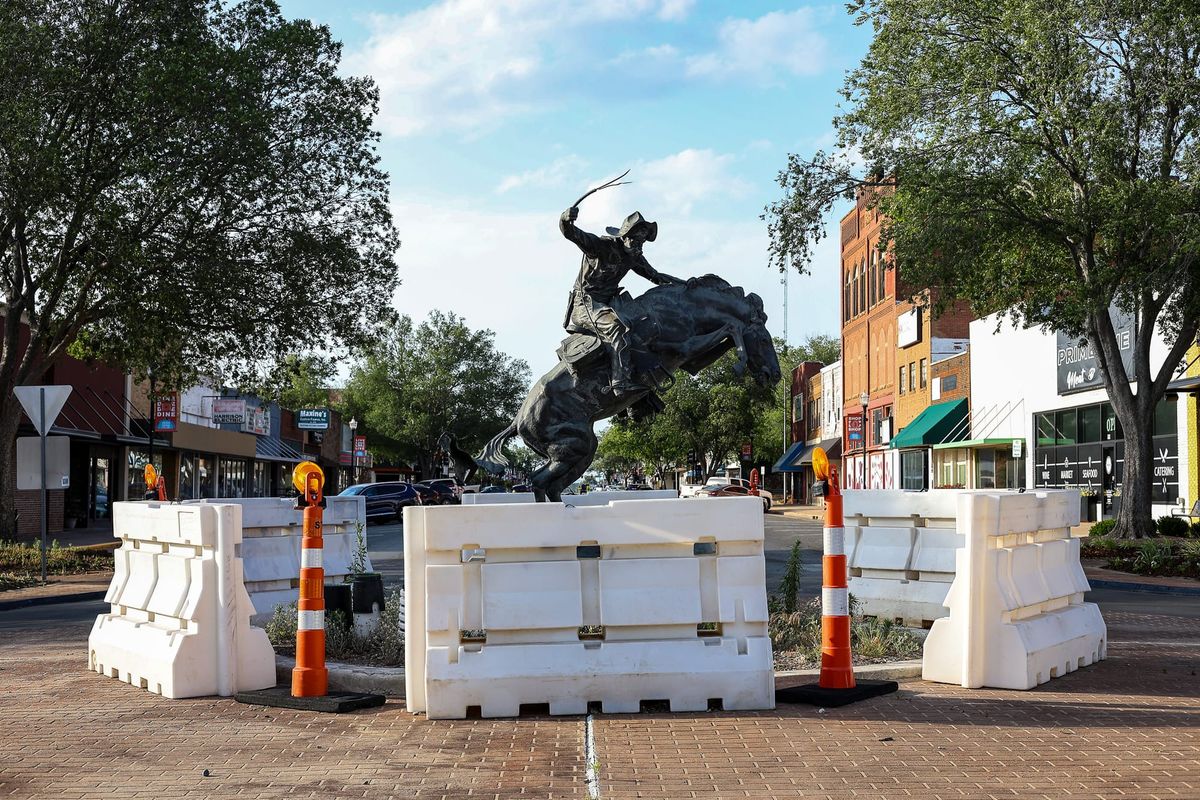
The Stillwater City Council voted 4-1 Monday to keep the downtown roundabout at 10th Avenue and Main Street, rejecting a four-way stop conversion and directing staff to advance the rehabilitation plan and return with a formal budget request.

Engineering firm Gose & Associates presented the cost comparison Monday as an engineer's opinion of probable construction cost. Rebuilding the roundabout is estimated at $165,080. Converting it to a four-way stop — which would require removing the central island, statue, and foundation — is estimated at $339,281, or roughly $174,000 more. Staff will return to council with a formal budget request once design is complete and construction bids are in hand.

The rehabilitation plan calls for full-depth pavement repair on the west lane, updated striping and signage at all four approaches, and new landscaping with hatchet stone edging to match the stone used at the nearby Block 34 development. The central island's dimensions would remain unchanged, and the existing bronze sculpture would stay in place.

The plan also includes solar-powered LED pavement markers around the roundabout and at its approaches, along with Block 34-style streetlights at the four corners of the intersection. Main Street is not a designated truck route, and the city has added signage at 12th Avenue directing commercial traffic away from the corridor. The roundabout's design does accommodate truck drivers who make a wrong turn onto Main Street — large vehicles can swing onto a traversable outer apron to navigate the circle — but the geometry requires careful maneuvering.

City Manager Brady Moore said the corner streetlights are already in the city's yard and ready to install, and would be added regardless of which option the council chose.

Councilor Kevin Clark cast the lone dissenting vote. Clark said he considered the roundabout ill-advised from the start and raised concern that the bronze sculpture limits driver visibility.

"I don't like this roundabout," Clark said. "I think it was ill-advised when it was created, and I think it's ill-advised to keep it."

Clark told the council he was confident the majority would keep the roundabout. He said if it stayed, the sculpture should be removed to improve sight lines.

The size concern has a basis in federal design guidance. Design documents presented to the council show the roundabout measures 39 feet across its outer travel lane — a dimension known in traffic engineering as the inscribed circle diameter. Federal Highway Administration roundabout design guidance used by state transportation departments defines mini-roundabouts, the smallest recognized roundabout category, as having inscribed circle diameters typically ranging from 45 to 90 feet. The Stillwater roundabout falls six feet below that lower bound.

Within that 39-foot span, the 13-foot central island is flanked by roughly 11 feet of mountable stamped concrete apron on each side between the island and the travel lane — the zone large vehicles are expected to overrun when navigating the circle. An additional 4 to 5 feet of traversable stamped concrete sits on the outside of the travel lane, giving large trucks room to swing wide, though not enough to complete a turn.

The federal guidance notes that values outside its typical ranges do not automatically create an unsafe condition if core design principles are met, but it also identifies compact inscribed circle diameters as a primary constraint on truck accommodation, noting that large vehicles at small roundabouts are typically required to drive over the central island rather than around it.

ADVERTISEMENT
CTA Image

ATTN Employers: If you're recruiting top talent, getting candidates here is half the battle. The Community Marketing Grant helps Stillwater employers offset travel costs for prospective hires flying in through Stillwater Regional Airport.

Bring them to town, show them what Stillwater has to offer, and let the community close the deal. 🤠

Applications Due June 17

Mayor Will Joyce said he would have spoken from the public podium in favor of keeping the roundabout had he not been presiding.

"I think it's an excellent addition to our community," Joyce said. "I think all of the evidence around roundabouts is that they are safer, that they do, in fact, do the job that we want it to do down there, which is to keep traffic slower."

Joyce said he did not consider the statue a significant visibility problem and would support keeping it, while addressing surrounding foliage to improve sight lines.

Vice Mayor Amy Dzialowski said she values roundabouts as a traffic-calming tool and appreciated hearing from residents who work and own property near the intersection.

The vote came after four residents addressed the council during public comment, all urging the roundabout's preservation.

Evan Frank said he considers the roundabout effective at slowing traffic and argued the city should install more of them.

"I actually think we need more of them personally," Frank said. "I think that most of the intersections downtown would benefit from being a roundabout."

Bobby Wintle told the council he believes roundabouts are dramatically safer than conventional intersections, citing research he said showed reductions in fatal and injury-causing crashes. Stone Lambert argued that the roundabout's collision history actually demonstrated its value — contending that drivers who struck the structure might have killed someone had a conventional intersection been there instead.

Cory Williams, owner of the property and Hatch Early Mood Food, a breakfast and brunch restaurant on the northeast corner of the intersection, said he was initially skeptical of the roundabout but has become a convert after watching traffic from his storefront.

"I think functionally, which is what you guys should most be concerned about, it actually works extremely well," Williams said.

The roundabout has been struck by vehicles multiple times since the city installed it in 2015. A semi-truck driver struck it in 2017. Most recently, a SUV driver demolished the decorative rock wall, destroyed the landscaping, and damaged the electrical infrastructure for the roundabout's lighting system in February 2025, city surveillance video showed. The wall and landscaping were removed after that crash and have not been replaced; jersey barriers and traffic cones have protected the island since.

The February 2025 crash, and the city's deliberations since, have been covered in a series of Stillwegian reports: the crash itself, initial committee discussions about the intersection's future, the city's pilot program converting three nearby intersections to flashing four-way stops, the Transportation Project Advisory Committee's plan to reconstruct the wall and add lighting, and last December's council debate that produced Monday's cost comparison request.

The council also discussed the persistent problem of semi-trucks navigating the roundabout despite existing signage. Councilor Tim Hardin said he witnessed a semi cut across the island just days before the meeting. Millis acknowledged signage alone cannot solve the problem.

"We're not going to eliminate it. We're just trying to minimize it," Millis said. Hardin suggested increased police enforcement as an additional tool.

Staff will proceed with design and return to council for authorization once construction bids are received, Millis said.

📺 Watch the presentation to City Council

Share this article
The link has been copied!