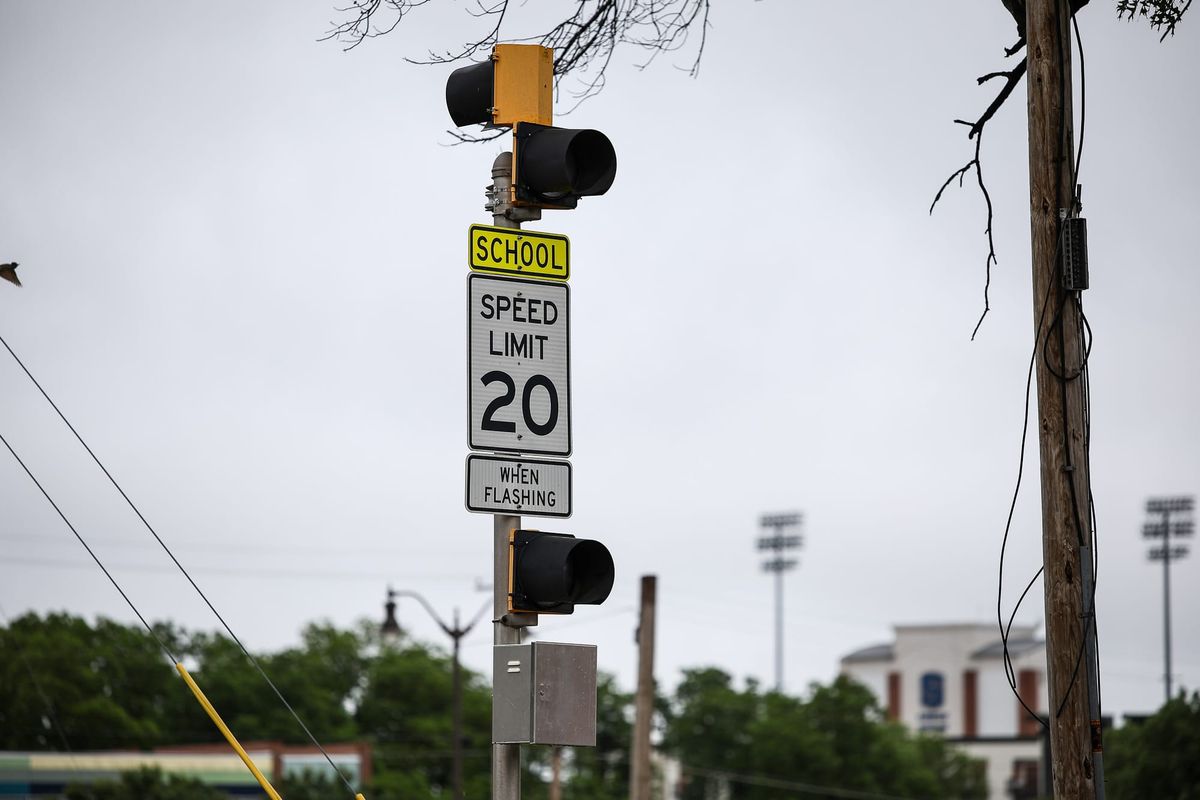
The Stillwater City Council advanced two ordinances Monday that would update city code to align with and expand on recent state law changes — one targeting cell phone use in school and construction zones, the other revising how the city handles unauthorized camping — while a proposed amendment to the city's noise ordinance was pulled by staff before it reached a council vote.

Cell phone ordinance

The council voted 5-0 to advance Ordinance 3608 on first reading, which would prohibit drivers from holding or using a handheld cell phone or composing, sending, or reading electronic messages — including texts, instant messages, photos, videos, and email — while driving in a school zone or construction zone. Exceptions apply for hands-free or voice-operated use and for emergency situations. Fines would be capped at $100, matching the state law penalty.

The ordinance builds on Oklahoma HB 2263, which took effect Nov. 1, 2025. The key practical expansion is the holding prohibition: under the prior law, a driver could argue they were not texting even after being pulled over, because the law did not explicitly address browsing, social media, music, or navigation apps. The ordinance's broad prohibition on simply holding a phone in a school or construction zone closes that argument — officers no longer need to establish what the driver was doing with the device.

ADVERTISEMENT
CTA Image

ATTN Employers: If you're recruiting top talent, getting candidates here is half the battle. The Community Marketing Grant helps Stillwater employers offset travel costs for prospective hires flying in through Stillwater Regional Airport.

Bring them to town, show them what Stillwater has to offer, and let the community close the deal. 🤠

Applications Due June 17

City Chief Communications Officer Dawn Dodson said in a statement to The Stillwegian that the state law provides officers clearer authority to enforce safety in high-risk zones. Chief of Police Chris Hassig, through Dodson, said the department began public awareness efforts on Nov. 1 and that additional outreach will continue as Ordinance 3608 moves forward.

City Attorney Kimberly Carnley said the ordinance was requested by the Stillwater Police Department to give officers a local code provision aligned with and expanding upon the state law. Councilor Kevin Clark asked why the city needed to act if a state law was already in place. Carnley said the city's existing code language does not match the new state statute, making the update necessary, and that most cities are adopting similar local provisions as a best practice.

Mayor Will Joyce said the practical effect for drivers is clear.

"This would, in school zones, even if you're just holding it, you can still get a ticket," Joyce said. "It doesn't require that they actually saw you sending a text or pressing the buttons if you're holding it."

The city plans to increase signage and public communication, including through social media, according to Dodson. The Stillwater Police Department published a Facebook post on Nov. 1 announcing the new state law and noting that violations may result in fines of up to $100. Dodson said additional public outreach efforts will continue as Ordinance 3608 moves forward. The ordinance goes to second reading June 1.

Camping ordinance

The council voted 5-0 to advance Ordinance 3609 on first reading, which would significantly update the city's camping code — replacing a broad prohibition on overnight camping in parks and public areas with a more precisely defined ban on unauthorized camping on all city-owned land.

The state law in question is Oklahoma HB 1764, which took effect Nov. 1, 2025, and expanded an earlier 2024 camping ban to include county- and municipal-owned lands — not just state property. The 2024 law, Senate Bill 1854, had explicitly excluded municipal land, creating confusion about whether city police could enforce it. HB 1764 closed that gap while giving municipalities the option to opt out by majority vote. Stillwater did not opt out.

The ordinance introduces a new definition: unauthorized camping means any tent, shelter, or bedding constructed or arranged to permit overnight use on property not designated as a campsite. Under the current code, overnight camping is prohibited in parks and public areas. The revised ordinance broadens that to all city-owned lands while adding the definition to give officers clearer authority to act.

Advertisement
CTA Image

Spring projects don't wait. Whether you're building a deck, fence, or addition, now's the time to price out your lumber needs. Stillwater Building Center carries what you need — with free delivery available. 📞 405-372-5959

Plan Your Project

Two exceptions carry over from the existing code. Camping remains permitted at Lake McMurtry in designated areas by permit, and during special events on city-owned property as approved by the city manager.

The revised ordinance also adds a graduated fine structure the current code does not include: up to $50 plus court costs for a first conviction, up to $100 for a second, and up to $200 for a third or subsequent offense. On first contact, however, officers must issue a warning rather than a citation — and no citation may be issued unless the person refuses assistance offered by the arresting officer. That assistance may include, but is not limited to, transportation to a shelter, food pantry, or other place where resources are available to assist the indigent or homeless.

Carnley said the changes mirror HB 1764 and would help when there is a need for enforcement. The council advanced the ordinance without discussion.

Noise ordinance pulled

A proposed amendment to the city's noise ordinance, Ordinance 3610, was pulled by staff before it reached first reading. Carnley told the council it would return at a later date, offering no further explanation.

According to the staff report in the agenda packet, the amendment would have extended the hours during which loud music is permitted in commercial zones — to 11 p.m. Sunday through Wednesday and to midnight Thursday through Saturday — while leaving residential noise timeframes unchanged.

The amendment would also have added commercial districts to the list of standing exemptions and removed the existing permit requirement for loud music outside allowable hours. Staff said the changes were intended to reduce confusion around frequent permit requests from businesses in commercial districts.

📺 Watch the City Council meeting

Share this article
The link has been copied!