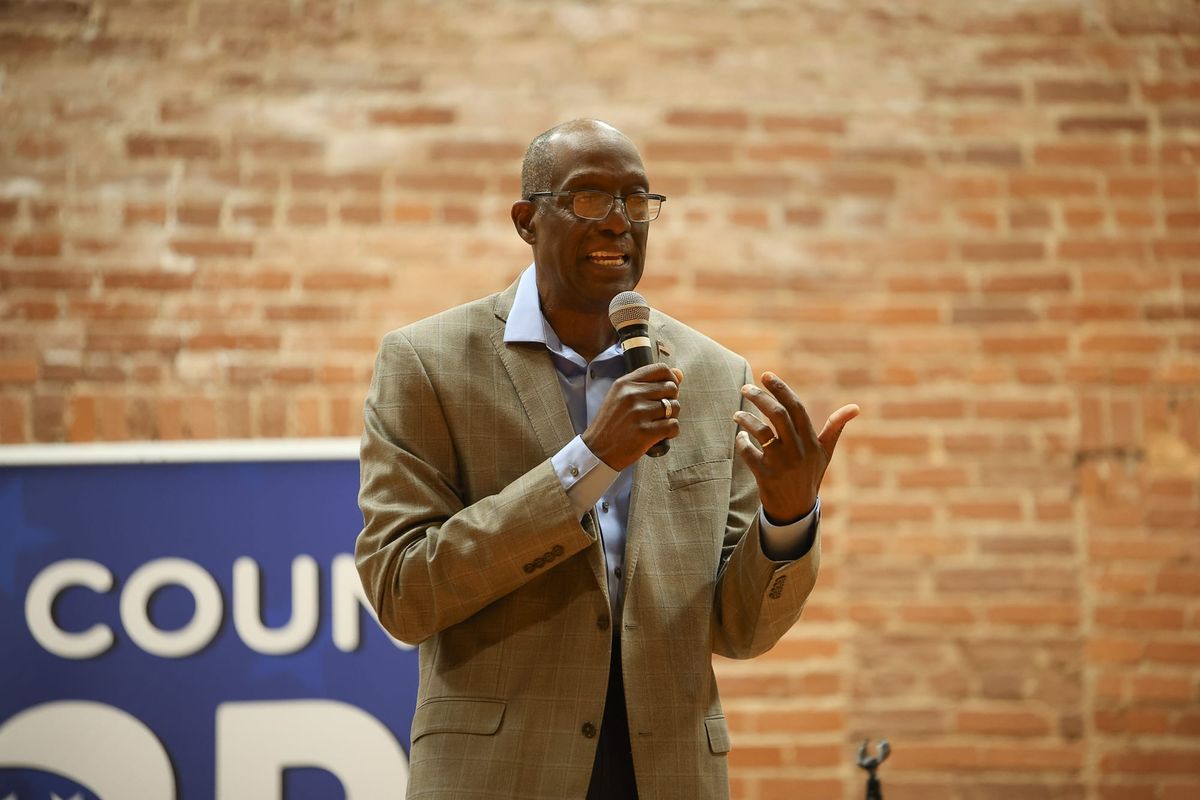
Aaron R. Means
Republican candidate for Oklahoma House, District 34, on the Nov. 3 ballot. A retired dentist and Air Force veteran making his third run against Trish Ranson.


Republican candidate for Oklahoma House, District 34, on the Nov. 3 ballot. A retired dentist and Air Force veteran making his third run against Trish Ranson.
Last updated: 10/21/2026
Oklahoma House, District 34 · Republican District 34 had no June primary. Means became the automatic Republican nominee after the Oklahoma State Election Board ruled his only opponent ineligible.
See the full District 34 race →
Republican — Candidate, Oklahoma House District 34
Means is a retired dentist who served in the U.S. Air Force and the U.S. Public Health Service before settling in Stillwater. He is originally from Baltimore and attended Morgan State University, according to his personal Facebook profile. He currently describes himself as self-employed as director of Una Casa para Oración Cristiana, a Christian prayer ministry. His 2026 campaign does not have a website. On his Rumble channel, Means describes his candidacy as rooted in conservative values on family and community.
Campaign Facebook: facebook.com/DrAaronMeans
Rumble: rumble.com/user/AaronMeansSr
I am a retired U.S. Public Health Service captain with a combined 27 years of service to our nation through two uniformed services: the U.S. Public Health Service and the U.S. Air Force.
I was born and raised in Baltimore, where I attended public schools and graduated from Morgan State University. I earned my degree in general dentistry at Howard University College of Dentistry in Washington, D.C., and completed a one-year internship there.
In 1990, I began my career as a public health dentist with the U.S. Public Health Service in Talihina, Oklahoma, providing dental care to Native American communities. During my USPHS service, from 1990 to 1998 and from 2001 to 2017, I also served at the Choctaw Nation Health Center in McAlester, the Standing Rock Sioux Indian Hospital in Fort Yates, North Dakota, and the Pawnee Indian Health Center, along with associated satellite clinics. I advanced to the rank of captain and served as chief dental officer of the Pawnee Indian Dental Clinic.
From 1998 to 2001, I served as a chief dental support officer in the U.S. Air Force at Minot Air Force Base in North Dakota, providing dental care to active-duty personnel and their families.
I am married to Shelia Means, my wife of 26 years, a retired advanced practice nurse and retired U.S. Air Force officer. We have a blended family of five adult children and 11 grandchildren. We have called Oklahoma home since 2001 and Stillwater home since 2012.
I serve as the Stillwater Police chaplain and as a board member of Shiloh’s Place Maternity and Parenting Home. From 2020 to 2025, I served as chairman of the Payne County Republican Party. I am also a member of the Stillwater National Day of Prayer Task Force.
I manage a prayer ministry at 2318 N. Washington in Stillwater, where we host group prayer sessions and a quarterly prayer breakfast. Two additional ministries are active at this location.
In the last two elections in which we opposed one another, voters had a limited record by which to compare our backgrounds, experience, and positions. Today, I have a public record of the principles I will promote and the policies I will support. Representative Trish Ranson also has an established voting record that voters can examine for themselves. We differ on many issues, including:
My priorities include public safety, parental rights, academic achievement, classroom-focused education funding, teacher support, school security, election integrity, fairness in women’s sports, property and income tax reform, small businesses, and accountability in government.
In 2026, I am asking voters to look beyond incumbency and carefully compare the records, votes, values, and priorities of both candidates.
Stillwegian fact-check: House records confirm Ranson voted no on HB 1217 (March 25, 2025), on SB 615 (April 28 and May 19, 2022), on SB 613 (April 12 and April 26, 2023), on HB 1005 (March 27, 2025), on SB 2 (April 19, 2021) and on HB 1280 (March 27, 2025). House records do not support the statement that her votes on HB 1449 differed: she voted no in the House Public Health Committee on Feb. 22, 2023, on third reading March 23, 2023, and on fourth reading May 29, 2024. HB 3379, which Ranson authored, passed the House Postsecondary Education Committee 6-2 on Feb. 10, 2026, and did not receive a floor vote. HB 1280 failed in the House 36-57, with members of both parties voting against it.
My concerns about age-appropriate school library materials are based on documented public discussions, concerns raised by Oklahoma parents and residents, and graphic excerpts presented during an Oklahoma State Board of Education meeting.
On Aug. 9, 2022, a Stillwater parent addressed the Stillwater Public Schools Board of Education and identified books of concern in local school libraries, including The Truth About Alice, Me and Earl and the Dying Girl, Perfect, and It Feels Good to Be Yourself. On March 23, 2023, graphic excerpts were presented at an Oklahoma State Board of Education meeting from titles including Let’s Talk About It, Lawn Boy, Gender Queer, and Stamped: Racism, Antiracism, and You.
The Stillwater Public Schools online library catalog is one starting point for identifying books that warrant further review, though no website or list should replace examining the actual material, considering the book as a whole, and applying the appropriate legal standards.
I would not automatically classify every book identified in these discussions as legally obscene. The fact that a book contains profanity, sexual references, or an explicit passage does not, by itself, establish that the entire work meets Oklahoma’s legal definition of obscenity. I am not claiming that every title remains in a Payne County school library today.
Parents have a right to know what materials are available to their children, and school districts have a responsibility to maintain age-appropriate library collections. I support enforcing existing Oklahoma law. If additional legislation is considered necessary, I would support clearly written, objectively applied standards that distinguish legally obscene material from other content that may be inappropriate for certain age groups, while respecting constitutional protections for free expression.
My goal is not to remove books simply because they address controversial subjects. My concern is ensuring that children are not exposed to sexually explicit material inappropriate for their age and that parents have a meaningful voice in decisions affecting their children.
Stillwegian fact-check: A search of the Stillwater Public Schools online library catalog on Oct. 21, 2026, found:
All five titles found are trade books — three novels, a nonfiction book for teen readers and a children’s book — sold by commercial publishers, not textbooks. The catalog shows only where library copies are held; it does not show whether any are used in classroom instruction.
Several of these titles appear on national lists of challenged and banned books. The American Library Association ranked Gender Queer the most challenged book in the U.S. in 2021, 2022 and 2023, and also listed Lawn Boy (2021 and 2022), Me and Earl and the Dying Girl (2021, 2022 and 2023), Let’s Talk About It (2023) and Stamped (2020) among its top 10. PEN America counts Gender Queer, Me and Earl and the Dying Girl and Ellen Hopkins’ Perfect among the most frequently banned books in U.S. public schools since 2021.
I am committed to protecting parental rights and ensuring that parents or legal guardians are appropriately informed and involved when adults provide counseling or guidance to minors concerning sexual orientation or gender identity, consistent with applicable law and exceptions necessary to protect a child’s safety.
I also believe children must be protected from adults knowingly exposing them to pornography or sexually explicit material inappropriate for their age. Providing counseling or guidance concerning sexual orientation or gender identity is not, in itself, equivalent to exposing a child to pornography.
District attorneys already have authority to prosecute offenses established by law, so any new proposal must identify the specific conduct that existing law does not adequately address. Before introducing legislation, I will consult with the Oklahoma Attorney General’s Office, fellow legislators, parents, educators, medical and mental health professionals, and legal experts.
The legislation must clearly define the prohibited conduct, the circumstances under which criminal liability would apply, and appropriate penalties. It must also address whether teachers, librarians, counselors, school administrators, medical providers, or parents would fall within its scope, using precise statutory language rather than broad terms that could lead to inconsistent or unintended prosecutions.
At the June 11 forum, I expressed support for legislation that would allow citizens to pursue civil accountability when a judge or attorney engages in legally actionable misconduct that contributes to a violent offender’s release and subsequent criminal activity.
The legislation must clearly define the conduct that could give rise to a lawsuit. It should not impose liability simply because a judge makes an unfavorable ruling, an attorney represents a defendant, or an offender commits another crime after being released. Prosecutors, defense attorneys, attorneys representing offenders in parole or release proceedings, and other legal professionals have different responsibilities and legal protections, and whether any of them could be held liable must be determined through careful legal analysis.
A plaintiff would need to prove the applicable legal duty, the defendant’s alleged misconduct, and a sufficient connection between that conduct and the subsequent harm. Judges generally have immunity from civil damages for judicial acts performed in their judicial capacity, and prosecutors and other attorneys may also have immunity. Any legislation must account for these protections and comply with constitutional requirements, including due process and the separation of powers.
If existing law already provides an appropriate remedy, I will examine whether strengthening enforcement of that law would be more effective than creating a new cause of action.
Repeat violent offenders must be held accountable. Oklahoma families deserve safe neighborhoods, a fair and effective criminal justice system, and meaningful accountability when misconduct contributes to preventable harm.
My position is informed by firsthand experience. I have personally appeared before a local school board to advocate for parental rights, student privacy, age-appropriate educational materials, and greater transparency. I raised concerns about recognizing biological sex, boys using girls’ bathrooms and private spaces, obtaining active parental consent before children are exposed to certain sexual education materials, and providing designated times for parents and taxpayers to review school library materials. My requests were not adequately addressed by the local school board.
Local control is important, but it should not be an excuse for failing to protect students’ rights or respond to legitimate parental concerns. Local school boards should retain authority over day-to-day school operations, local priorities, and decisions best made by educators and families. The Legislature has a responsibility to establish clear, consistent statewide standards when parental rights, student safety and privacy, educational transparency, or fairness are at stake, as it did with Senate Bill 615 on school restrooms and Senate Bill 2 on school athletics.
On Oklahoma’s 2014 Parents’ Bill of Rights, I would begin by reviewing the existing law to identify gaps in implementation, transparency, and enforcement. Areas I would examine include parents’ access to information about curriculum and library resources; a transparent process for raising concerns about specific books; clearer parental consent and notification requirements for sex education and other sensitive matters; reasonable timelines for districts to respond to parents; and the remedies available when districts do not follow the law.
These are areas for review, not a claim that I have already drafted legislation. Local control and parental rights should work together, not against each other.
Stillwegian fact-check: Stillwater Public Schools board policy EFA-R1, last revised Oct. 10, 2023, states that “a student or the student’s parent will have the right to reject the use of library media center materials which seem incompatible with the student’s values or beliefs” and that no parent may determine the reading matter of students other than their own children. The district’s library media centers webpage tells parents with requests or concerns about what their child can access to contact their school’s library media specialist, and says parents can log in to their child’s library account to see what the child has checked out. In February 2023, a district spokesperson told the Stillwater News Press that parents can notify their child’s school if they do not want their child reading a specific book. Under the same policy, a parent or guardian may ask to have a book at their child’s school reconsidered by submitting form EFA-E1 to the principal. A review committee that includes a parent evaluates the material, which stays in circulation during the review, and the committee’s decision may be appealed to the school board.
I believe parents have the primary responsibility for making educational decisions for their children. I support Oklahoma’s Parental Choice Tax Credit for eligible private-school expenses and the existing tax credit for qualifying homeschool expenses.
Education funding should follow the student, but the formula must account for the actual costs of educating all students. Public school districts must continue to provide facilities, transportation, staffing, special education, and other essential services, and those expenses do not automatically disappear when enrollment declines. I would pursue transparent, weighted per-student funding; targeted, time-limited transition assistance for districts with unavoidable fixed costs; and accountability rules that prevent duplicate payments for the same educational service.
I support the objective behind HB 1280 (2025) of directing at least 50% of school district budgets toward instructional expenditures, and I would pursue greater transparency in classroom spending.
Teacher pay must be a measurable budget priority. I would work to bring Oklahoma teacher compensation to at least the average of neighboring states within four years. During my first legislative session, I would pursue a costed compensation plan based on current salary data, regional comparisons, teacher vacancies, and retention rates, with sustainable funding sources and measurable benchmarks rather than unfunded raises. I would also evaluate campus security needs and resource gaps.
To finance these priorities, I would review administrative expenditures and program effectiveness and identify documented savings. Any recurring commitment, particularly teacher salary increases, must have a sustainable funding source. Children should not be required to follow the money. Educational dollars should follow the children.
My pledge is both a personal commitment and a legislative priority. Yes, I would support legislation similar to House Bill 3030. I will not sign an agreement that prevents me from being accountable to the voters I represent, and I would support clear statewide limits on these agreements. Any narrowly defined protections for legitimate trade secrets must not be used to conceal public expenditures, tax incentives, infrastructure commitments, or government decisions that the public has a right to examine.
Responsible data center development would require five safeguards:
Google’s Stillwater project may offer economic benefits, including construction jobs, local business activity, and revenue for local taxing jurisdictions, but projected benefits must be distinguished from actual results. Google and OG&E announced an energy agreement in April 2026 intended to protect existing utility customers from the costs of serving Google’s electricity demand. I welcome those commitments, but the public should be able to evaluate the actual terms and effectiveness of those protections, not simply rely on corporate assurances.
My position is not that Stillwater should reject responsible business investment. It is that no corporation should receive a blank check simply because it promises economic growth. I will serve the voters of House District 34 — not big business, not special interests, and not government secrecy.
Stillwegian fact-check: OG&E announced April 30, 2026, that under its agreements to serve Google’s data centers in Stillwater and Muskogee, Google will pay the full cost of connecting the sites to the grid. The agreements require approval from the Oklahoma Corporation Commission.
OG&E’s rates apply to its own customers. The city-owned Stillwater Electric Utility, not OG&E, provides electricity to homes and businesses in Stillwater, and the city also provides their water. OG&E serves the Oklahoma State University campus under a franchise Stillwater voters approved in 2007. On Nov. 5, 2024, Stillwater voters approved a second franchise agreement allowing OG&E to serve the data center campus, 10,250 of 14,180 votes, according to Oklahoma State Election Board results. The city has said the agreement does not change residents’ electric provider or rates, and that it expects to receive a franchise fee from OG&E of about $2.25 million per data center per year once each is fully operational.
Oklahoma homeowners deserve meaningful property tax relief, greater transparency, and a stronger voice in decisions that affect their financial security.
I recognize that limiting the right to vote in bond elections to property owners raises serious constitutional concerns. The U.S. Supreme Court struck down property-owner-only voting restrictions in Kramer v. Union Free School District No. 15 (1969) and City of Phoenix v. Kolodziejski (1970). I would not pursue a blanket property-owner-only voting requirement.
My proposal to give voters the option of paying additional property taxes if they support a bond would require careful legal and financial review. Secret ballots must remain secret, and a bond cannot responsibly depend on identifying individual voters or assuming that only supporters will pay. I would explore legally sound alternatives that give taxpayers a more meaningful voice while ensuring that any bond has a workable repayment plan.
I would review existing property valuation limits and homestead exemptions, evaluate additional relief for seniors and homeowners on fixed incomes, and require clear public disclosures before bond elections, including the total cost, repayment period, estimated property tax impact, and intended benefits. I would also support regular public reporting on bond-funded projects.
Property taxes help support Stillwater Public Schools, public safety, infrastructure, and other essential local services. Any proposed relief should include a transparent fiscal analysis and a realistic plan for maintaining those services.
Homeownership should represent stability and security — not the fear of being taxed out of your own home.
If you can be taxed out of your home, do you really own it?
I believe Oklahoma families should keep more of the money they earn. I support lowering Oklahoma’s individual income tax rates through a responsible, phased approach, with the long-term goal of eliminating the tax when the state can do so without jeopardizing essential services or fiscal stability. Individual income tax is Oklahoma’s largest single source of General Revenue Fund collections, accounting for approximately 40% of the fund in fiscal year 2025.
My first priority would be a comprehensive, transparent review of state spending to identify duplicative services, unnecessary administrative costs, ineffective expenditures, and waste, fraud, or abuse, and to document recurring savings before implementing tax reductions.
If income tax collections decline, I would prioritize verified savings and greater efficiency while protecting essential services, including public safety and education. Any proposed tax reduction should include a public fiscal analysis of its impact on state revenue. I would not support unfunded tax cuts, borrowing to cover recurring expenses, or simply shifting the tax burden to other taxpayers.
Government should live within its means so hardworking Oklahomans can keep more of theirs.
Stillwegian fact-check: The individual income tax supplied 42.3% of the state’s General Revenue Fund in fiscal year 2025, according to the Oklahoma Policy Institute’s analysis of state revenue data.
The two issues I believe deserve particular attention in House District 34 are government accountability and transparency, and improving academic achievement for our children.
Government accountability and transparency: The northern portion of House District 34 is experiencing significant developments associated with Google’s data center project. My understanding is that preliminary discussions between Google and city officials began before the COVID-19 pandemic, but many residents felt they were not meaningfully included until public approval was needed for essential electrical infrastructure and utility services. Residents were then told that nondisclosure agreements restricted what city officials could share. As a state representative, I would support legislation ensuring public officials cannot use nondisclosure agreements to conceal public expenditures, tax incentives, or infrastructure commitments, and I would advocate for timely disclosure and community input before major public commitments are made.
Improving academic achievement: Every child deserves a strong academic foundation, beginning with early literacy, handwriting, and mathematics. From kindergarten through third grade, I would advocate for direct, teacher-guided instruction using printed books, pencils, paper, and hands-on activities in phonics, handwriting, reading comprehension, counting, and basic math, while reducing unnecessary dependence on Chromebooks and other digital devices. Technology can support learning, but it should not replace effective teaching or meaningful interaction between teachers and students.
As a legislator, I would prioritize policies that strengthen early literacy and mathematics, support teachers, and measure student progress through meaningful academic outcomes.
Correction, Oct. 21, 2026: Question 10 as sent to the candidate understated the individual income tax’s share of the state’s General Revenue Fund as about one-third. It supplied 42.3% in fiscal year 2025.
Responses have been shortened by The Stillwegian with the candidate’s approval and lightly edited for grammar, spelling, and AP style. Substance and positions have not been altered.
I have been a Stillwater resident for 10 years and was born in Oklahoma. My heart is for our nation and state to be one under God.
I have known Aaron and Sheila Means for about 15 years. I can say they are wonderful friends, and I have seen them serving the community and state. They are both amazing people of faith and integrity and have been active in political endeavors for some time. Frequently they are at our state Capitol talking with government officials. Aaron has served as Payne County Republican chairman.
They pray diligently for our state and nation and the leadership in both. Their hearts are aligned for the best of our state and country. Their concerns for our children and young people have carried through everywhere they go. They are both retired military and have served our country well.
I would like for everyone to consider voting for Aaron Means as he is running for state representative for House District 34. The vote will be Nov. 3, with early voting Oct. 28-29. We need him there representing our families.
This letter has been edited for grammar and AP style.
Through my involvement and leadership in Payne County Republican Women and Eagle Forum Oklahoma, I’ve come to understand the importance of having representatives who stand firm in their convictions and defend our constitutional freedoms.
That’s why I am proud to endorse Aaron Means for Oklahoma House District 34.
Aaron is a godly man, devoted husband and father, U.S. Air Force veteran and dedicated community leader and volunteer. As former chair of the Payne County Republican Party, an associate member of Payne County Republican Women and an active member of Eagle Forum Oklahoma, Aaron has demonstrated his commitment to faith, family and freedom.
I appreciate his unwavering stand for parental rights, the sanctity of life and our constitutional rights. I believe Aaron will fight for you and me with integrity, courage and conviction.
Our freedoms, our families and our future are too important to take for granted. On Nov. 3, make your voice heard at the ballot box. Every vote matters, and so does the future of Oklahoma! – Diana Ward
This letter has been edited for grammar and AP style.
Having spent 22 years as a counselor in Oklahoma’s public education system, I have had the opportunity to see firsthand the challenges facing our children, families, educators and communities. These experiences have given me a deep appreciation for the importance of strong families, quality education and leadership that genuinely listens to the people it serves and recognizes the vital role of our educational system.
Education continues to be especially important to me. I believe that investing in our children and supporting those who educate them is an investment in future generations and the future of our state. In my conversations with Aaron, he has expressed his support for education at all levels and his understanding of the important role educators and families play in preparing the next generation. I believe he understands the challenges and the importance of ensuring that our schools have the resources and support necessary to fulfill their vital role in our society.
Having known Aaron for several years, I have seen firsthand that his commitment to faith, family, integrity and service is more than just words. These values are reflected in the way he lives and interacts with others. I have always appreciated his willingness to listen, ask questions and take the time to understand the concerns and perspectives of those around him.
I believe that genuine leadership begins with a heart to serve and a willingness to listen. Our communities need leaders who understand that the decisions made today will have a lasting impact on our children, families and future generations.
As a resident and voter in Payne County, I am proud to express my personal support for Dr. Aaron Means as a candidate for the Oklahoma House of Representatives, District 34. – Lori Kloxin
This letter has been edited for grammar and AP style.
I am writing to endorse Dr. Aaron Means for Oklahoma House District 34 representative. I have known Dr. Means for several years and can confidently say that he has the character and integrity to properly represent all of the people of Oklahoma House District 34.
In the 1830s, the Rev. Charles Finney saw our nation undergoing many struggles. Finney wrote, “The Church must take right ground in regard to politics. . . . [T]he time has come that Christians must vote for honest men and take consistent ground in politics. . . . Christians have been exceedingly guilty in this matter. But the time has come when they must act differently. . . . God cannot sustain this free and blessed country which we love and pray for unless the Church will take right ground. . . . It seems sometimes as if the foundations of the nation are becoming rotten, and Christians seem to act as if they think God does not see what they do in politics. But I tell you He does see it, and He will bless or curse this nation according to the course [Christians] take [in politics].”
I believe as a nation and as a state, we are facing many similar struggles today. Overcoming them requires leadership that stands on a foundation of integrity, not pandering for votes. I have known Dr. Means to hold such integrity and be a representative who will support the betterment of House District 34.
Therefore, I fully endorse Dr. Aaron Means for Oklahoma House representative on Nov. 3. – Steve George
This letter has been edited for grammar and AP style.
Dr Means is the best candidate I can imagine for any office and is dedicated to improving our community, schools and state. He is well prepared, articulate and caring, Dr Means is honest and forthright with character and is a really good listener. Please vote for Dr Means for the betterment of our state and community.
Sincerely, JAMES WILLIAM CARLEY
Here lately it seems that we all look around and wonder, “What in the world is going on?” Whether it is on a local, state or national stage, disruption, fraud, corruption and chaos just appear to be rampant.
We take these opportunities usually to find someone else at fault and seldom become introspective. So you didn’t vote last time, you didn’t support a candidate, you didn’t help them get their platform and message out or visit with your neighbors. This is what it gets us. WE DO STILL CONTROL OUR DESTINIES. We do not need to leave the solutions to someone else.
We are at the recurring campaign cycle in time. We have those who are willing to make a difference. They have the courage to place themselves out front to public scrutiny by running for public office.
I have yet to see the perfect candidate who satisfies all my expectations. Yet, what I look for is the candidate who shares the values that I hold dear and has the moral character and life experiences to make a solid decision when the times come.
Some of our electorate want a different state and nation than I do. I must admit that I am fearful about the direction that we are going. If we do not send godly, conservative and rational men and women to represent us in our government, then we will see the continued deterioration of our republic. I do not want to see this, and this is why I support Dr. Aaron Means for House District 34. – Gary McCune
This letter has been edited for grammar and AP style.
Submit an endorsement letter → · Deadline: 11:59 p.m., Friday, Oct. 23, 2026
Submitted a letter and changed your mind? You can retract a published endorsement at any time, no explanation needed. Email electiondesk@thestillwegian.news.
| Election | Result |
|---|---|
| Nov. 3, 2026 general election, HD 34 | On the ballot vs. Rep. Trish Ranson (D) |
| 2020 general election, HD 34 | Lost to Trish Ranson by 5 points |
| 2018 general election, HD 34 | Lost to Trish Ranson by 14.8 points |
How Means became the nominee: The Oklahoma State Election Board ruled his only primary opponent, Ted Riley, ineligible at a candidacy contest hearing on April 16. Riley had registered to vote in HD 34 on Nov. 5, 2025 — more than a month after the six-month registration deadline required prior to the April 1-3 filing period. Riley did not attend the hearing or respond to the petition.
Related coverage: Oklahoma State Election Board removes Ted Riley from HD 34 ballot (NonDoc)
Aaron Means: if you find an error here, contact us at electiondesk@thestillwegian.news.