63% of Payne County foster children are placed outside the county. A Stillwater nonprofit is trying to change that.
Lions Meadows of Hope is one of five agencies statewide selected to participate in Oklahoma's new Kinship Navigation Program


Lions Meadows of Hope is one of five agencies statewide selected to participate in Oklahoma's new Kinship Navigation Program
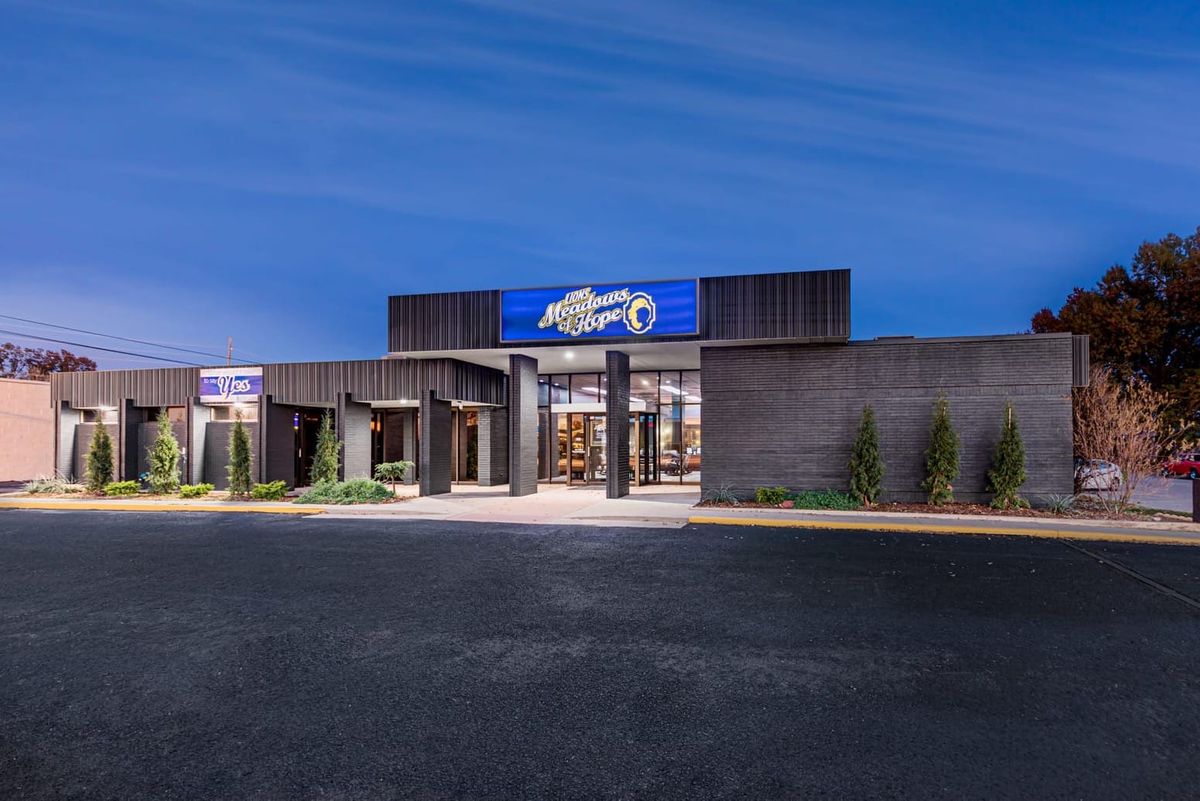
Lions Meadows of Hope has been selected as one of five agencies statewide to run Oklahoma's first Kinship Navigation Program, a state effort to keep children who enter foster care with relatives and in their home communities.
The Stillwater-based nonprofit will serve Payne, Lincoln, Logan, Noble, Pawnee, Osage, Kay, and Grant counties beginning this month. Services are free and voluntary.
Lions Meadows of Hope CEO Bryan Larison said the need is visible in state data that tracks where children land when a relative cannot say yes.
"We have several kids in Payne County that aren't in Payne County," he said. "They were removed from Payne County. They went to a stranger's home. An hour away."
New data from Oklahoma Human Services (OKDHS) show how far local children have traveled from home. Thirty-three of the 52 Payne County children in foster care and related placement settings — 63 percent — are living outside the county. Across the eight counties Lions Meadows of Hope will cover, the figure is 126 of 179 children, or roughly seven in 10. Lincoln County has the highest rate, at 88 percent.
The figures exclude children placed with relatives, children in tribal custody and children in higher levels of care such as group homes.
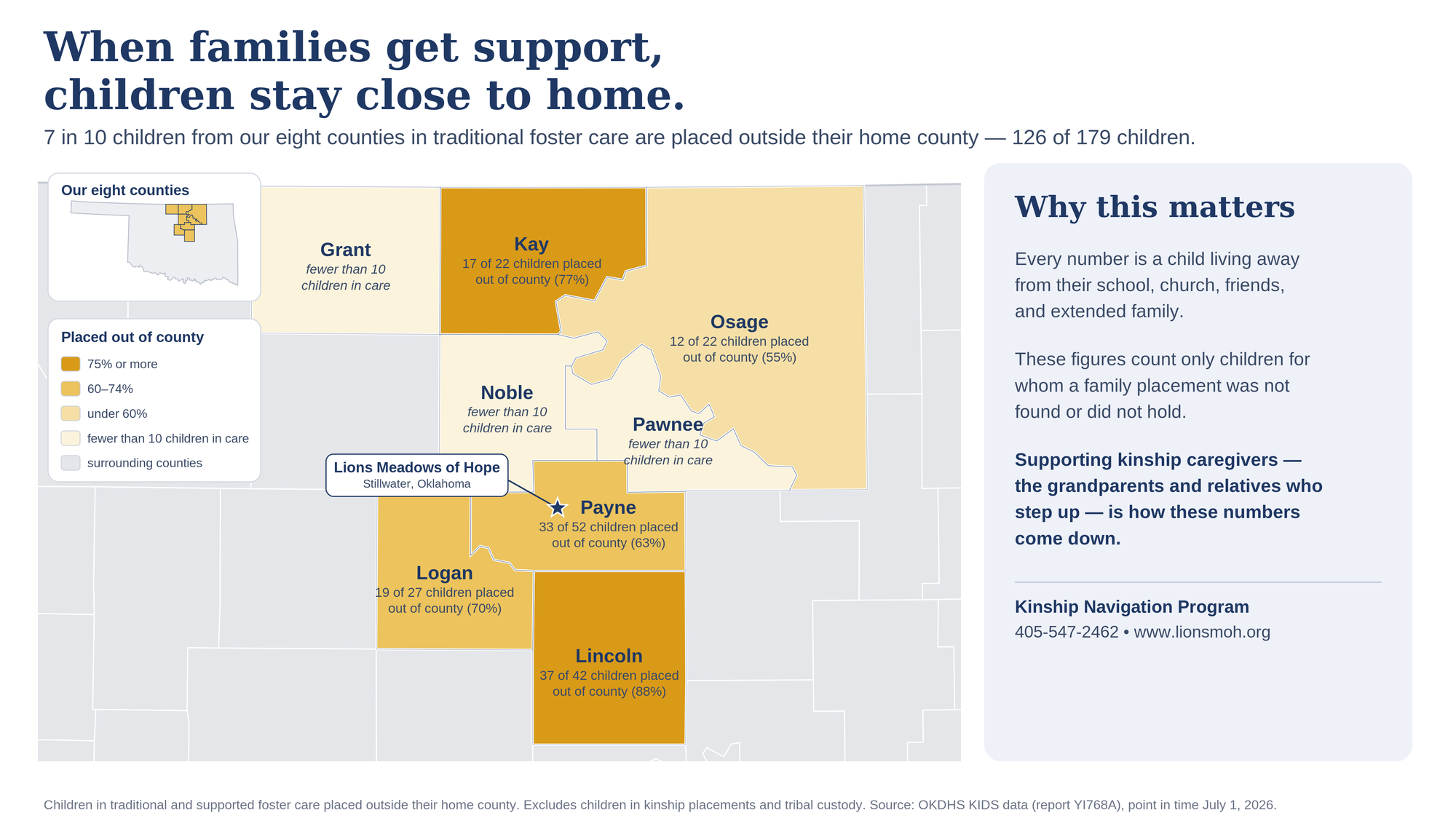
Payne County also takes in more children than it sends away, according to OKDHS data. Forty-six children from other counties are placed here, while 28 Payne County children are placed elsewhere — a net difference of 18. Stillwater is one of the region's larger communities, and children removed from smaller surrounding counties often land here.
Larison said the distance carries costs that compound over time.
"Because that child is now an hour away, they're not in their same school. And then that causes that trauma to that kiddo — typically comes out in behavior. So now, instead of just trying to solve the problem of helping mom and dad correct whatever issue they were having, now we've created a new problem by removing these kids from their family and their community."
Referrals come from OKDHS after a court places a child with a relative or family friend. A navigator contacts the family the next business day, or sooner through an on-call line in an emergency.
The program carries up to $1,000 per family that the agency can spend on immediate needs — food, beds, car seats, a utility bill, and gas money — to stabilize a placement in its earliest hours.
"These are grandparents, aunts and uncles, close family friends, but they're people that this child knows. These people weren't ready to take a child on. So these funds are meant to mitigate that reason that somebody might say, no, I can't do it because we don't have enough money for food."
Oklahoma heat is hard on windows. Thermal expansion stresses glass, seals, and frames until seals fail and cool air escapes. Stillwater Building Center provides estimates and pinpoints your problem areas.
Families that accept ongoing help stay enrolled at least 90 days. Navigators accompany caregivers to court, explain rights and grievance procedures, and help families navigate a system most have never encountered.
"Most people aren't experts on the foster care system," Larison said. "We know what foster parents' rights are, we know what foster children's rights are, we know grievance procedures. We help them figure out how to make sure their voice is heard through the court system."
Larison drew a clear line between the agency's role and the state's. Navigators do not assess caregivers or make placement decisions — that remains the court's and OKDHS's responsibility.
"We're not there to say, you're doing good enough to keep this kid, or you're doing this wrong. That's DHS's role," he said. "We are there to say, what do you need to keep these kids in your home?"
Lions Meadows of Hope's traditional foster parents complete roughly three months of training before accepting a placement. Kinship caregivers get no such runway. They are also managing existing family relationships alongside an active case — a dynamic that traditional foster care does not produce.
"How do you navigate caring for your children's children?" Larison said. "What's Christmas going to look like? What are birthday parties going to look like — when DHS is saying, I'm sorry, but dad can't see this child except in a supervised setting in a DHS office."
He said the difficulty does not diminish the value.
"It is the best place for kids — with their family — but that doesn't mean it's the easiest," Larison said. "What's true a majority of the time is family will fight for family. They're not going to give up."
A message from Visit Stillwater
August is bursting with excitement in Stillwater! From the Payne County Free Fair and the return of Cowboy sports to the start of a new semester and can't-miss community events, there's something for everyone to enjoy.
The program draws on tertiary prevention dollars made available under the federal Family First Prevention Services Act. Larison said Oklahoma has accessed those federal funds previously but is using them for kinship navigation for the first time.
A startup grant covers training, licensing fees, and operating costs through Dec. 31. Continued funding depends on the state building a billing structure to draw down federal money, which requires a state match.
"The question is, are we willing to invest in keeping children with family so that we can reduce the total number of children that are in traditional foster care with people that they don't know," Larison said.
Staff will be trained in the Arizona Kinship Navigator Model, an evidence-based program monitored for fidelity. Lions Meadows of Hope will run the program with the equivalent of three full-time employees — covering the largest geographic service area of the five agencies statewide. Larison said the agencies serving the Oklahoma City and Tulsa areas have six to eight staff each.
He expects to enroll at least 25 families by the end of the year. The greatest need, he said, is in Stillwater, Guthrie, and Ponca City — the three communities with the highest number of children in the eight-county area.
The kinship navigation program reaches only families referred by OKDHS following a court-ordered placement. Relatives caring for children under informal family arrangements — with no DHS case or court involvement — are not eligible for a navigator or the $1,000 stabilization fund, though they may attend support groups and receive referrals to community resources.
Larison said that informal group is likely the larger one.
"The majority of kinship care is informal," he said. "It's still out-of-home care, but it's the best, because an arrangement has been made between the parent and that caregiver before the government has gotten involved."
Asked what Stillwater residents should take from the program's launch, Larison said to look for people already doing the work quietly.
"Look around and see if they already know somebody that's taking care of a child that doesn't belong to them," he said. "Those people that said yes to those kids probably are the type of people that don't ask for help. They just do it. So just help. Don't wait for them to ask."