Ranson, Means split on judicial panel, religious charter schools in third matchup for House District 34
The Democratic incumbent and her two-time Republican challenger both oppose the property tax state question but differ sharply on schools and judicial selection.
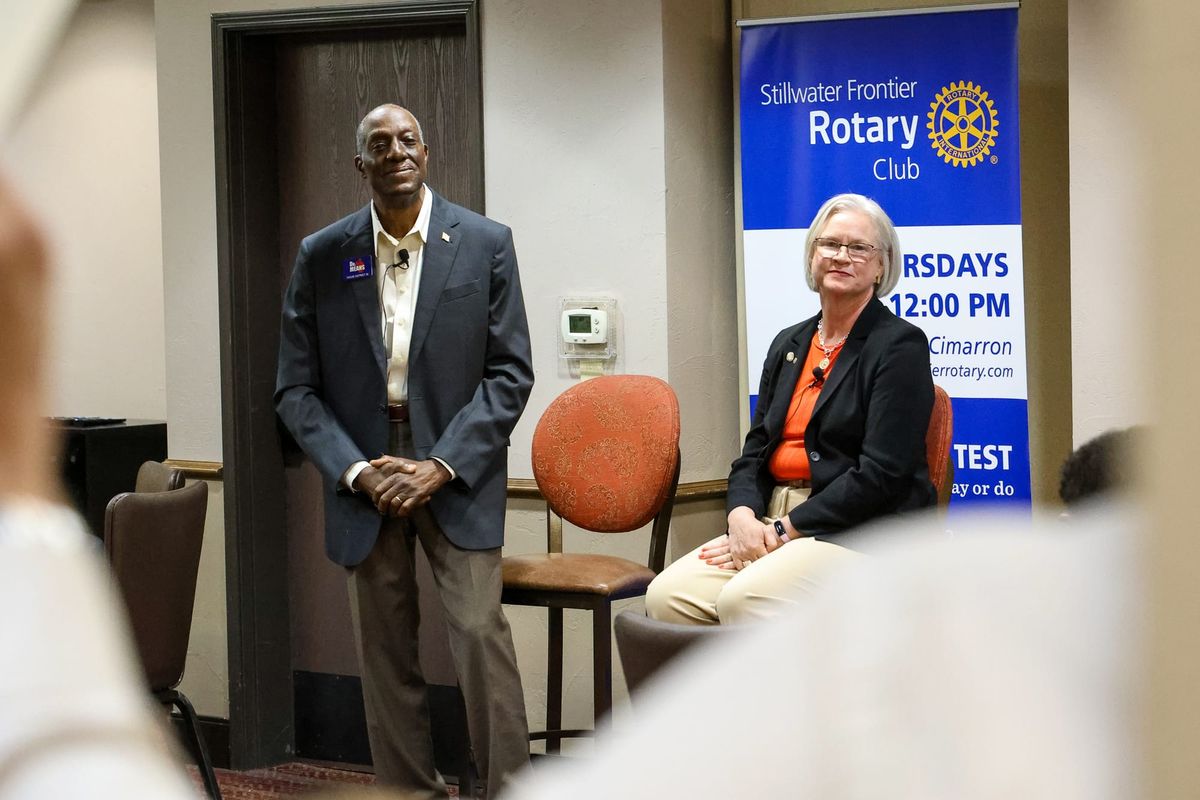
Republican Aaron Means, left, and state Rep. Trish Ranson, D-Stillwater, take part in the Stillwater Frontier Rotary Club’s House District 34 candidate forum Thursday, Oct. 22, 2026, in Stillwater. Ranson is seeking a fifth term against Means, whom she defeated in 2018 and 2020. – Photo by Chris Peters
Republican Aaron Means, left, and state Rep. Trish Ranson, D-Stillwater, take part in the Stillwater Frontier Rotary Club’s House District 34 candidate forum Thursday, Oct. 22, 2026, in Stillwater. Ranson is seeking a fifth term against Means, whom she defeated in 2018 and 2020. – Photo by Chris Peters
State Rep. Trish Ranson, D-Stillwater, and Republican Aaron Means will face each other on the ballot for the third time Nov. 3, and at an Oct. 22 candidate forum they disagreed on how Oklahoma picks its judges, whether tax dollars should fund religious charter schools and whether struggling third graders should be held back.
The forum was hosted by the Stillwater Frontier Rotary Club and moderated by Kevin Clark. The candidates alternated answering prepared questions.
Ranson, a Democrat seeking her fifth term, framed her campaign around public education, health care access and bipartisan problem-solving. Means, who lost to Ranson in 2018 and 2020, centered his on what he called family values and parental authority.
House District 34 covers the core of Stillwater. Neither candidate appeared on the June 16 primary ballot. Ranson was unopposed for the Democratic nomination, and Means became the Republican nominee after the Oklahoma State Election Board ruled his only primary opponent, Ted Riley, ineligible in April.
Meet the candidates
Ranson, 56, taught elementary music for 15 years at Westwood Elementary School before she was elected in 2018. She has served as chair of the House Democratic Caucus since 2023. Her House Bill 1979, creating an Early Childhood Task Force to study how the state delivers services to children from birth through age 5, was signed into law by Gov. Kevin Stitt on May 11.
Ranson said in her opening statement that the 2018 teacher walkout led her to leave the classroom and run for office, citing children going home on weekends with food sacks and "the fact that I had 565 students and I had zero budget to teach them with."
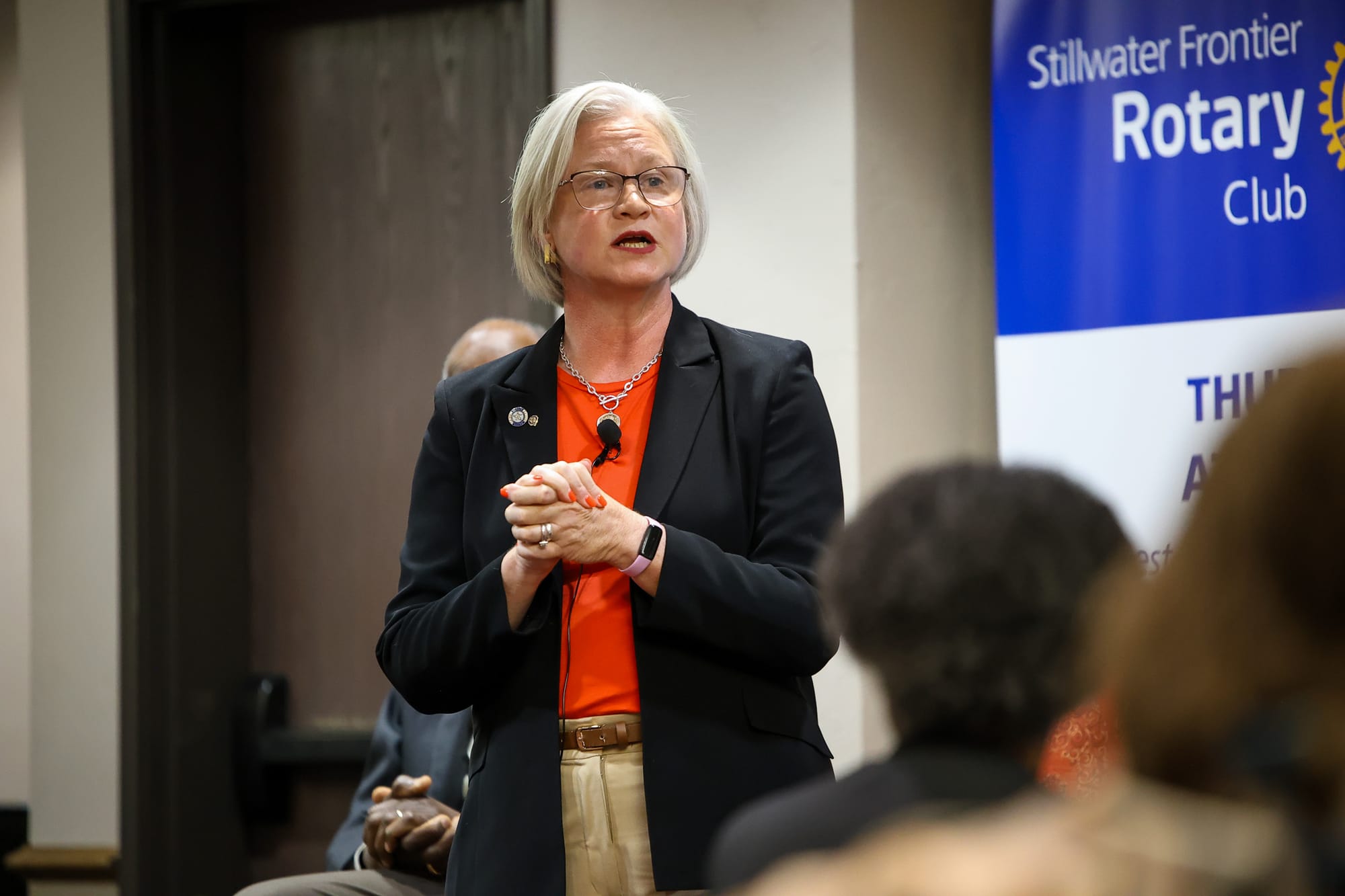
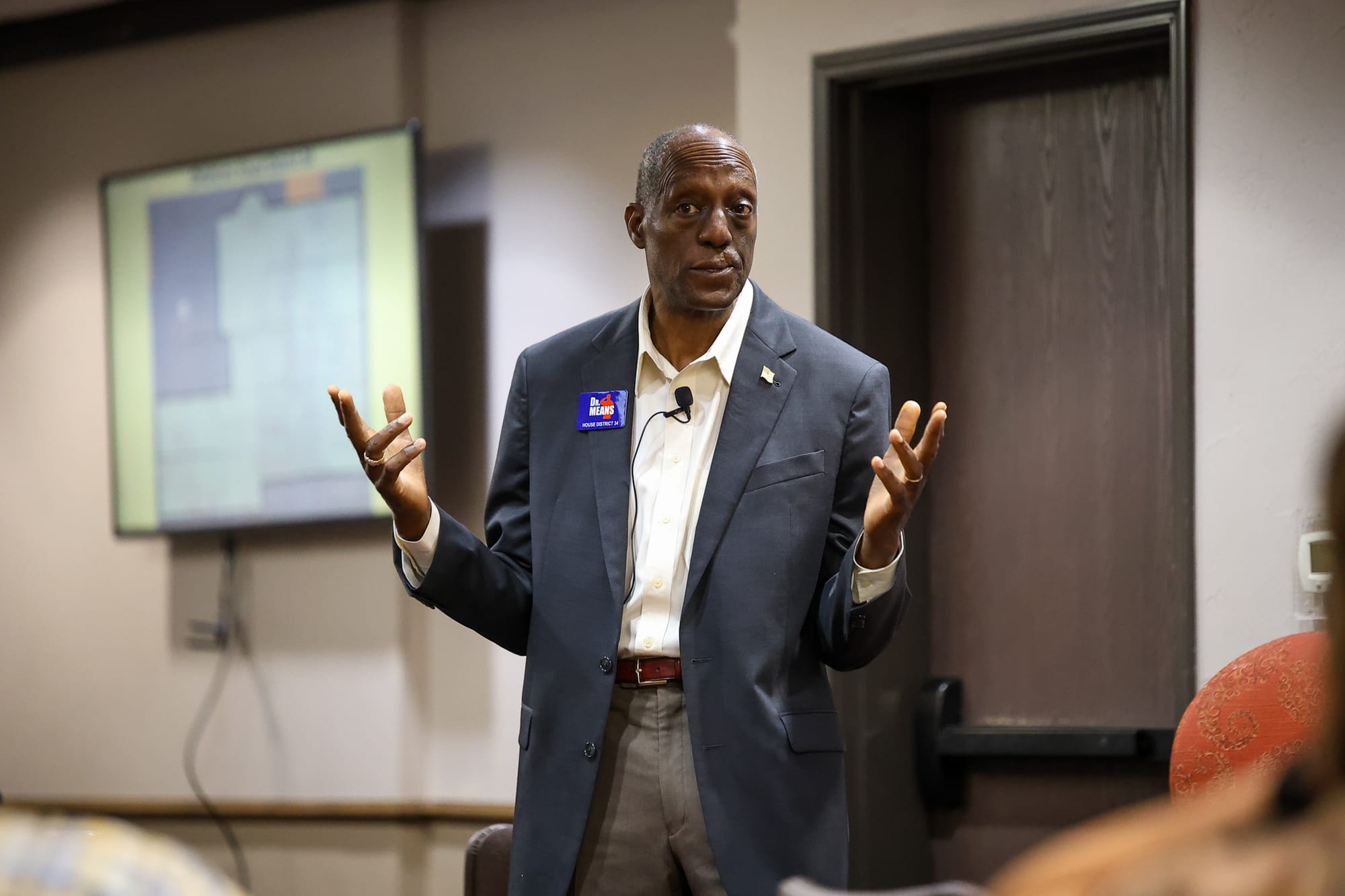
State Rep. Trish Ranson, D-Stillwater, left, and Republican Aaron Means answer questions at the Stillwater Frontier Rotary Club’s House District 34 candidate forum Thursday, Oct. 22, 2026, in Stillwater. – Photos by Chris Peters
Means, 67, is a retired U.S. Public Health Service captain who served 27 years in the Public Health Service and the U.S. Air Force, much of it as a dentist with Indian health clinics in Oklahoma and North Dakota, including as chief dental officer at the Pawnee Indian Dental Clinic. He chaired the Payne County Republican Party from 2020 to 2025, serves as a chaplain for the Stillwater Police Department and directs Una Casa para Oración Cristiana, a prayer ministry in Stillwater. He lost to Ranson by 14.8 percentage points in 2018 and by 5 points in 2020. His 2026 campaign does not have a website.
Means said voters knew little about his beliefs during his first campaign, but that he now has a history in the community and Ranson has a voting record, and "those two things bring a big contrast between the two of us."
"I believe that the family is the core of our society," Means said. He said he stood with parents during a dispute over school bathroom use and that "we finally got that battle won." In his Stillwegian questionnaire, Means said he worked with a small group in Payne County when Stillwater Public Schools faced the issue, and he cited Ranson's vote against Senate Bill 615, the 2022 law requiring public schools to designate multiple-occupancy restrooms by biological sex. House records confirm Ranson voted against the bill.
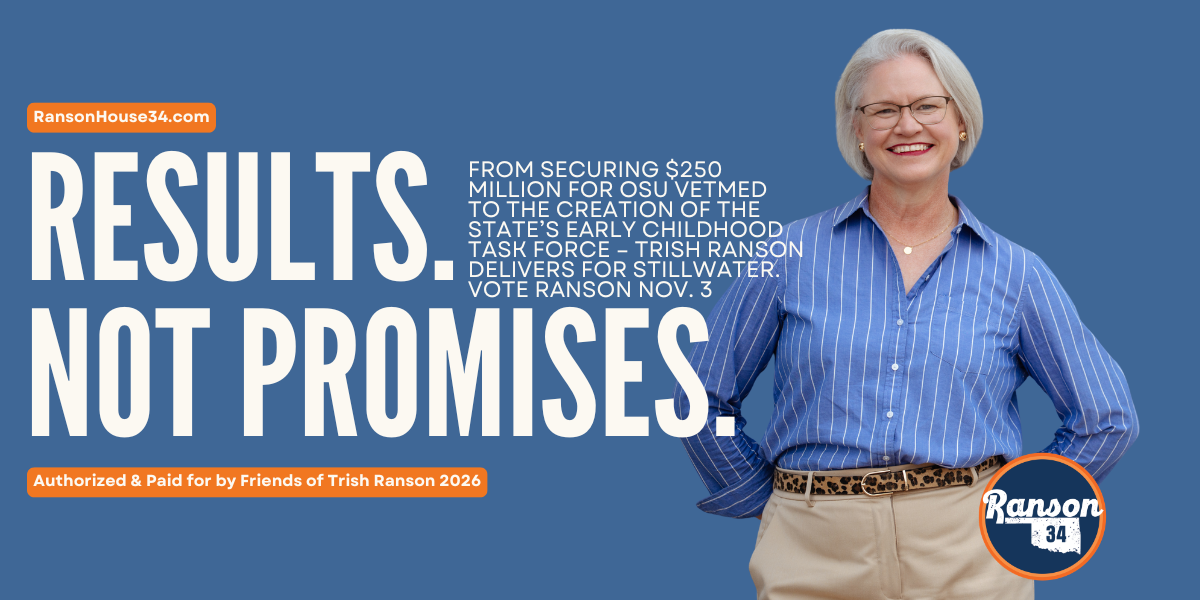
Authorized and paid for by Friends of Trish Ranson 2026
Results. Not Promises. From securing $250 million for OSU VetMed to the creation of the state’s early childhood task force – Trish Ranson delivers for Stillwater.
Means said he supports "active consent" in public schools, meaning parents would give permission before children are exposed to certain material. "I believe parents should be the No. 1 influencer of their children," he said.
Asked by The Stillwegian to respond, Ranson said in an email that she was unclear what Means was implying. She said she has voted on thousands of bills in eight years and that Means has never reached out to discuss votes he agreed or disagreed with. Noting that she and her husband have been married 28 years and have two adult children, she said, "I believe the government should work for all families — not just ones that look like mine."
Judges and property taxes
Two legislatively referred state questions are on the Nov. 3 ballot.
State Question 845 would restructure the 15-member Judicial Nominating Commission, which screens applicants for appellate court vacancies and sends three names to the governor. Under the ballot title, the governor and the Oklahoma Bar Association would each appoint six members based on current congressional districts, any number of commissioners could be licensed attorneys, and party-membership limits on members appointed by the governor and at-large members would be removed.
Means said he initially opposed the measure but now supports it, saying "little steps are better than no steps" and that the goal should be a court system that is not beholden to any agenda on the left or the right.
ADVERTISEMENT
Buying or refinancing in Stillwater? Brittney, Misty and Angelica at the Oklahoma Community Credit Union bring local expertise and competitive rates to every home loan. And unlike many lenders, your loan stays right here — local.
Ranson opposes the measure. She said the commission was created after a 1960s Oklahoma Supreme Court bribery scandal, and the lack of similar corruption since shows the system works. She said the changes would remove safeguards on the commission's partisan balance and attorney membership. "If it's not broken, then we shouldn't fix it," she said. Ranson voted for the resolution that placed SQ 845 on the ballot in 2025.
State Question 847 would lower the annual cap on growth in a property's fair cash value from 5% to 4% for most property, and from 3% to 1.75% for homesteads and agricultural land, beginning in tax year 2027. It would also create tiered caps for homeowners 65 and older whose incomes exceed the current senior freeze limit. The Oklahoma Tax Commission projected local governments would collect $45.78 million less in the first year.
Both candidates oppose SQ 847.
Ranson said the measure offers no plan for replacing funding for public schools, career technology centers and counties. "Do we need tax reform? Absolutely," she said, adding that she did not see the current Legislature taking it on. Ranson voted against Senate Joint Resolution 39, the resolution that placed SQ 847 on the ballot.
Means said property tax reform is needed but should be developed carefully with county officials and legislators. "It needs to be done, but it needs to be done right," he said. He said one main reason for his opposition is the measure's changes to the senior freeze. Under the ballot title, seniors whose household income is at or below the current limit would still see no increase in their homestead's fair cash value, while seniors above that limit — who do not qualify for the freeze today — would get new annual caps of 0.35% to 1.75%, depending on income. Means objected to tying seniors' protection to those income tiers, saying, "I do not believe that we need to drag them back into the whole process."
🗳️
Readers can vote in The Stillwegian's reader polls on SQ 845 and SQ 847 through 11:59 p.m. Friday, Oct. 30.
Asked which ballot state questions belong on, Means said they should go on general election ballots because turnout is larger. Ranson said lawmakers have sent issues to voters that the Legislature should have resolved itself, citing an effort this session to put a Medicaid expansion measure on the ballot that did not get enough votes to advance.
Health care funding
Ranson called health care funding "the biggest issue for this next session after January." She said the CEO of the Elk City hospital told her it expects a $4.5 million cut and could not stay open long, which would leave residents two hours from the nearest hospital. She said about half of Oklahoma's counties lack a birthing center, and that the state may need to draw on reserves she estimated at about $4 billion while it looks for long-term solutions. "It's all of us," she said of the counties affected.
Means said he would bring experts together to define the problem and test solutions, an approach he said he learned in the Air Force. He proposed encouraging doctors, nurse practitioners and physician assistants to practice in rural communities and expanding community health centers. "We have the minds, we have the talent, we have the providers and we can resolve this particular issue," he said.
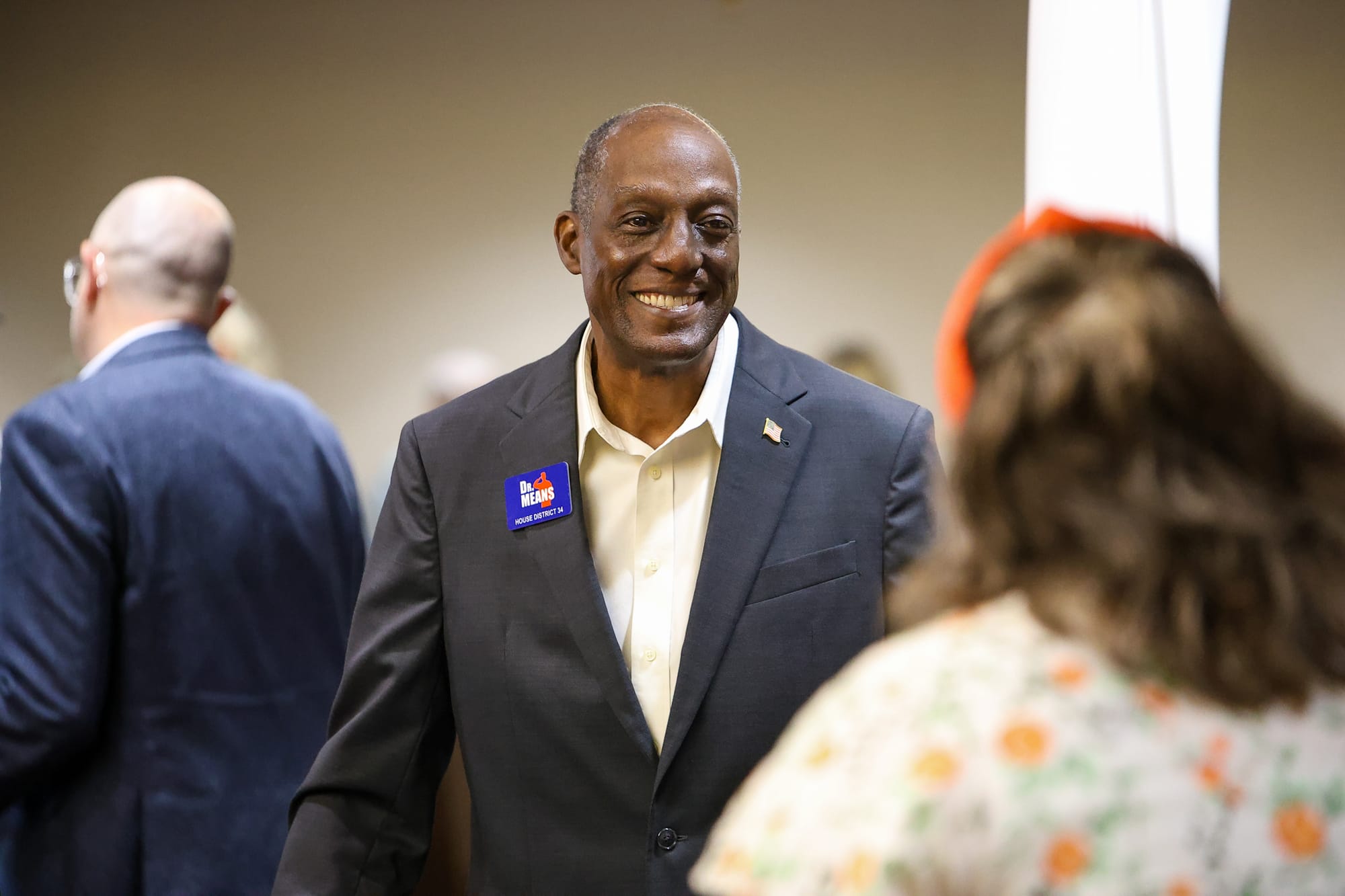
Republican Aaron Means greets an attendee at the Stillwater Frontier Rotary Club’s House District 34 candidate forum Thursday, Oct. 22, 2026, in Stillwater. – Photo by Chris Peters
Retention and religious charters
Senate Bill 1778, signed by Stitt on April 21, brings back mandatory third-grade retention starting in the 2026-27 school year for students who do not meet reading benchmarks, with good-cause exemptions.
Means said students who cannot meet grade-level standards should be retained, but that schools should introduce reading and math fundamentals as early as kindergarten so fewer children reach that point. "Let's find solutions to help every child not get to the place where they would fall into the category of needing to be retained," he said.
Ranson opposes mandatory retention. She described a fourth-grade boy who arrived at school in tears because he did not know whether he had passed the third-grade test, and said early learning should be built on play, music and outdoor exploration. "It needs to start with play. It needs to start with music," she said. She said her early childhood task force will look at school readiness.
On religious charter schools, Ranson said, "I believe that we should have a separation of church and state." She also criticized the state's private school tax credit program, saying private schools do not face the same outcome measures as public schools.
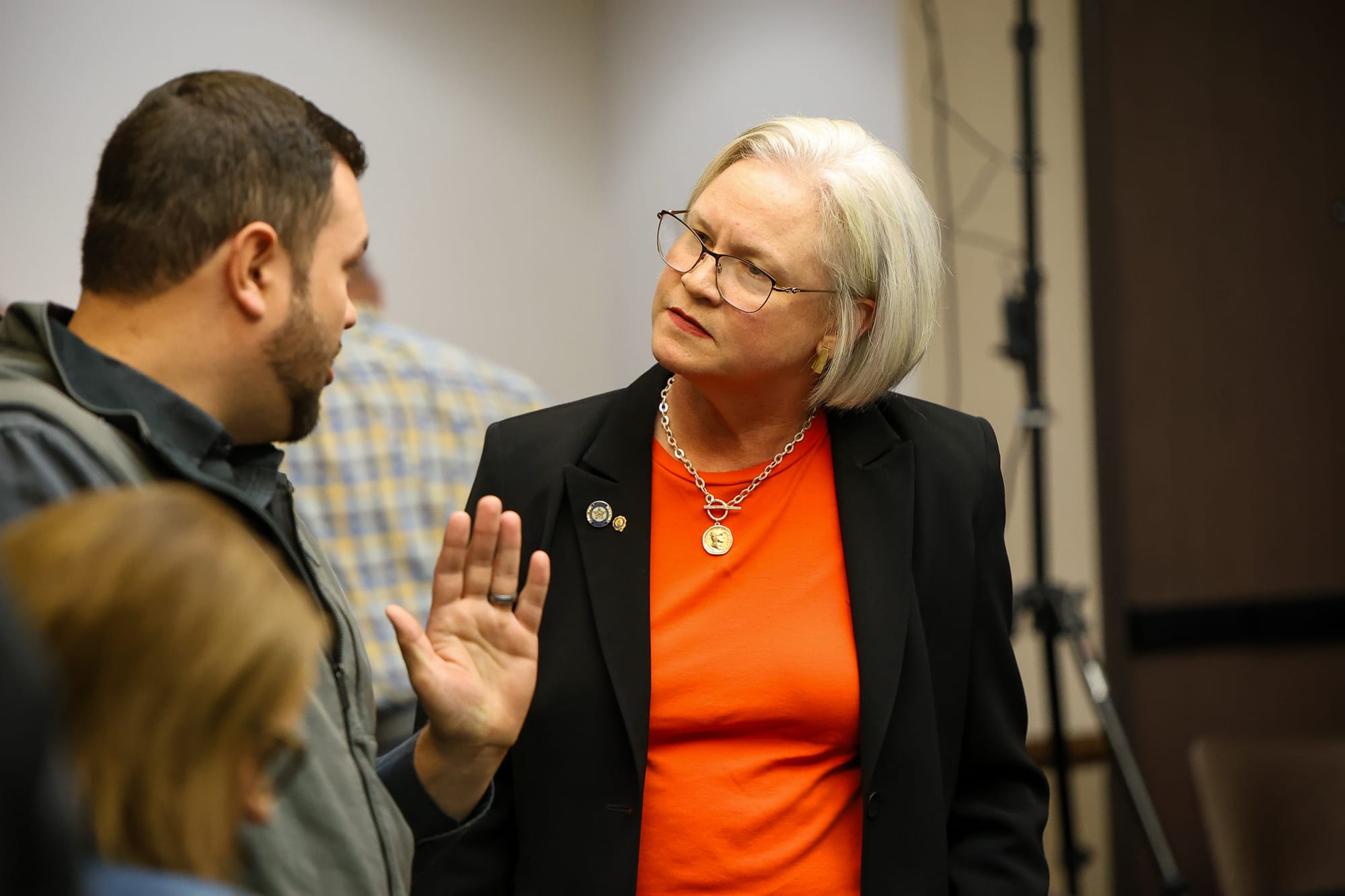
State Rep. Trish Ranson, D-Stillwater, listens to an attendee at the Stillwater Frontier Rotary Club’s House District 34 candidate forum Thursday, Oct. 22, 2026, in Stillwater. – Photo by Chris Peters
Means said parents should be able to move their children to the environment where they learn best, including faith-based schools. "I do not believe that children should have to follow the money," he said. He also said the First Amendment's limits apply to Congress, not to Oklahoma's education system. "It says Congress. It doesn't say the state of Oklahoma educational system," he said.
The U.S. Supreme Court ruled in Everson v. Board of Education in 1947 that the First Amendment's Establishment Clause applies to state governments through the 14th Amendment.
Means did not respond by Thursday morning to questions from The Stillwegian, including one about the Everson ruling.
The Statewide Charter School Board voted 4-3 on Oct. 12 on Ben Gamla Jewish Charter School's application, one vote short of the five required for approval. Attorney General Gentner Drummond issued a binding opinion Oct. 22 that state law does not allow the board a third vote on the application. On Oct. 23, the board voted 7-0 to appeal a federal court order it had originally sought, according to Oklahoma Watch. The board's attorney said the appeal to the 10th U.S. Circuit Court of Appeals is meant to clarify whether the board should follow the Oklahoma Supreme Court's ruling against religious charter schools or the federal judge's order barring it from rejecting Ben Gamla solely because the school is religious.
NDAs and the data center
Asked about local officials signing nondisclosure agreements during early economic development talks, Means said NDAs involving elected officials should have limits. "The No. 1 constituent of an elected official are the people," he said. In his Stillwegian questionnaire, Means said he would support legislation like House Bill 3030, a 2026 bill by Rep. Jim Shaw, R-Chandler, that would have barred public officials from signing NDAs related to their public duties. The bill died in committee without a hearing.
Ranson said she has heard misinformation about the Stillwater data center project while canvassing and that she understands Stillwater city councilors did not sign NDAs.
Stillwater Mayor Will Joyce, a member of the City Council, wrote in a comment on his Oct. 29, 2024, Facebook post about the project that city officials knew the company's identity "but we are under NDAs that prevent public disclosure while the project is being evaluated." He called the agreements standard practice in economic development.
Joyce confirmed to The Stillwegian on Wednesday that he signed a nondisclosure agreement with Kipper LLC, the Google affiliate developing the data center campus. He said he does not have a copy and has not reviewed it since signing. He said he has stated several times that nothing in the agreement has prevented him or other council members from answering questions or discussing the data center project. The Stillwegian has requested copies of the city's agreements.
Asked to respond, Ranson said in an email that she thinks of Joyce as mayor, though he is technically a councilor. "Although he did sign an NDA, I've never heard him respond to a question with 'I can't answer that,'" she wrote. "I apologize if I was misleading in my response."
At the forum, Ranson questioned whether a ban on the agreements would be good policy. "Banning something is a really easy bill to file," she said.
She said cities across the state and the Oklahoma Municipal League are working through how to meet businesses' security needs, which she called a national security issue for projects like the data center, while staying transparent with taxpayers.
"As a state representative, I've never been asked to sign an NDA," she said. In her questionnaire, Ranson said her greatest concern about the data center is the aging water pipeline from Kaw Lake.
ADVERTISEMENT
Shop Stillwater Sundays — Spend $50 at Stillwater shops, restaurants, hotels or attractions the Sunday after an OSU home football game and you're entered to win a $100 gift card to a local business from Visit Stillwater.
Asked what issue they hear most while canvassing, Ranson said education usually tops the list but concerns vary across Stillwater: residents in the southwest worry about eastern red cedar, wildfire and insurance, while those in the northeast raise the data center, water, traffic and damage to a pond in Parkview Estates. She said not every concern calls for legislation.
"It's relationships most of the time," Ranson said. "How can I be that intermediary between constituent and city, between state and city?"
Means said the top issue he hears at the door is the family structure. He said parents want to know their children will not be exposed to materials, festivals or “agendas that will compromise parents’ authority and the innocence of children,” and that he has campaigned hard on protecting parental authority.
Closing statements
Means said he has not accepted money from lobbyists or organizations, including Republican groups. "I'm a Republican because I looked into their platform," he said. He also called for accountability and transparency in how tax dollars are spent.
Ranson cited bipartisan work on funding for Oklahoma State University's veterinary hospital, eastern red cedar eradication and early childhood services. "That is not one-party solution. It's bipartisan," she said. Ranson was among the House authors of House Bill 2773, which appropriated $250 million for OSU's veterinary teaching hospital. She also co-authored House Bill 2988, signed in May, which expands a cedar and invasive woody species removal program from a pilot in the North Canadian River watershed to a statewide program run by the Oklahoma Conservation Commission. The law takes effect Nov. 1. It creates a revolving fund for the program but does not appropriate money to it.
Asked which funding she meant, Ranson said in an email that money for cedar removal was found within the Conservation Commission after the budget was set, and that the revolving fund lets the commission apply for federal grants and provide local grants. "This bipartisan bill got the ball rolling," she wrote.
Fundraising
Ranson has raised more than 20 times as much in new contributions as Means, according to reports filed with the Oklahoma Ethics Commission. Both candidates' most recent reports cover activity through Oct. 19, when Ranson reported $59,352.53 in cash on hand and Means reported $2,902.48.
Ranson's committee has reported $151,316.89 in receipts this election cycle, including $29,918.15 transferred from her 2024 campaign committee, leaving $121,398.74 in new contributions. Individual donors gave $91,098.08. Political action committees representing business, professional, labor and education groups gave $25,000.66, two tribal nations gave $5,000 and the Democratic Party of Oklahoma gave $300. Her campaign reported an additional $2,000 PAC contribution received Oct. 22, after the reporting period closed.
Ranson has spent $91,964.36 this cycle. Her largest expense has been payroll for four campaign staff members, about $23,700 combined, followed by $12,279.60 for fundraising and financial consulting. From Aug. 11 to Oct. 19, her campaign spent nearly $22,000 on advertising, mailers, printed literature and yard signs. Her committee also gave $1,500 to six other state House candidates.
Means has reported $5,939.78 in contributions since forming his committee in May, plus a $150 in-kind contribution of food and supplies. He put $2,000 of his own money into the campaign, and individual donors gave $3,307. His filings show no contributions from political action committees or party organizations. Two other legislative candidates' campaign committees gave $632.78.
Means has spent $3,037.30 this cycle. His largest expense was $1,620 for newspaper advertising. He also paid $625 in filing and ethics fees and $370.30 for printing.
Both campaigns' filings are available through the Ethics Commission's Guardian system: Ranson's committee and Means' committee. Their next reports, covering Oct. 20 through Dec. 31, are due Jan. 31, 2027.
Disclosure: Ranson's campaign paid The Stillwegian $1,200 for online advertising in September and has purchased paid content on her candidate profile. Advertising and Paid content is available to every candidate.
How to vote
Early voting continues 8 a.m. to 6 p.m. through Friday, Oct. 30, and 8 a.m. to 2 p.m. Saturday, Oct. 31, at the Payne County Expo Center, 4518 Expo Circle East in Stillwater, and the Cushing Chamber of Commerce, 1301 E. Main St. in Cushing. On Election Day, Nov. 3, polls are open 7 a.m. to 7 p.m. Voters can find their polling place at okvoterportal.okelections.gov.
Read both candidates' full questionnaire responses on their Stillwegian profiles: Trish Ranson and Aaron Means.
📺 Watch the candidate forum
Share this article
The link has been copied!
Members Discussion
Your link has expired. Please request a new one.
Your link has expired. Please request a new one.
Your link has expired. Please request a new one.
Great! You've successfully signed up.
Great! You've successfully signed up.
Welcome back! You've successfully signed in.
Success! You now have access to additional content.