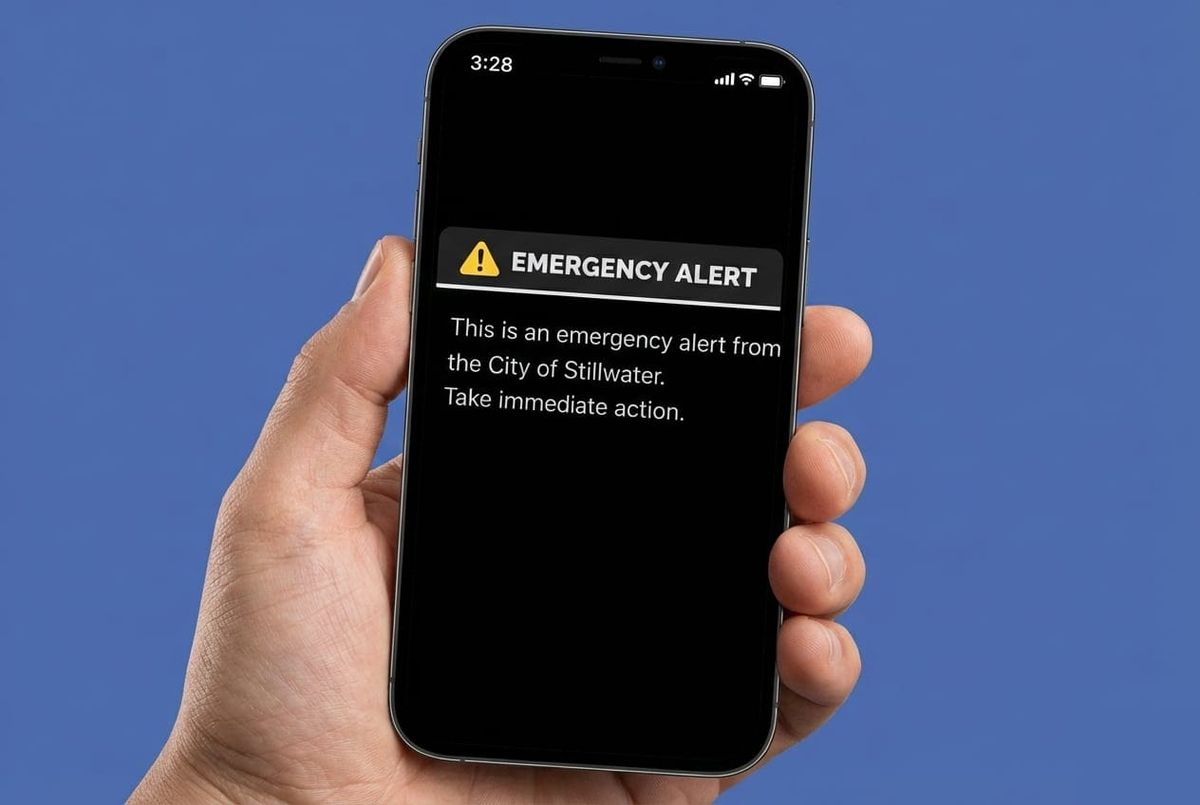
Council approved FEMA emergency alert agreement after member pulled item for public explanation

Subhead: Stillwater gained access to system that pushes alerts to all cellphones in a targeted area, without requiring opt-in

The Stillwater City Council approved a memorandum of agreement Monday with the Federal Emergency Management Agency (FEMA) to give the city access to the federal emergency alert system that pushes notifications directly to cellphones — no sign-up required — in a targeted geographic area.

The vote was 5-0, but not before Council Member Kevin Clark pulled the item from the consent docket to give the public a fuller explanation of what the agreement does and why the document itself could not be included in the agenda packet.

Stillwater City Councilor Kevin Clark speaks during the Feb. 23 city council meeting. Clark pulled the FEMA emergency alert agreement from the consent docket to allow a public explanation before the council voted 5-0 to approve it

Clark said the memorandum of agreement with FEMA's Integrated Public Alert and Warning System, known as IPAWS, was subject to an official-use-only designation that exempts it from the Freedom of Information Act — meaning the public could not view the underlying document.

"I think we have an important topic here, [so] that people understand what we're doing, why we're doing it, what it's going to cost us, and the benefit we're going to see from this," Clark said.

Rob Hill, Stillwater's director of emergency management, then walked the council through the system. IPAWS, he explained, is the same federal infrastructure behind AMBER Alerts, Silver Alerts, and Blue Alerts that appear automatically on cellphones, television, and radio.

"As a result of March 14, 2025, we looked at mitigation measures that would help us better be connected and communicate with our community," Hill said. "And one of the things that we said was we need to be able to activate IPAWS."

SPONSORED
CTA Image

Daily Essentials by Axios
Get the news that matters in your inbox:

  • AM gets your Smarter, Faster on the morning's important news. PM catches you up on the biggest stories of the day. Finish Line gives you tips from leaders in tech, business and culture before you head off to bed.
Subscribe for free

The March 2025, wildfire tore through portions of Stillwater under high winds and dry conditions, destroying homes and infrastructure and forcing evacuations. According to the city staff report, the fast-moving fire exposed critical gaps in how Stillwater reaches residents during emergencies. The city's existing mass notification system, operated through a platform called RAVE, relies on residents opting in — and those who have not signed up cannot be reached through it.

IPAWS operates differently. Hill described how emergency managers log in, draw a geofence around a map — an outline of the affected area — and send an alert to every cellphone within that boundary, regardless of whether the user has signed up for any local notification service.

"We would notify them and send this message out to them, and then basically it tells them who's sending the message, what the threat is, what we want them to do as a result of it, where we want them to go if it's an evacuation notice," Hill said. "And we can continue to update them through the process."

Clark pressed Hill to clarify the opt-in question directly.

"This is not an opt-in, opt-out thing," Clark said. "If you're in the geofenced area, you're going to receive these messages."

Hill confirmed that, with one caveat: users who have manually disabled emergency alert categories on their phones — such as turning off AMBER Alerts in their device settings — would not receive the messages. Otherwise, alerts reach everyone in the targeted area.

Hill also outlined the city's approach to layering its notifications during a future emergency: alert residents most directly threatened first, then expand the message to the broader community to keep people away from affected areas and inform them of shelter locations and other resources.

"Whatever we feel is necessary for them to protect themselves and their property in the future," Hill said.

Clark also said the city would use IPAWS strictly for emergencies — not general community announcements.

"We're not going to use it for, hey, we've got a big activity in the park this weekend," Clark said. "This is for emergency purposes."

ADVERTISEMENT
CTA Image

Submit Your Receipts by Friday, Feb. 27

Upload any Stillwater purchase receipt from Presidents' Day week by Friday, Feb. 27 to enter for your chance to win a $250 American Airlines gift card. Drawing will be March 2.

Got Your Receipts? Enter Now

Hill said Stillwater's emergency management staff spent months preparing for this step — taking required courses, passing tests, and submitting training certifications to Motorola Solutions, which now owns the RAVE system the city already uses. The one-time activation fee is $1,200, drawn from the Emergency Management office's operations and maintenance budget.

Mayor Will Joyce said he was glad Clark had flagged the item.

"I think there were a lot of folks in town last year who felt like we were surprised that we didn't already have that, and we all learned a little bit about how these systems actually work," Joyce said. "And it's not something that is automatic, and the fact that you all put in the time and effort and the training to be prepared so that we can utilize this system going forward is really important, and we appreciate that."

Hill also gave the council a preview of what comes next. He said emergency management has taken a second mitigation step following last year's wildfire, and planned to present it at the council's March meeting. He did not detail the specifics, saying only that it would involve the city's public information, leadership, and public safety components.

"We're going to save that one for next time," Hill said.

With IPAWS access now authorized, Stillwater joins more than 1,600 federal, state, local, tribal, and territorial alerting authorities across the country that use the FEMA-managed system to issue critical public warnings in their jurisdictions, according to FEMA.

📺 Watch the presentation to City Council

Share this article
The link has been copied!