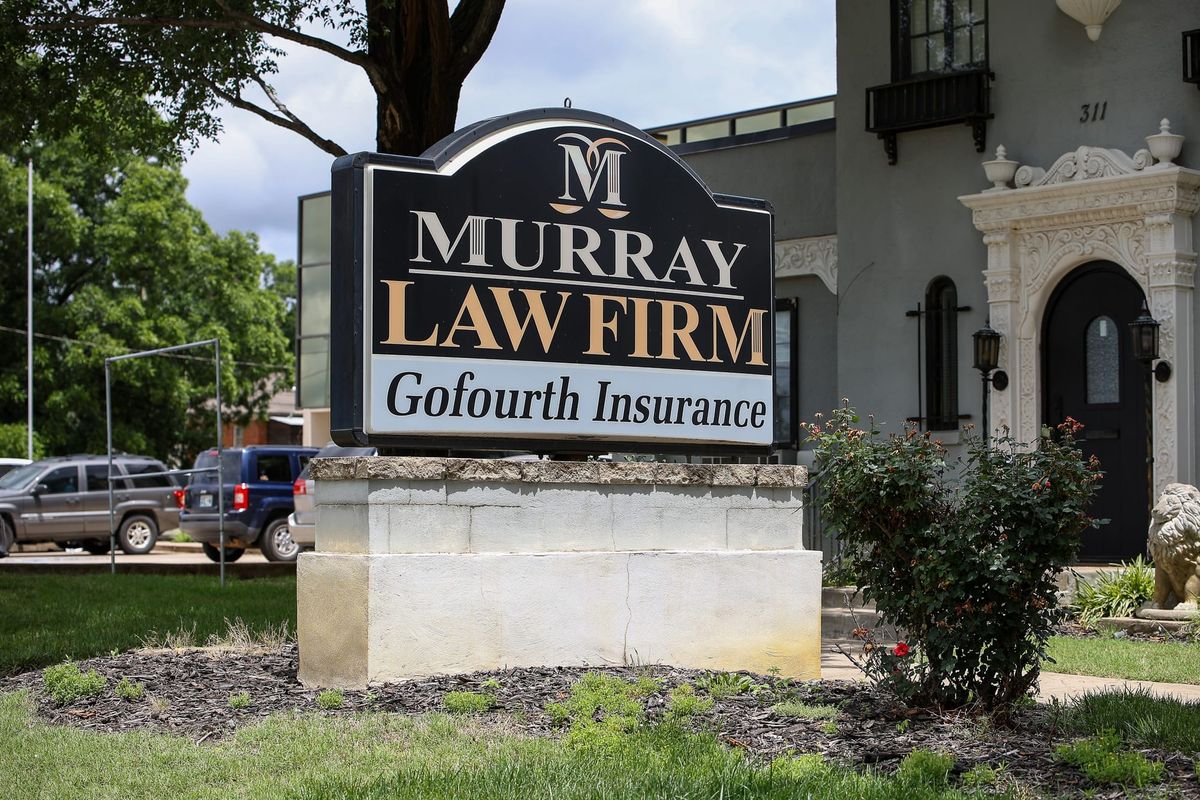
The Stillwater Planning Commission voted unanimously May 19 to recommend approval of a specific use permit that would allow Murray Law Firm to install an electronic message center sign at its office at 311 S. Duck St.
The 5-0 vote sends the permit to the Stillwater City Council, which is scheduled to take up the item June 1.
The sign would be added to the firm's existing monument sign and consists of a 3-foot-by-8-foot static cabinet panel displaying the firm's name and logo above a 4-foot-by-8-foot LED electronic message center panel. Attorney Jamie Murray, who has operated at the location since 2012, told commissioners he envisioned the sign serving as a community bulletin board for local events, and wanted to display time and temperature — a feature he said is absent from Duck Street.

Murray said he also had a specific hope for the Fourth of July.
"I've always wanted to have a sign that on the 4th of July I could put a flag waving on that so people would know it's the 4th of July," Murray said.
That ambition ran into an immediate obstacle. Senior Planner Henry Bibelheimer told commissioners the city's sign code requires static images and that a waving flag would not be permitted.
"I believe it says that images have to be static, and they have to be on the screen for at least 8 seconds," Bibelheimer said. "So you can't have messages, like a movie, scrolling across the screen."
Commissioner Mark Prather pushed back gently. "I don't think the flag can wave," Prather told Murray. "It doesn't have to be static. It can't wave?"
Chair Jana Phillips confirmed: "It can't wave."
Build It Right — Start Local
🪜 Tools, lumber, and job-site essentials backed by local expertise. Stillwater Building Center helps homeowners and contractors get projects done right the first time. 📞 405-372-5959
Murray took it in stride, joking he might need to start a petition. "I'm going to double-check on this waving flag," he said before leaving the podium.
Neighbor William Hadaway, whose family owns property on Duck St., had come to the meeting to oppose the sign but said the restrictions outlined by staff addressed his concerns.
"I didn't like the idea of animated images, but if he wants to have a waving flag on the 4th of July, I would not complain," Hadaway said.
At the close of the hearing, Bibelheimer acknowledged he may have cited the wrong standard.
"I will have to double-check because I'm reading through the code and it doesn't actually say the 8 seconds," he said. "That was from a different code. So we'll confirm. We'll work with Mr. Murray."
In a follow up email, The Stillwegian asked Bibelheimer to clarify the applicable standard. In a written response, he confirmed the error.
"The 8-second static image is from a different city's code, and does not apply in the City of Stillwater," Bibelheimer said. "A waving flag on an electronic message center sign would be allowed by Section 23-186.m(8) as long as the video is not longer than 10 seconds."
ATTN Employers: If you're recruiting top talent, getting candidates here is half the battle. The Community Marketing Grant helps Stillwater employers offset travel costs for prospective hires flying in through Stillwater Regional Airport.
Bring them to town, show them what Stillwater has to offer, and let the community close the deal. 🤠
Section 23-186.m(8) of the city's Land Development Code permits recorded video on electronic message center signs provided each sequence runs no longer than 10 seconds. The section does not require static images, though it prohibits audio and live streaming video.
The code also bars the sign from displaying words such as "stop," "go," "slow," or "danger" that could be confused with traffic control signs. And the sign must be equipped with photosensitive technology that automatically dims the display as ambient light decreases — a requirement Murray acknowledged at the meeting, saying he was aware the sign would need to tone down after dark.
The permit was required because the property sits in Transect Zone 5 of the Corridor Redevelopment Area Planning District, which governs signage under Office District standards. Under city code, electronic message center signs in the Office District require a specific use permit regardless of proximity to residential uses — a lower threshold than other commercial districts, where the permit is triggered only when a property abuts a residential zone.
Bibelheimer said the requirement reflects the Office District's lower-intensity character and its tendency to appear near residences. Assistant City Attorney Kim Payne said the approach is common elsewhere.
"It is very common in other cities as well to have the same requirement of a specific use," Payne said. "So it's left on a case-by-case basis determining where it's located versus a residential neighborhood."

If installed, the Murray sign would be the second electronic message center sign on Duck Street, joining one at the United Methodist Church at the corner of 6th Avenue and Duck Street. That sign runs parallel to Duck Street and is oriented toward east/west traffic on U.S. Highway 51.
The Murray sign, positioned perpendicular to Duck Street, would be the first electronic message center sign oriented toward north/south Duck Street traffic. By comparison, Main Street — which runs three blocks to the east — has 10 such signs from 12th Avenue to Hall of Fame Avenue.
📺 Watch the presentation to Planning Commission