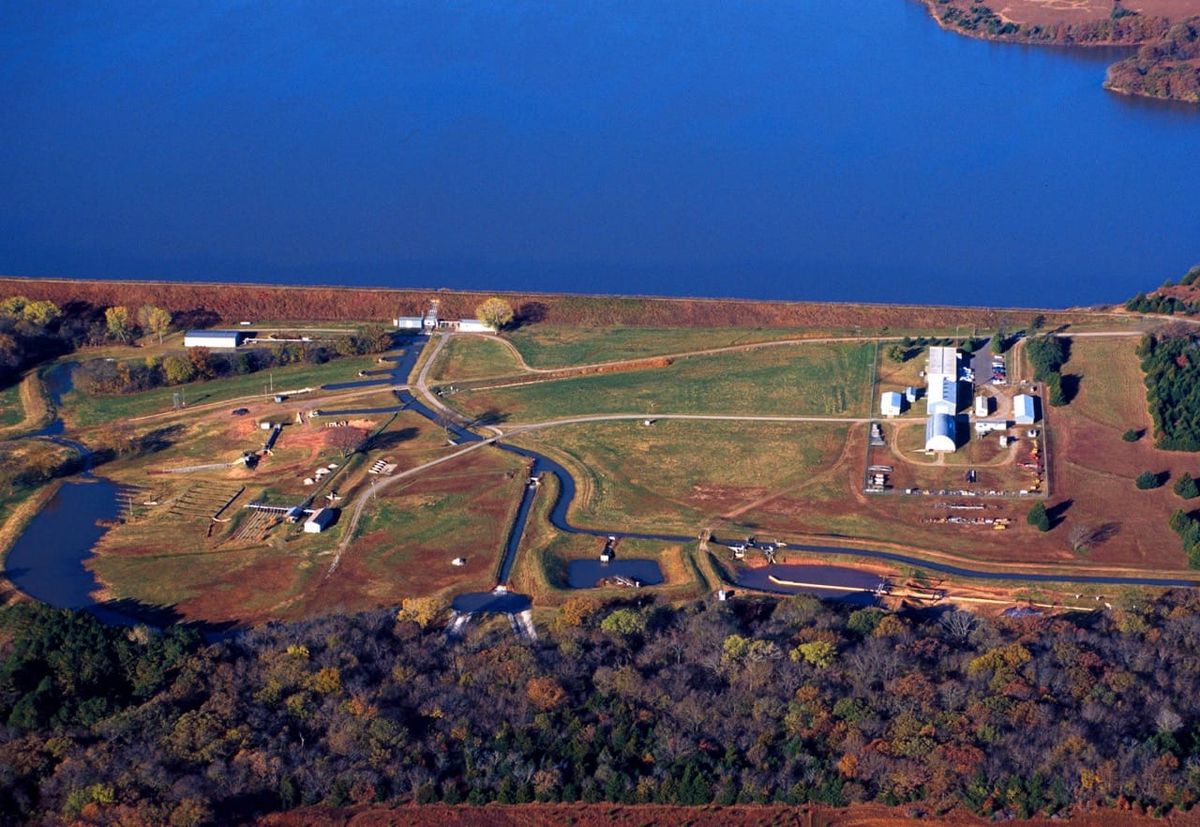
Oklahoma State University engineers told a Stillwater civic group this month that repairing the Lake Carl Blackwell dam will cost $22 million — and that the university has no funding secured to do it — as a former Stillwater city manager continues to push OSU and state regulators for more aggressive action on the 89-year-old structure.
Carl Weinaug, who served as Stillwater's city manager from 1983 to 2003, sent a letter in January 2026 to OSU leadership outlining six specific actions he is asking the university to take regarding the dam's safety. Weinaug has spent months building public awareness through a Facebook page called Protect Stillwater OK and a website, dambreachmap.com, arguing that decades of documented warnings about the dam have gone without adequate response.
OSU engineers Brandon Neal, the university's director of energy services, and Casey Shell, chief facilities officer, laid out the dam's condition and funding status at a presentation to the Stillwater Frontier Rotary Club on Wednesday, April 16.
"The odds today of that dam breaching — knock on wood — of there being some movement on the dam, are incredibly low," Neal told the Rotary audience. "But it still deserves attention because the consequences are so high."
OSU, in a written statement to The Stillwegian, said the rehabilitation need is urgent while maintaining no imminent threat exists. "Rehabilitating the dam is an urgent priority," the statement said.
What 'poor' means — and what it doesn't
The dam, an earthen structure roughly a mile long built in 1937 and 1938, sits approximately six miles west of Stillwater on Stillwater Creek. It is owned and operated by OSU and provides drinking and irrigation water for the university campus, supports recreation, and serves as the site of university, state, and federal research.
Its "poor" condition rating stems from seepage, past soil movement, and slopes that don't meet modern engineering standards, OSU said. The dam's downstream face, at roughly a 1-to-1.5 ratio, is steeper than the modern standard of 1-to-2.
"We've had a good hard rain event, and we had a little soil movement," Neal said at the Rotary presentation. "The whole dam didn't move. It just kind of bellied out a little bit, and that's not good."


Left: Construction of the Lake Carl Blackwell dam in 1937, showing steam-powered equipment used to build the earthen embankment. Center and right: The dam's concrete spillway during high water conditions, photographed June 15, 2025. The dam has been rated "poor" by national dam safety standards due to the steepness of its downstream face. – Photos courtesy Oklahoma State University
Neal elaborated on what drives the condition rating. "It is just steeper than what we would call modern standards," he said. "Even that would be okay if we hadn't had some issues with it moving a couple of times."
Shell said the proposed backslope project — which would rebuild the downstream face to a 3-to-1 grade — has been fully designed and is ready for construction the moment funding is in place.
The dam's "high hazard" classification is separate from its condition rating and reflects potential downstream consequences if the dam were to fail, not the likelihood of failure. Because Stillwater sits downstream, the dam carries that designation regardless of its condition.
"If that dam were brand new today and in perfect condition, it would still be considered a high hazard dam," Neal said.
Nationally, more than 16,700 dams carry a high hazard classification. Of those, approximately 2,500 — about 15 percent — are rated in poor or unsatisfactory condition, according to the Association of State Dam Safety Officials. In Oklahoma, the Oklahoma Water Resources Board lists roughly 40 dams statewide in poor or unsatisfactory condition.
Big-box stores can't custom-fit a door to your opening. Stillwater Building Center's in-house door shop can — and their window prices undercut national companies by half or more.
A project ready to build, with no money to build it
OSU applied for and received a Federal Emergency Management Agency High Hazard Potential Dams grant in 2019 — the first year that grant program was available in Oklahoma — which funded the geotechnical analysis and construction drawings for the backslope rehabilitation. Those drawings are complete and ready for construction, OSU said.
But the scale of the project has outpaced available grant funding. Natalie Orbesen, P.E., dam safety program manager for the Oklahoma Water Resources Board, which administers the FEMA grant program in Oklahoma, said the state's highest-ever allocation under that program was just over $1 million in 2022. Prior years ranged from $200,000 to $400,000.
"They've applied for all of the grant programs that I work on to get funding for the project," Orbesen said. "They've not left any money on the table — it's just not enough money on the table."
OSU also applied for dam rehabilitation funding under the American Rescue Plan Act but could not accept the grant, which had a maximum award of $1 million, because recipients were required to demonstrate they had full project funding in place — a threshold OSU could not meet.
When asked at the Rotary presentation whether the project could be phased to accommodate smaller funding increments, Neal said no. "Unfortunately, we're down to the part that has to be done all at once," he said. "The vast majority of that is the earthwork."
OSU said it is actively pursuing both grants and legislative support and has guided congressional delegation tours of the dam site. Shell mentioned at the Rotary presentation that the university also plans to approach the City of Stillwater and Payne County as potential funding partners.
The funding struggle has deep roots. Shell referenced efforts by then-U.S. Rep. Wes Watkins as early as 2003 to secure federal money for the dam, adding that OSU lacked matching funds at the time even when some federal dollars were within reach.
"It's been on our list for a long time," Shell said, "and we continue to fight the fight."
The U.S. Natural Resources Conservation Service, which administers federal watershed rehabilitation programs for hundreds of aging dams across Oklahoma, confirmed to The Stillwegian that Lake Carl Blackwell does not fall under any NRCS watershed project, because NRCS was not involved in the dam's original construction. Funding for the project, an NRCS official said, would need to come elsewhere.
What failure would mean
Lake Carl Blackwell holds approximately 61,500 acre-feet of water across 3,370 surface acres. By comparison, Kaw Lake — Stillwater's primary municipal reservoir — holds more than 428,000 acre-feet across 17,000 acres. Neal noted at the Rotary presentation that emptying Lake Carl Blackwell entirely into Kaw Lake would raise that lake's level by roughly four feet. The dam sits at the head of a 75-square-mile watershed.
OSU facilities management engineers inspect the downstream face of the Lake Carl Blackwell dam on February 25, 2026. The slope, steeper than modern engineering standards allow, is the primary driver of the dam's national "poor" condition rating and the focus of a $22 million rehabilitation project OSU has no funding secured to complete. – Photos courtesy of Oklahoma State University
OSU monitors the dam closely. Staff walk the structure weekly, a survey team tracks specific points monthly using precision equipment, a licensed civil engineer conducts a formal annual inspection, and OSU partners with the Oklahoma Aerospace Institute for Research and Education to conduct drone inspections. When water flows over the spillway — which happens once or twice a year — the university increases inspections to daily visits.
"No matter what's happening in the world, we're sending somebody from our utilities production team out," Neal said.
OSU also maintains the dam through ongoing vegetation management, plugging animal burrows, grass cover maintenance, concrete spillway repairs, and rock armoring restoration.
The dam has two issues being addressed separately from the backslope project: a seep on the dam face that OSU is working with an engineer to address with a drain system, and a base tunnel the university plans to seal.
If the dam were to fail catastrophically, Neal said floodwaters would follow Stillwater Creek downstream — flooding a path wider than the standard 100-year floodplain all the way to Ripley, roughly 22 miles away.
Weinaug's research, drawn from OSU's own 2007 Emergency Action Plan and Payne County assessor data, puts specific numbers to that scenario. He estimates a breach would inundate 3,450 homes, OSU student rentals, and businesses across more than 22 square miles, with floodwaters traveling at 4 to 6 feet per second and reaching the first downstream properties within roughly an hour. Total appraised value of property in the inundation zone, according to Weinaug's analysis of county assessor records, is approximately $1.2 billion. The Stillwegian did not independently verify those figures.
Monitoring, emergency planning, and what's in place
OSU updates its Emergency Action Plan annually and submits it to the OWRB and the Oklahoma Office of Emergency Management. Payne County Emergency Management and Stillwater Emergency Management also receive updated copies as changes are made, OSU said. The plan is current as of March 2025. A tabletop exercise of the plan — bringing together the agencies involved in a simulated dam emergency — was completed in May 2023. The next exercise is planned for 2028.
Orbesen confirmed the EAP was updated in 2024. All high hazard potential dams regulated by OWRB are required to have an emergency action plan, she said.

The dam's breach inundation map dates to a 2007 engineering study. OSU said the methods used remain current and that while some downstream development has occurred since then, the results would not be substantially different if the study were redone today. Orbesen said the inundation area itself is unlikely to change significantly since the volume of water behind the dam hasn't changed, and that in an actual emergency the 2007 extent data would be overlaid on current aerial imagery.
Orbesen said OWRB has worked with OSU on the dam since 2019 and characterized the university as actively engaged. "They are definitely taking the steps to find the funding and to monitor the dam and make sure that it continues to operate as it's supposed to," she said.
A former city manager pushes for action
Weinaug has framed his campaign not as opposition to OSU but as an effort to push the university and regulators toward action he argues has been deferred too long.
In a November 2025 Facebook post, he wrote that for 20 years, local, state, and federal agencies had encouraged OSU to take proactive measures on the dam, and that OSU's own 2021 geophysical study identified areas of instability and recommended further study. "That was four years ago," he wrote. "Nothing has happened."
OSU and Weinaug offer differing accounts of what the 2021 study represents. Weinaug has characterized it as a safety evaluation that identified internal structural concerns requiring follow-up. OSU said the study was a research project comparing nondestructive electronic testing methods to traditional physical testing — not a safety evaluation — and that its findings support the use of geophysical methods as an initial screening tool, not a substitute for physical boring and testing. "The standard of design remains physical sampling of materials through boring and physical testing of the materials," OSU said. "This is the basis of design for our current dam rehabilitation project."
Weinaug also cites a 1995 engineering study by Benham-Holway that he says found the dam failed minimum safety factor standards across multiple failure modes, including internal erosion, seepage, and piping. OSU's current rehabilitation design is based on the more recent EST Inc. geotechnical analysis funded by the 2019 FEMA grant. The Stillwegian did not independently review either study.
Orbesen said she has corresponded with Weinaug regularly and had one phone conversation with him. "I'm happy anytime there's a story about dam safety," she said. "I just want to make sure the information is correct."
Weinaug's January 2026 letter to OSU leadership lays out six specific requests: commission an updated geophysical evaluation of the dam's interior; update the 2007 breach inundation map; develop a unified multi-jurisdictional Emergency Action Plan with the City of Stillwater and Payne County; deploy advanced monitoring systems; include OSU's dam safety commitments in the Payne County Hazard Mitigation Action Plan; and formally notify OWRB of OSU's readiness to participate in state funding programs.
📺 Watch OSU Engineers Presentation to Stillwater Frontier Rotary