Morris Brings Old-School Grit, Family Values to Oklahoma State – Roundtable analysis of new football coach's debut
The Stillwegian's Daniel Allen and Chris Peters discuss Morris' fit, his coaching philosophy and the road ahead after OSU's first coaching change in more than two decades
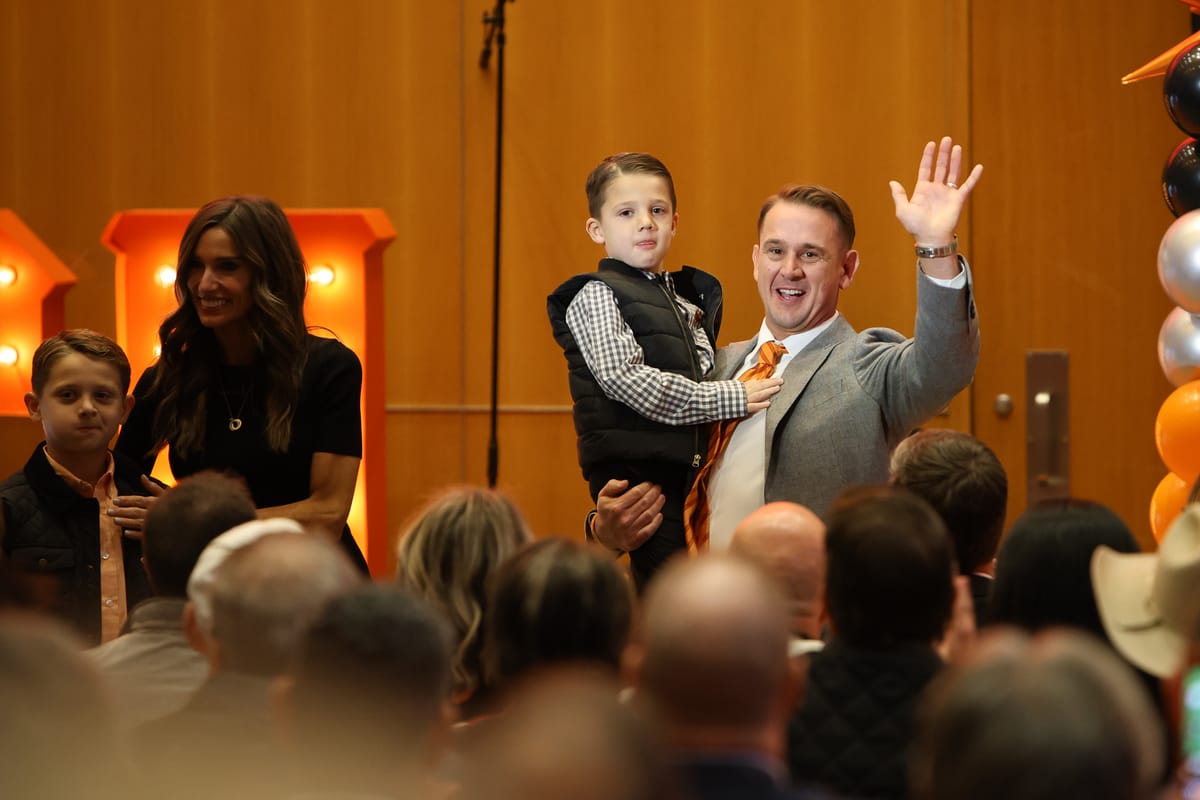
Oklahoma State head coach Eric Morris waves to the crowd while holding his son George during the Dec. 8, 2025 introductory press conference at the OSU Alumni Center. Morris' wife Maggie and their son Jack also joined him on stage as the Morris family was welcomed into the Cowboy family. Morris emphasized throughout the event that family comes first and that his children will attend Stillwater Public Schools. – Photo by Chris Peters
Oklahoma State head coach Eric Morris waves to the crowd while holding his son George during the Dec. 8, 2025 introductory press conference at the OSU Alumni Center. Morris' wife Maggie and their son Jack also joined him on stage as the Morris family was welcomed into the Cowboy family. Morris emphasized throughout the event that family comes first and that his children will attend Stillwater Public Schools. – Photo by Chris Peters
A new era of Oklahoma State football is underway.
Last Monday, OSU officially introduced Eric Morris as its new coach. Morris, 40, who spent three seasons at North Texas and recently guided the Mean Green to an 11-2 campaign and an appearance in the American Athletic Conference Championship game, will succeed former OSU coach Mike Gundy after 21 seasons at the helm.
Still, a multitude of questions linger ahead of what is expected to be an eventful offseason for the Cowboys. That is where we come in.
Below are five thoughts and takeaways from The Stillwegian's Daniel Allen and Chris Peters on Morris' hiring and what we have learned so far.
What did Morris' introductory press conference reveal?
Allen: Morris dazzled and stole the spotlight moments into his introductory press conference.
His poise and enthusiasm impressed. He seemed to give a satisfactory answer to any question asked, especially when referring to rival Oklahoma as "the school down south" and expressing a willingness to bring back the Bedlam football game. He seemed like a seasoned Stillwegian — no pun intended — rather than a coach addressing OSU fans, administrative officials and media members for the first time.
He emphasized grit, effort and discipline while shedding light on his high-octane, up-tempo offensive philosophy. All of which should gel perfectly in the Big 12.
Morris showed he's a fit for the OSU job, even if it entailed replacing the school's all-time winningest coach. Of course, it's a small sample size with no on-the-field results to prove anything. But introductory press conferences can reveal enough. And if anything, it showed athletic director Chad Weiberg made yet another splash hire.
Peters: Confidence. Not just from Coach Morris but from those who shared the stage with him. As athletic director Chad Weiberg pointed out, "This has not happened here in over 20 years," referring to the last time the football program stepped into a new era under a new coach. We saw the Cowboy family at its best in welcoming Morris and his family with open arms.
It was clear from the beginning that family comes first to the Morrises. In Coach Morris' words, when evaluating any job opportunity, he starts with two questions: "The first one is personal, right? Does this align with my values and who I am as a person? And ultimately, is it a place where I want to live? And number two is professionally, right? And professionally, for me, it's as simple as this. Can we win a championship there?"
Morris made his commitment to Stillwater abundantly clear when he said, "There perhaps is not a better place than Stillwater, Oklahoma, for me wanting to raise my family right now." He emphasized that "my kids will be going to the Stillwater Public Schools. It's something we believe in." His emphasis on family values and community integration showed he understands what makes Stillwater special.
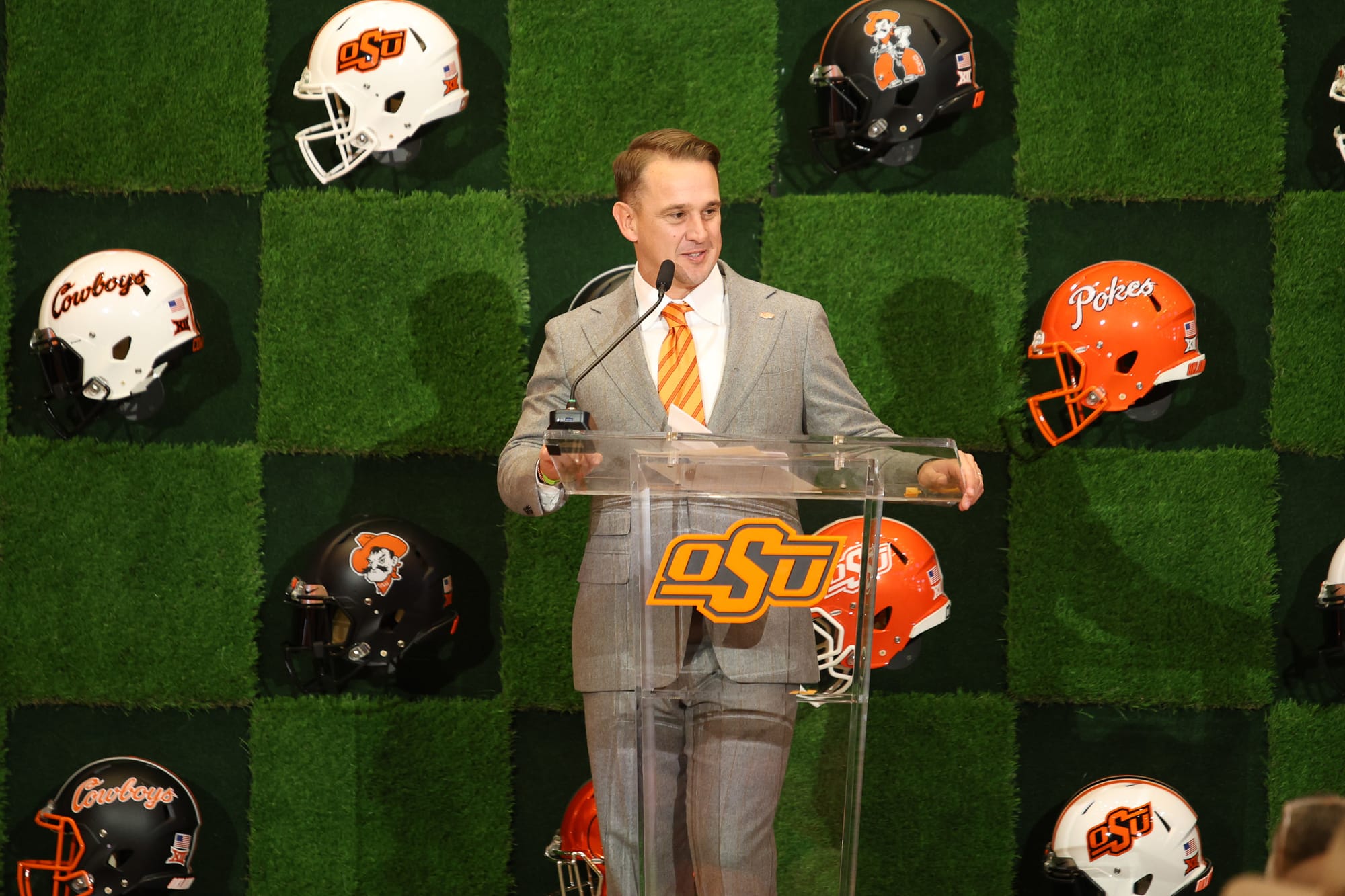
Oklahoma State head coach Eric Morris addresses the crowd during his introductory press conference Monday, Dec. 8, at the OSU Alumni Center. Morris, 40, takes over the program after Mike Gundy's 21-season tenure as head coach. The Shallowwater, Texas native guided North Texas to an 11-2 record this season and has a reputation as one of college football's top offensive minds, having developed quarterbacks Baker Mayfield, Patrick Mahomes and Cam Ward during his coaching career. – Photo by Chris Peters
Of all OSU's options, why Morris?
Allen: OSU fans might not take kindly to this, but candidly speaking, the Cowboys will never be on the same tier as Oklahoma, Texas, Alabama and other prominent college football programs regarding recruiting and general program buzz.
That said, the Cowboys needed someone who has a history of cashing in on under-the-radar prospects. They had that in Gundy, who made a living off projecting hidden talent and developing it into college stardom. That was until the era of NIL and the transfer portal caught up to him, and his reluctance to invest in such areas proved to be an indictment of his tenure.
So, given his pedigree, what better candidate than Morris?
As an offensive coordinator at Texas Tech under Kliff Kingsbury, Morris recruited and developed Baker Mayfield and Patrick Mahomes. As a head coach at Incarnate Word, Morris discovered eventual first-overall-pick Cam Ward. As an offensive coordinator at Washington State, he did the same with current Oklahoma starting quarterback John Mateer. And most recently at North Texas, he cashed in on former walk-on Drew Mestemaker, who leads the nation in passing yards and ranks second in passing touchdowns as a redshirt freshman.
And not to mention, Morris has a history of utilizing the transfer portal. So, all things considered, the Cowboys might have their coach of the future.
A message from Visit Stillwater
The temperatures are dropping, but the holiday spirit is heating up in Stillwater! Find special gifts and holiday happenings all throughout America’s Friendliest College Town.
Peters: Stillwater values humility and accountability in its leaders. While some fans might enjoy having a chest-beating coach who proclaims they're number one, the reality is you need a coach who brings more than on-field performance. You can't bring in a personality full of ego here—humility is a strength in Stillwater.
Morris seems to have those qualities in spades. He understands that "football is a really tough sport. It's hard to win. It's made for tough people that are big, strong, fast, willing to sacrifice for one another." But what sets him apart is his emphasis on relationships: "You have to spend a lot of time building relationships on the front end. That way you can coach them really hard on the grass."
Morris also brings the accountability mindset learned from Mike Leach, noting how Leach "was really militant in the way that he built his program, and the standard was the standard, and he was going to hold everybody in that building accountable."
This old-school approach combined with genuine relationship-building is exactly what OSU needed. Morris himself said it best: "I believe in doing things the hard way, the tough, gritty way. I've earned everything I think that I've gotten in life, and I feel like I'm going to relate to everybody in this town." He's not afraid to speak his mind but is also humble enough to know he must put in the work to cement his place in the hearts of Cowboy fans around the globe.
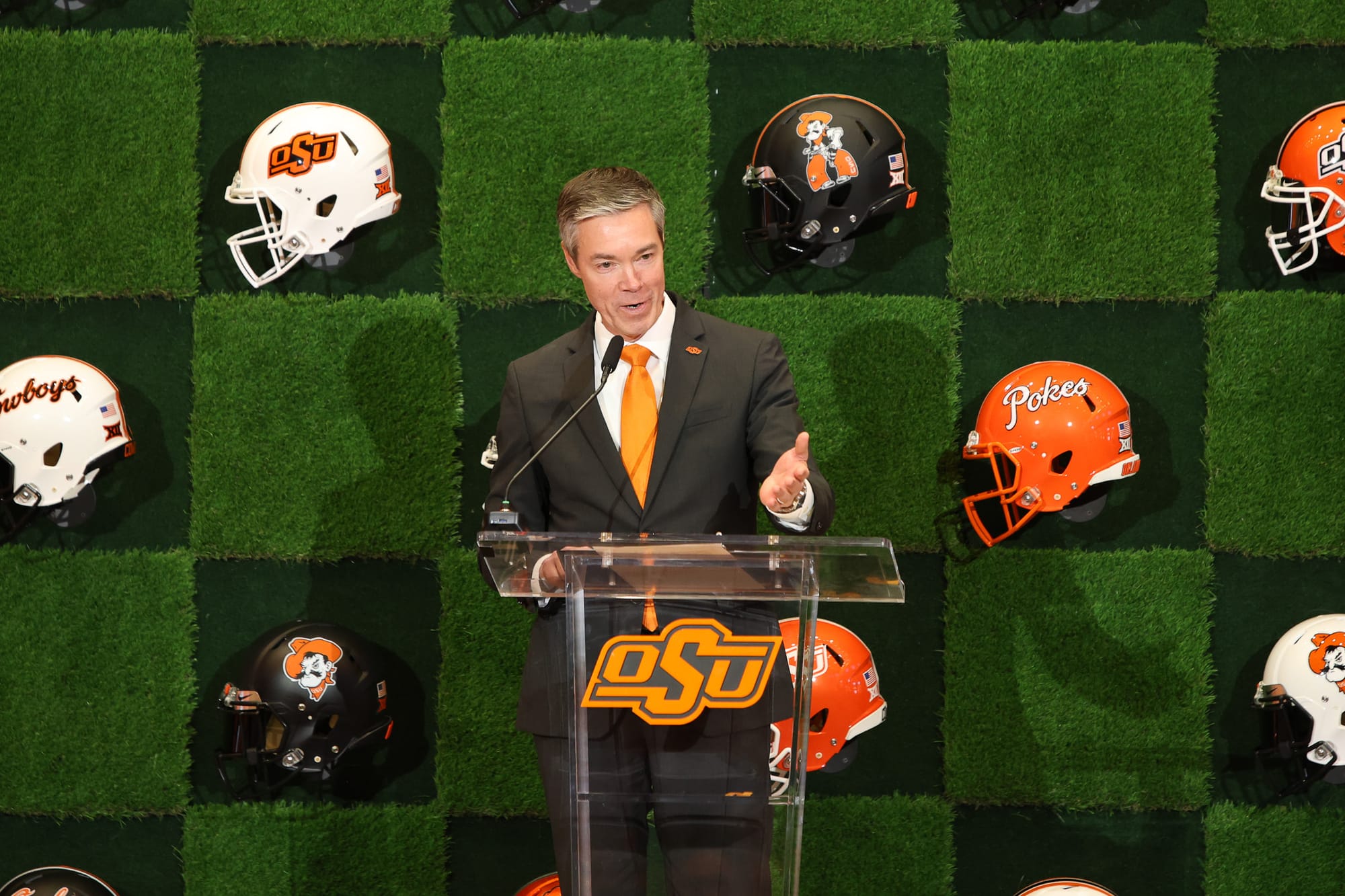
Oklahoma State athletic director Chad Weiberg speaks during the introductory press conference for head coach Eric Morris on Monday, Dec. 8, at the OSU Alumni Center. Weiberg praised Morris as checking every box the athletic department was looking for in its coaching search, noting "it was clear that Coach Morris wanted to be at Oklahoma State." Weiberg has overseen several successful coaching hires at OSU, including women's basketball coach Jacey Hoyt, men's basketball coach Steve Lutz and wrestling coach David Taylor. – Photo by Chris Peters
What grade should OSU's hiring of Morris warrant?
Allen: A solid A-minus.
I've touched on his pedigree as a talent evaluator and developer. But beyond that, he's one of college football's most brilliant offensive minds. Wherever he's gone, offensive efficiency has followed. North Texas has averaged at least 34 points per game on offense in each of his three seasons while ranking 20th or better in total offense rankings.
Not to mention, Florida, Penn State, Auburn and LSU could each be considered destination jobs. Amid coaching changes, such schools tend to poach from other Power Four programs, hiring seasoned coaches who are established winners at a high level. LSU cashed in with Lane Kiffin from Ole Miss. Penn State did, too, with Matt Campbell from Iowa State. But when those schools don't cash in, they revert to backup options — often proven Group of Five coaches. Auburn, Florida and Arkansas all did.
Morris was a hot name thrown around on social media and message boards as a backup option. Thus, simply put, he was the best possible hire OSU could have made. And had Weiberg not expedited OSU's coaching search, the Cowboys would have likely missed out.
Peters: A for effort – and A for execution.
With college football being so centered around a head coach, you would imagine an athletic director is always keeping an eye out for potential new leadership. Weiberg and his team clearly did their homework. As Weiberg explained, they knew the profile they wanted: "An accomplished coach with a track record of winning games and building programs. A leader who creates a culture young men want to be part of. A man that you would want your son to play for while learning valuable skills and lessons in the process."
But the real magic, as Weiberg called it, was the fit: "Coach Morris checked every one of those boxes and more." Even better, "it was clear that Coach Morris wanted to be at Oklahoma State. He wanted to be the next head coach of Cowboy football, and he wanted to raise his family in Stillwater." That mutual desire — OSU wanting Morris and Morris wanting OSU — is what separates a good hire from a great one. The speed and efficiency of this hire showed Weiberg was serious about getting his man before other programs came calling.
How quickly can Morris get OSU back to bowl contention?
Allen: Weiberg told reporters that the athletic department plans to max out the roster budget with NIL investment. Even without enhanced funds, who's to say Morris won't cash in on another hidden gem in the transfer portal.
Weiberg also noted how OSU football was built on high-caliber offenses and scoring points in bunches in the early days of the Gundy era. Morris is an air-raid disciple who played under legendary coach Mike Leach at Texas Tech. He has also coached under or alongside current coaches in USC's Lincoln Riley, TCU's Sonny Dykes, Wake Forest's Jake Dickert, Dana Holgorsen, among others. He is a proven offensive mind whose offense have produced videogame-like numbers wherever he's been.
So, if Weiberg's comments hold true, given Morris' pedigree as a quarterback whisperer and the increased funds in contrast to his prior coaching stops, Morris has a chance to get OSU back to the top of the Big 12 rather swiftly.
Peters: Returning the program to bowl eligibility should be a reasonable expectation for year one. The investment made by program boosters, mega donors and fans warrants postseason play, even if it's a lower-tier bowl game.
Morris certainly seems confident in his ability to sell what Cowboy football and Stillwater have to offer. When asked if OSU can win a championship, he didn't hesitate: "Hell yes, we can win a damn championship around here."
He laid out his plan clearly: "We're going to go out and we're going to outwork and outrecruit everyone. We're going to identify the top talent throughout the state and the nation to come to Stillwater and be a part of this program."
The first year will test how good of a salesman he is, but Morris understands the work ahead. He told the team at their first meeting: "This is not going to be easy, but we will forge our identity in the cold, dark hours of the offseason when nobody's watching."
It's the following years where the rubber meets the road — expectations for Big 12 Championships and playoff appearances will ultimately determine Morris' future as head coach.
What will Morris' biggest challenge be in Year 1?
Allen: Piecing together a roster.
The Cowboys already have 23 players in the transfer portal, 13 of which entered during the season after Gundy's firing. Morris will need to hit the portal as soon as it opens Jan. 2 to build a roster for 2026.
But then there's the appeal element — or lack thereof — in recruiting to a 1-11 team that hasn't won a conference game in two seasons. The Cowboys have history, largely thanks to the consistency Gundy established during his time in Stillwater. But recency bias plays a major factor in the modern age. And Morris and Co. will have to overcome that if he hopes to return OSU to a bowl game in his first season.
Peters: Finding a true QB1. If the air-raid offense is returning to Boone Pickens Stadium, then Morris needs the right player to execute it.
The good news? Morris knows exactly what he's looking for. He explained his unique recruiting approach: "We have a way that we're able to judge that in the recruiting process, and so if I take a three-star quarterback, nobody get mad at me." What sets his quarterbacks apart, he said, is "their ability to process information really fast, and what's going on in between the brains."
Morris can overcome the severely lackluster performance of Cowboy football's last two seasons by pointing to what he accomplished at North Texas — turning an 11-2 season and conference championship appearance into a compelling recruiting pitch.
He's also evolved his offensive philosophy beyond just passing: "Teams that can run the football win in December, and they win championships." That balanced approach could be key to immediate success while he develops the quarterback position.
📺 Watch the event
Share this article
The link has been copied!
Members Discussion
Your link has expired. Please request a new one.
Your link has expired. Please request a new one.
Your link has expired. Please request a new one.
Great! You've successfully signed up.
Great! You've successfully signed up.
Welcome back! You've successfully signed in.
Success! You now have access to additional content.