None of this would be possible without the subscribers and advertisers who supported The Stillwegian this year. Thank you 🙏
– Chris Peters, Founder, Editor & Reporter
Sometime in the next two years, Google will flip the switch on the first phase of a $3 billion data center campus on the outskirts of Stillwater. It will be the largest private investment in our city's history — a bet that this college town on the Oklahoma plains has what one of the world's biggest companies needs: land, water, power, and a government willing to make a deal.
I covered this story from the first public whisper to the construction dust. Ten stories over eleven months. And it still remains to be seen if Stillwater made a good deal or if a global tech company bamboozled a rural community into trading it's resources for fixed payments.
Here's how the story unfolded.
Kipper who?
By the time I started covering this story in January 2025, Stillwater residents had been speculating for months about who was behind Kipper LLC. The entity working with city and county leaders under non disclosure agreements to build a massive data center campus in city limits.
When I first heard the name Kipper, my mind immediately heard the theme songs from a late 1990's British animated children series my kids and I watched when they were young. Dora the Explorer and especially Caillou have nothing on coolness of Kipper the Dog.
Kipper.ai, entered the social media comments as theoretical possibility. A top search result for Kipper LLC at the time. Considering Kipper.ai markets their product as "undetectable" AI-powered writing tools to college students, conspiracy minded individuals could start making connections to why they might build a data center near a college campus.
Kipper.ai is more than likely building their writing tools using large language models from OpenAI, Anthropic, or even Google and more importantly they didn't seem fit the big clue shared by the City of Stillwater: Being a U.S.A. based Fortune 100 Company.

The project plan had been drafted in August 2024. The public first learned about it in October, when the city began the approval process for what officials would only describe as a data center development backed by an unnamed Fortune 100 company. By November, voters had approved a franchise agreement allowing Oklahoma Gas & Electric to supply high-voltage electricity for the project—a sign of how seriously city leaders were taking the opportunity. Voters overwhelmingly passed the agreement with 73% approval.
We all knew Kipper LLC was a front for a larger corporation but we would have to wait six months to know for sure.
The deal and approval gauntlet
In early January, a city council agenda item laid out the stakes: a proposed agreement with Kipper LLC for up to six data center facilities on a 400-acre campus, each valued at approximately $500 million. A potential $3 billion investment. In exchange? A 25-year exemption on ad valorem taxes and payment in lieu of taxes.
I wrote a preview of the January 13 council meeting, breaking down the proposed PILOT payments—$58.2 million over 25 years just for the first two phases, split among Stillwater Public Schools, Meridian Technology Center, Payne County, and the county health department.

The city still wasn't saying who was behind Kipper LLC. But public information has a way of telling stories if you know where to look.
When the tax incentive agreement landed on the Payne County commissioners' agenda the following week, I started connecting dots. City leaders had offered clues: a US-based Fortune 100 company, a leader in artificial intelligence, owner-operated facilities, and definitively not a cryptocurrency mining operation.

For me the shortlist included Meta, Microsoft, Google, NVIDIA, Amazon, and Apple. But datacenters.com maintains a list of all data centers in Oklahoma, and only one company on that list met all the qualifications: Google, which has owned and operated a massive data center complex in Mayes County near Pryor since 2007.
I published my simple analysis. This is most likely Google.
The lone no vote
The tax incentive agreement required approval from all taxing entities: the City of Stillwater, Payne County, Stillwater Public Schools, Meridian Technology Center, and Payne County Health Department. It passed everywhere. But not unanimously.
At the January 21 county commissioners meeting, Stillwater City Manager Brady Moore made the pitch for a 25-year tax abatement. "We looked at other projects around the state and wanted to make sure Stillwater was getting the best [deal], not just around the state, around the nation," he told commissioners.
There was no representative from Kipper LLC in the room. When Commissioner Zach Cavett asked about their absence, Mayor Will Joyce explained: "I find it better that they're not here trying to advocate for a community decision that we've got to make on our own. They didn't speak at our city council meeting on this subject. They didn't speak at the school board meeting, even though they had a guy sitting in the room."

Commissioner Rhonda Markum cast the sole dissenting vote—the only no in the entire approval process across all taxing entities.
"I have several constituents that are not in agreement with the 25-year tax deferment," Markum said. "They're really not in agreement with the data center either, but they're not for the 25-year tax deferment."
Commissioner Seth Condley, a former educator who still coaches soccer at Stillwater Public Schools, acknowledged receiving emails urging him to vote no. But he motioned to approve, citing the benefits to the school district.
Markum's vote would prove to be a preview of a continued resistance.
The Tolkien tell
Three days later, at a Payne County Board of Health meeting on January 24, I got my hands on an information packet. There, on the cover page, was the project's internal code name: Project Rohan.
I like to think that I notice details some don't but I will admit that I didn't catch that the project code name was mentioned twice in the tax incentive agreement.
While no other publication seemed to also point out that detail, I immediately recognized a literary reference—to a people whose identity is defined by horses.

Google is known for meaningful code names. And if you know your Tolkien, you know Rohan is the kingdom of the Horse-Lords, the Rohirrim, a noble race renowned for their exceptional horsemanship and fierce independence.
I thought about what a Google employee would see if they searched for Stillwater, Oklahoma. The bronco buster statue downtown Oklahoma State University Cowboys. The old granite Oklahoma Land Run centennial monument. Horse imagery is everywhere.

Somewhere in Mountain View, a project code name picker must have looked at those search results and thought: They're like the Rohirrim.
Cowboys on the Oklahoma plains. The Horse-Lords of Rohan.
I was almost certain now.
The health board voted 4-0 to approve. City leaders said the company should reveal itself in March or April.

The calendar invite and reveal
In early March, I received a calendar invite from the city. The subject line was simple: "Discussion - Data Center Project." A date, time and location. Nothing more.
At that meeting, I received an embargoed press release. Google was officially behind Kipper LLC. Alphabet, a multi-trillion-dollar tech company, was coming to Stillwater.
The embargo meant I couldn't publish until the next morning. But I could have ignored it. I could have broke the story immediately.
I didn't.
Stillwater is small town where relationships matter. Breaking that embargo might have gotten me a few hours of exclusivity, but it would have been detrimental to the trust I need to build—trust that took months of showing up to meetings, asking questions, and providing accurate and responsible reporting.
The embargoed release was a test of trust. And passing it meant something.
On March 12, 2025, The Stillwegian was first to report that Google was coming to Stillwater—ahead of every other outlet.
"Google choosing Stillwater is a testament to the strength of our economy, our workforce, and our commitment to community investment," Mayor Joyce said in the release.
Regular readers of The Stillwegian weren't surprised. They'd been following the breadcrumbs for weeks.
The breaking news traveled. Mike W. Ray writing for the Southwest Ledger asked me if they could publish the story in the weekly print paper. We agreed to terms and suddenly The Stillwegian had its first story published in newsprint.

Some long time Payne County residents might recognize Mike. He is the son of Homer and Beth Ray who ran Yale News until their untimely deaths in 2000 while driving to cover a Yale High School playoff football game. Mike also had a stint at the Stillwater News Press.
The neighbors
Planning commission meetings are usually procedural. This one wasn't.
When Google's 202-acre preliminary plat came before the commission on August 5, Crystal Hayes stood up to speak.
Hayes lives near the data center property. The development sits across from her property on Richmond Road . She'd watched the construction ramp up, watched the truck traffic multiply, claimed near head-on collisions on roads that weren't built for this kind of heavy truck traffic.

"I will absolutely vehemently oppose number seven. That is my driveway," Hayes told commissioners about Lot 7.
David Barth, the Development Services Director, explained that Lot 7 would house an OG&E substation, not a data center building. He assured Hayes that any work affecting her property approach would require coordination. "You can't restrict someone access to their property," he said.
The plat was approved 5-0.
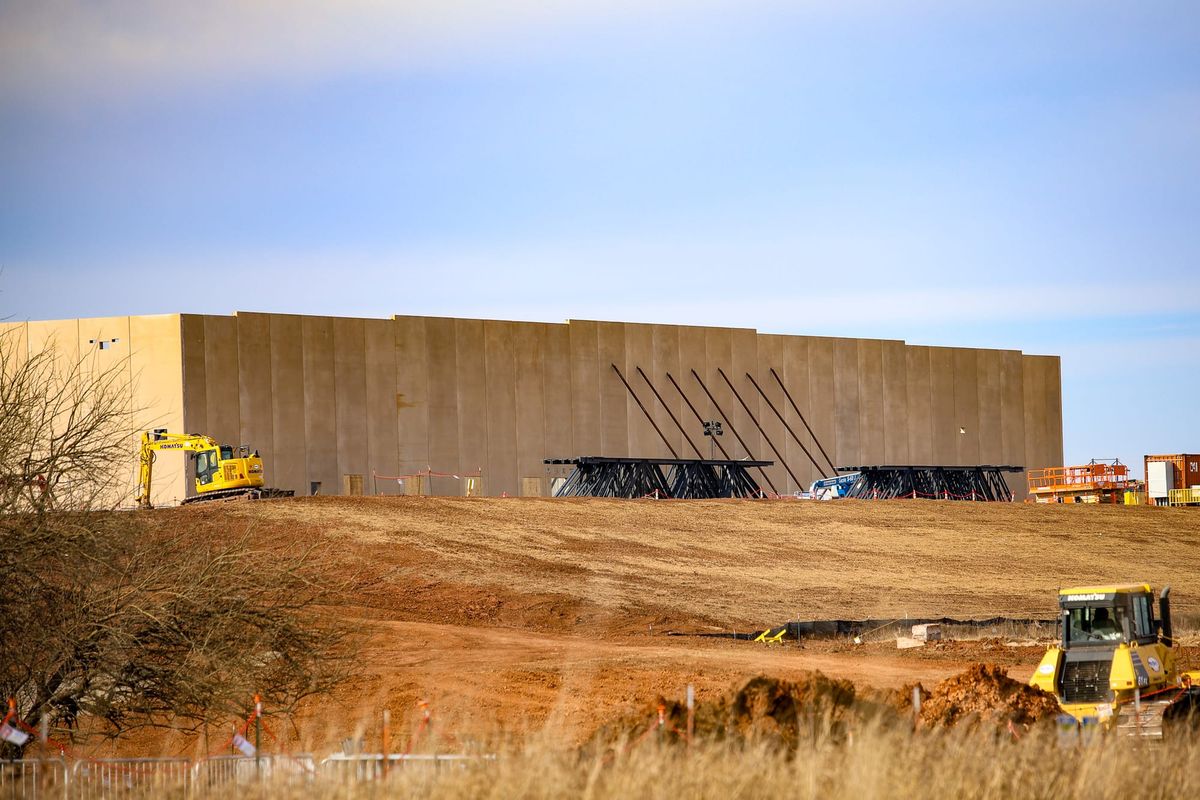
After the meeting, I drove out to get my eyes and camera on the progress. The construction site is massive. Construction trailers dotted the property. The land had been graded flat, vast and brown.


Early construction at Google's data center site, Aug. 5, 2025: graded earth, blue stormwater barriers, construction trailers, and heavy equipment staged behind gates. A Stillwater water tower rises in the distance—a reminder of the infrastructure questions still to come. – Photos by Chris Peters
I could understand the disruption to locals who live nearby. But I also thought about what comes next: once construction of these initial phases are done and Richmond Road is paved, it'll eventually just be a bunch of boring industrial buildings with a handful of cars parked outside.
Reddish water and dead fish
In April, heavy spring rains turned the stripped construction site into a runoff source. Red silt and dirt flowed off the property and into the Park View Estates pond.
I was there. I documented the dead fish, the reddish-brown water, the local television crews interviewing neighbors from Park View Estates.


Dead fish, reddish-brown water, and KFOR Channel 4 interviewing Park View Estates residents after spring rains washed construction runoff from the Google data center site into their pond, April 22, 2025. – Photos by Chris Peters
But I didn't publish a story.
I don't do investigative news—yet. At the time, I wasn't prepared to request records from the Oklahoma Department of Environmental Quality and other entities to assess the damage and who could be held responsible. So I held back.
The homeowners association eventually sued, and when they did, publication after publication jumped to the headline "Stillwater HOA sues Google." The more accurate framing—"Stillwater HOA sues data center construction contractor"—was harder to find.
Looking back, I've grown more comfortable going after records. Next time, I won't shy away.
Commissioner Markum would later tell state lawmakers about the damage: inadequate silt fencing, cleared topsoil and trees, and a construction site unprepared for Oklahoma weather.
The state legislative takes notice
By October, the Google project wasn't just a Stillwater story anymore. Data center proposals were popping up across Oklahoma, and the state legislature wanted to understand they will impact Oklahomans.
An Oklahoma House Utilities Committee study on October 21 brought Stillwater and Payne County officials to the Capitol—and the contrast was stark.
Commissioner Markum, the lone no vote from January, finally had a platform. She told lawmakers the first two data center buildings would use approximately 2.7 million gallons of water daily. If all six buildings are constructed, that number could reach 8.1 million gallons per day.
She revealed that county officials had been required to sign non-disclosure agreements before learning project details—something the assistant district attorney at the time believed conflicted with Oklahoma's open government statutes. It seems she signed the NDAs anyways.
"I'm really concerned about the water usages," Markum said. "Without water we can't live."
City Manager Moore presented a sharply different view, emphasizing the city's transparency efforts and Google's community investment—including a $600,000 donation to Stillwater Public Schools for energy-saving projects.
Meridian Technology Center CEO Dr. Doug Major reported that more than 315 workers had been trained since July through mandatory safety orientations. Manhattan Construction was the primary contractor. One local concrete company had hired 40 additional employees specifically to support the project. Work is expected to continue for six to 10 years.
The story blew up on Facebook reaching over 20,000 people and in the comments, Mayor Joyce showed up.
Since his election in 2018, Joyce has been willing to engage with people on social media—probably less so post-pandemic, but he still speaks up when commenters attempt to spread uninformed opinions. That day, he was in the comments correcting misinformation from people who clearly hadn't read the article.
The building begins
By November, the project had moved from controversy to concrete.
After the final plat came before the planning commission on November 4, I drove out again to document the progress. The construction site had transformed: internal roads paved, water lines being installed, infrastructure taking shape.


Google's data center campus on Dec. 24, 2025: the gated entrance to Crystal Hayes' ranch on Richmond Road, overhead power line warnings along the unpaved route, and construction progress on the Phase 1 building in Tax Incentive District 1. – Photos by Chris Peters
Richmond Road remains unpaved but heavily trafficked—construction trucks navigating the rural route between Perkins and Jardot Roads. The contractor has committed to paving the road in the coming months.
David Barth told commissioners that erosion control measures had been strengthened after the spring complaints from Park View Estates. "I have not heard complaints since those measures were implemented," he said.
The final plat passed 4-0.
The open questions
Here's what I still don't know:
Did Stillwater make a good deal with Google? The tax incentives are generous—25 years, compared to the five-year deferment Google received in Pryor. The promises are big. But 25 years is a long time, and the full picture won't be clear for decades.
Does the phased approach protect Stillwater's interests? City leaders structured the agreement so Google can't build all six phases at once—they have to come back for approval. The idea is that this keeps power in local hands. Mayor Joyce noted that the company must commence construction on the final phase within 10 years. But will future councils hold the line if Google pushes?
Will the needed water infrastructure get built? Google's later phases depend on water capacity Stillwater doesn't yet have.
Here's the math: Stillwater's water treatment plant currently handles 18 million gallons per day, with average demand running 6 to 8 million gallons daily. The first two data centers will use approximately 2.7 million gallons per day. If all six buildings are constructed, that number climbs to 8.1 million gallons per day.
The city has secured a $112.9 million loan from the Oklahoma Water Resources Board and developed a $210 million improvement plan that includes expanding treatment capacity from 18 to 24 million gallons per day and constructing a seven-mile pipeline to Lake McMurtry as a secondary raw water source.
But here's the biggest challenge: our raw water pipeline from Kaw Lake is nearly 50 years old. It runs 36 miles and serves 120,000 people. If it fails, the city has less than a day's worth of reserve drinking water—staff can only shut down the line for about six hours before we start running out.
And for Google to build beyond the first two phases? City Manager Brady Moore has said Google must invest significant capital to expand Stillwater's water treatment capacity before constructing additional data centers. The later phases of Project Rohan depend not just on city planning—but on Google helping foot the bill.
Looking ahead
Data centers and related energy projects are now appearing across Oklahoma. In Tulsa County alone, two hyperscale projects—Project Anthem and Project Clydesdale—would require billions of gallons of water annually.
Some projects face pushback from residents and activists. Very few face resistance from elected officials. Oklahoma is being marketed as a place with abundant resources, cheap land, and minimal government red tape. It's like Governor Kevin Stitt likes to say, "Oklahoma is open for business."
Virginia officials who testified at the legislative study offered a cautionary tale: data centers created jobs and economic growth, but they're now driving almost all projected energy demand growth in the state. Consumer electricity bills are rising as a result.
Stillwater Electric Utility customers might not directly see an increase, but OG&E customers might. The utility has asked the Oklahoma Corporation Commission to use "construction work in progress" or CWIP—a cost-recovery measure that allows utilities to charge customers for new energy generation and transmission projects before they're brought online. The commission denied a recent request by OG&E in November, but only because Senate Bill 998, the new state law enabling CWIP, wasn't in effect when they originally applied. Expect them to try again.
I'll also be watching where the money goes.
Stillwater Public Schools will receive approximately $624,000 annually from Phase 1 alone—how will the district use it? Meridian Technology Center, Payne County, and the Payne County Health Department will each receive their shares. Did the PILOT payments make a difference? The community betterment payments—$132,432 annually from Phase 1, earmarked for parks, infrastructure, and economic development—will start flowing to the city. What will they fund?
Stillwater was early to this wave and seems to be in good position to dictate its future with big tech corporations. Whether that makes us a model or a cautionary tale depends on what happens next.
I'll be watching in 2026 to help document the next chapter of this story.
Full Coverage: Big Tech Comes to Town
- City council poised to make big decision on data center agreement — January 11, 2025
- Clues to who is behind Kipper LLC — January 17, 2025
- Payne County approves 25-year tax abatement for data center project — January 21, 2025
- Data center tax abatement clears final hurdle, reveals project code name — January 24, 2025
- Stillwater welcomes Google: Tech giant to build data center campus — March 12, 2025
- Stillwater tackles water challenges with $210M master plan — May 19, 2025
- Google data center plans advance as planning commission OKs 202-acre preliminary plat — August 6, 2025
- Stillwater taps into $112.9M loan for water upgrades — August 20, 2025
- Local officials offer contrasting views on Stillwater data center at state study — October 23, 2025
- Planning commission advances Google data center final plat — November 11, 2025