Inside the HD 35 Republican Runoff: What the Numbers Reveal
Dillon Travis (30.41%) and Mike Waters (21%) advance to January 13 after primary split five ways, with nearly half of voters still up for grabs


Dillon Travis (30.41%) and Mike Waters (21%) advance to January 13 after primary split five ways, with nearly half of voters still up for grabs
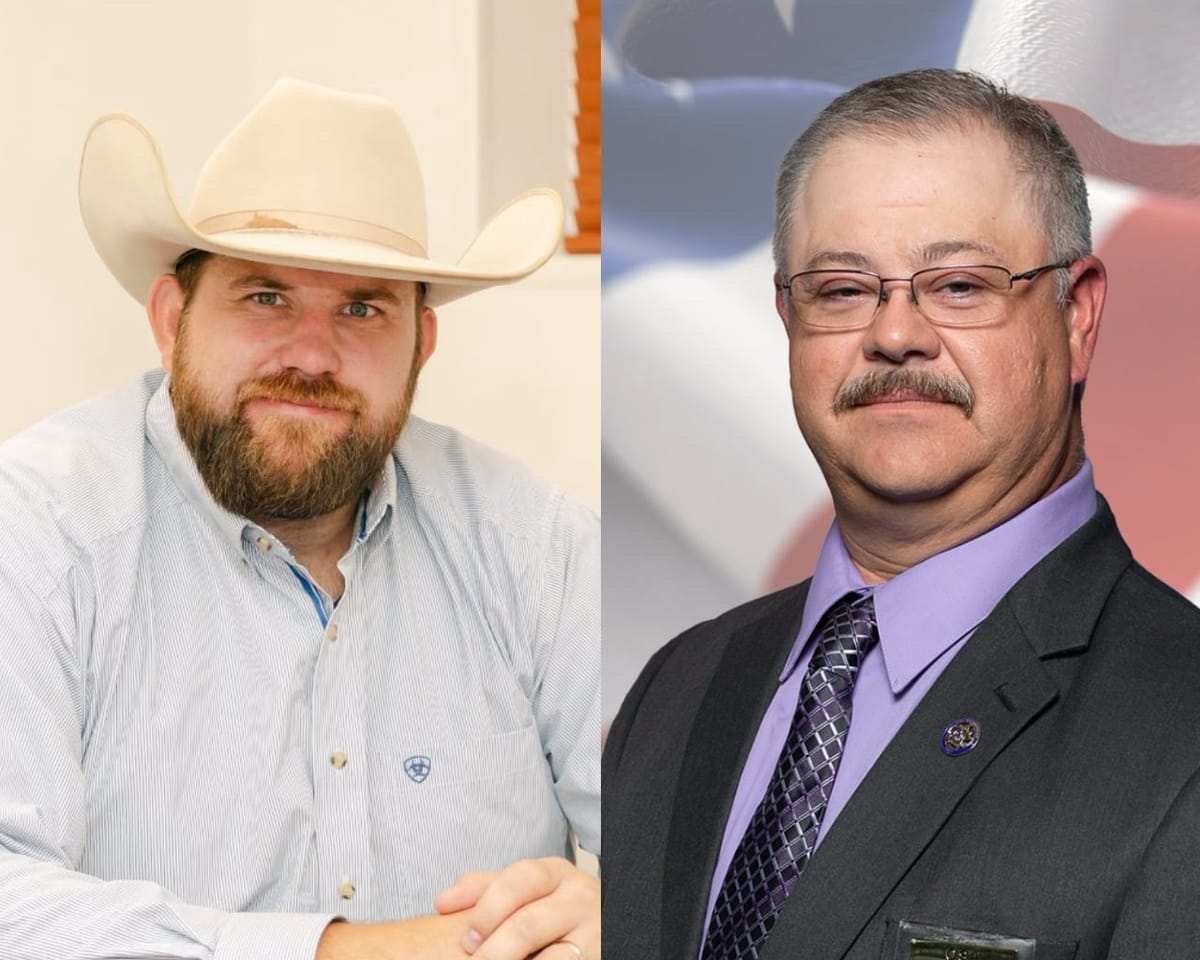
Dillon Travis and Mike Waters will face each other in a January 13 runoff election after finishing first and second in the December 9 Republican primary for Oklahoma House District 35, setting up a contest between a sixth-generation farmer/rancher and agricultural business owner and a former sheriff with lifelong ranching experience.
Travis, a sixth-generation Oklahoma farmer/rancher from Maramec and owner of Southern Plains Ag Co., captured 30.41% of the vote with 753 votes in the five-candidate race. Waters, a former Pawnee County Sheriff, rancher, and business consultant, finished second with 520 votes (21.00%).
The race for second place was remarkably tight, with just 16 votes separating Waters from fourth-place finisher Kevin Wright. James Winn placed third with 509 votes (20.56%), followed closely by Wright with 504 votes (20.36%). Amber Roberts finished fifth with 190 votes (7.67%).
All 26 precincts in the district completely reported results. A total of 2,476 voters cast ballots in the Republican primary.

The election results reveal distinct geographic patterns that will shape the runoff campaign. Travis won all five counties in the district—Creek, Noble, Osage, Payne, and Pawnee—demonstrating broad regional appeal. He edged out Waters even in Pawnee County, Waters's home base where he served as Sheriff, by a margin of 389-353. Despite losing his home county, Waters captured 67.9% of his total votes from Pawnee County alone, revealing his heavy geographic concentration.
Travis's support was more evenly distributed across the district, with Pawnee County representing 51.7% of his vote total, followed by Noble County at 23.8%. Waters's campaign was heavily concentrated in Pawnee County, where he served as Sheriff, with just 15.8% of his votes coming from Noble County and smaller percentages from other counties.
In Pawnee County's largest precinct (590202), Waters won decisively with 150 votes compared to Travis's 82 votes, demonstrating his strong name recognition in his former jurisdiction. However, Travis overcame this deficit through stronger performance in other Pawnee County precincts and won convincingly in multiple precincts across Noble and Creek counties.
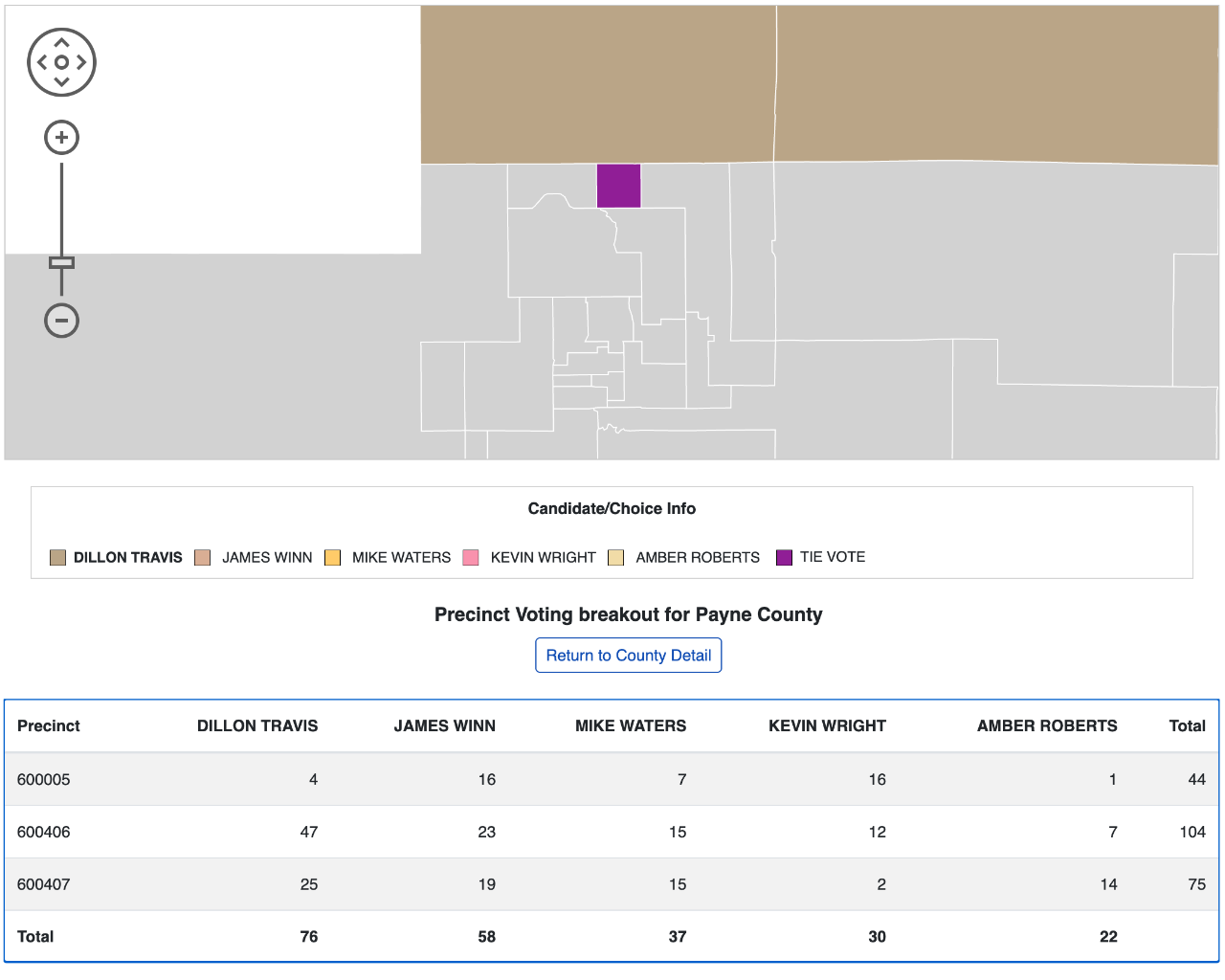
With 1,203 votes cast for the three eliminated candidates—representing 48.6% of the total—both runoff candidates face the challenge of winning over supporters of Winn, Wright, and Roberts. The ability to consolidate these voters in what is expected to be a low-turnout special election runoff will likely determine the outcome.
Travis led across all voting methods, receiving 682 votes on Election Day, 53 votes by absentee mail, and 18 votes through early voting. Waters received 426 Election Day votes, 79 absentee mail votes, and 15 early votes, showing stronger performance in early and absentee voting relative to his overall totals.
A message from Visit Stillwater
The temperatures are dropping, but the holiday spirit is heating up in Stillwater! Find special gifts and holiday happenings all throughout America’s Friendliest College Town.
Travis emphasizes his production agriculture background as a sixth-generation Oklahoma farmer and rancher, positioning himself as the authentic farming candidate. Owns Southern Plains Ag Co., a chemical, seed, and fertilizer business serving customers across Oklahoma, Kansas, Nebraska, and Texas. His top priorities include:
Education Reform: Advocates implementing Mississippi's 2015 approach that moved the state from 50th to top 10, specifically retention-based promotion policies where students must demonstrate reading proficiency to advance grades. Notes Oklahoma passed similar law in 2015 but backed off after parental pressure while Mississippi stayed the course. Strong supporter of CareerTech programs, having attended Drumright CareerTech for diesel mechanics.
Opposes "woke curriculum" and "gender identity" topics in schools: "Teachers don't need to be teaching that in our schools...politics don't need to be in schools." Emphasizes consulting with teachers, principals, and superintendents "on the front lines" to identify actual problems.
Agricultural Protection: Strongly opposes foreign ownership of Oklahoma farmland, citing personal example of neighboring land "destroyed" after being purchased for illegal marijuana operation. "I've got some land up the road that was a wonderful piece of property, and in six months it was destroyed."
Emphasizes American food security: "I never want America to have to worry about where its food is coming from." Will work to lower input costs for farmers and ranchers. Supports protecting landowner rights while fighting foreign land grabs.
Rural Infrastructure: Pledges to eliminate "government waste spending" and redirect funds to rural counties for roads and bridges. Notes Pawnee and Noble counties "have some of the worst roads in the state," costing his operation money in feed truck repairs.
Opposes new sales taxes on rural Oklahomans, focusing instead on cutting waste. Says he sits on "our national NRCS board" and observes: "There's some government employees that don't do a whole lot and get paid a good check...it doesn't take four or five people to do one job." *See member discussion for a clarification of this quote.
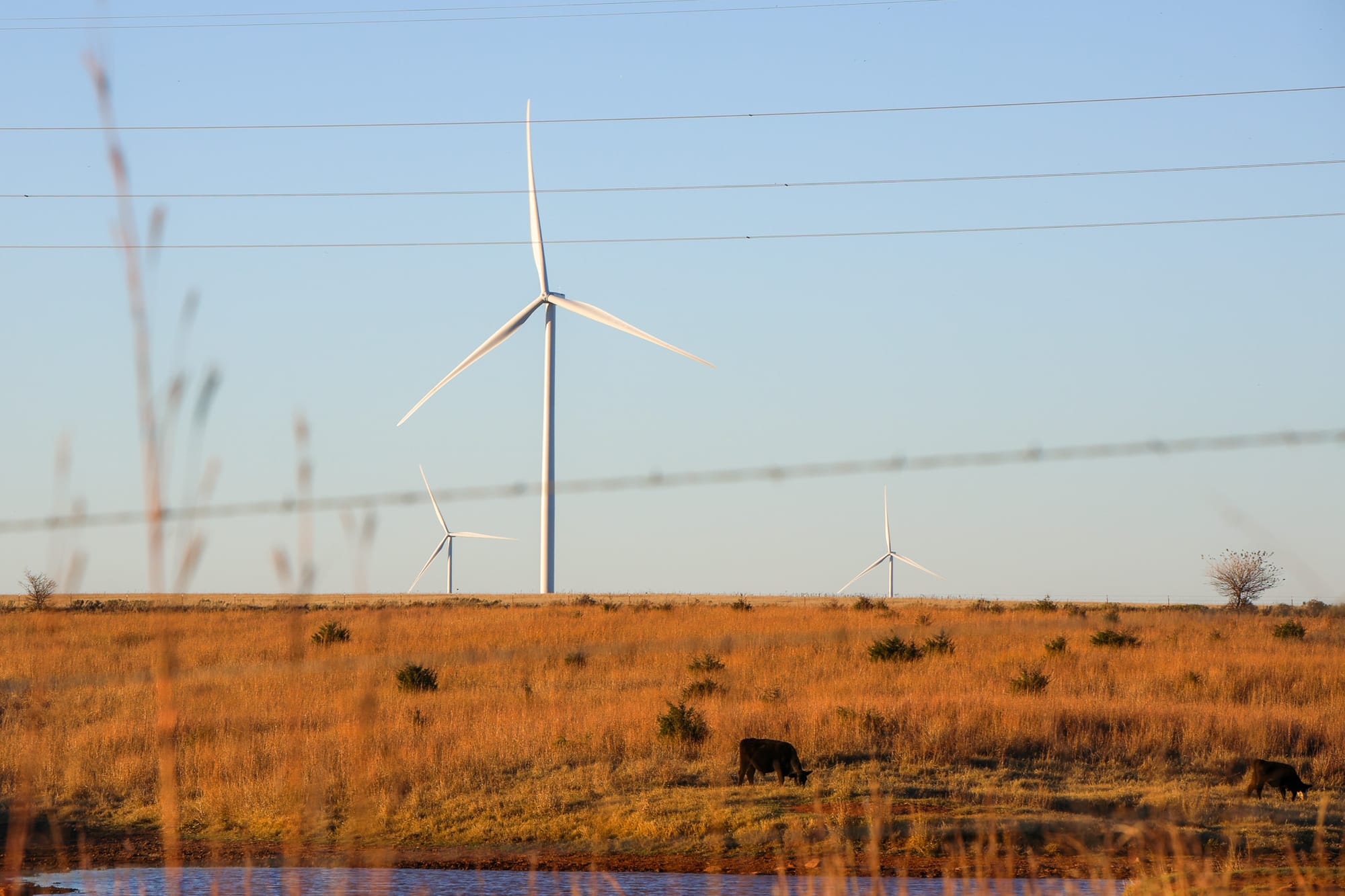
Energy Policy: Opposes tax subsidies for wind energy and data centers, arguing they should be "self-sufficient" without taxpayer support. Strongly supports natural gas development: "Oklahoma doesn't need wind or solar. We've got plenty of natural gas. Oil and gas is what made this state. Agriculture and oil and gas." Notes data centers create noise pollution, health concerns, and strain on electrical grid while demanding rate increases from consumers. "I would be 100% against tax incentives to data centers and windmills."
Property Rights: Supports individual landowner rights. On wind energy: "If my neighbor wants to put them on, that's his choice. That's his property." However, believes eliminating tax subsidies would naturally reduce wind farm development. Concerns about data centers' impact on drinking water, noise, and health effects on nearby residents.
Waters runs on his 25-plus years in law enforcement and lifelong ranching experience, having been raised on a cattle ranch and currently running livestock in Pawnee County. His top priorities include:
Public Safety: Promises to "back the blue," crack down on violent crime and drug trafficking, and oppose "soft-on-crime policies." Advocates addressing county jail staffing crisis and fully implementing State Question 781 funds (only 44 of 77 counties have applied). Supports treating mental illness and addiction "in clinics and recovery centers, not in your county jail." Calls for better support for firefighters and EMS personnel including modern equipment and mental health programs, plus state funding for rural volunteer fire departments.
Veterans Affairs: Advocates fully funding veterans' services and healthcare access. Supports Senate Bill 530's Oklahoma Veterans Foundation. Pledges to "cut the red tape that slows down care." Personal connection through father's Vietnam War service and stepdaughter's U.S. Air Force service.
Elder Care: Board member of United Community Action Program serving nine counties. Calls for stronger oversight, modernized facilities, and fair funding to address nursing home funding gap. Pledges to crack down on elder abuse and ensure seniors live with "dignity, safety, and the care they deserve."
Agriculture: Opposes increased beef imports that "undercut our local producers and threaten our food security." Supports consistent disaster relief for producers, expanding OSU Beginning Farmer and Rancher programs, and investing in rural infrastructure including roads, broadband, and local processing facilities. Promises to fight burdensome regulations, protect private property rights, and "streamline permitting, simplify compliance."
Education: Supports defending parental rights, increasing teacher pay, and keeping "politics out of the classroom." Acknowledges $25 million added to formula "not enough" to meet rising costs. Emphasizes parents need "a seat at the table when decisions are made." Has supported early childhood education across five counties through United Community Action Program.
Both candidates emphasize conservative values, Second Amendment rights, and commitment to rural Oklahoma. Both oppose State Question 836's open primary proposal, support federal term limits, and pledge accessibility to constituents.
Each has deep agricultural roots—Travis as sixth-generation farmer/rancher running production agriculture operation and ag business, Waters having been raised on cattle ranch and currently running livestock. Both understand production agriculture challenges firsthand, pledge to protect farmers and ranchers from burdensome regulations, and support property rights. Both advocate eliminating government waste to fund priorities rather than raising taxes on rural Oklahomans.
Travis's Path: Must maintain his geographic spread that won him all five counties while building on his narrow 36-vote margin in Pawnee County, where Waters has deeper roots as former Sheriff. Needs strong turnout in Noble County, where he won 179-82, and must appeal to eliminated candidates' voters in Creek County, where Winn won 111 votes to Travis's 58. His door-knocking operation (over 800 doors in the primary's first three weeks) will be crucial in a low-turnout special election. Winning all five counties gives him momentum but the close Pawnee County result shows Waters's potential strength in a head-to-head matchup.
Waters's Path: Must overcome losing even his home county of Pawnee, where he served as Sheriff, while expanding his appeal across the district. Though he earned 353 votes in Pawnee County, Travis's 389 votes there demonstrate the challenge Waters faces. Must leverage law enforcement endorsements from sheriffs in Payne, Noble, and Osage counties to build credibility and name recognition outside Pawnee County. Needs to consolidate support from voters who chose Wright (504 votes) and Winn (509 votes), both of whom ran stronger than Waters in several precincts. His challenge will be converting his law enforcement credentials into district-wide appeal beyond his Pawnee County base.
The winner of the January 13 runoff will face Democrat Luke Kruse in the February 10 general election. The special election was called to fill the unexpired term in District 35, which covers portions of Pawnee, Noble, Payne, Osage, and Creek counties. The seat became vacant after Rep. Ty Burns resigned in August 2025, two days after pleading guilty to misdemeanor domestic abuse and assault charges.
Special election runoffs typically see significantly lower turnout than primary elections, making voter mobilization and the ability to consolidate support from eliminated candidates critical factors in determining the outcome.
Editor's Note: Election results are official as reported by the Oklahoma State Election Board as of December 17, 2025, at 9:20 AM CT. Analysis based on county and precinct-level results data.