An OSU fire ecologist who was evacuated during the March 14, 2025 wildfire told a Stillwater civic group earlier this month that conditions that day were mild compared to what could come — and that eastern red cedar is the primary reason the wildland-urban edge around Stillwater remains at high risk.
Dr. David Engle, Regents Professor Emeritus of natural resource ecology and management at Oklahoma State University, addressed the Stillwater Frontier Rotary Club on June 11, offering a detailed assessment of why March 14 unfolded the way it did, what a more severe fire could look like, and what residents and officials can do now to reduce risk.
Engle and his wife live on Garden Pointe Dr., inside the Boulder Creek neighborhood. They evacuated that night expecting to return to nothing.
"My wife said, when we come back, we probably won't have anything here," Engle said.
Their home survived. Two houses in the neighborhood did not.

The March 14 fire burned under what Engle described as relatively moderate conditions. The maximum temperature reached roughly 70 degrees. Wind gusts peaked around 45 mph at local Mesonet stations. Relative humidity bottomed out around 12 percent, not the single-digit lows that accompany the most dangerous fire weather. The anticipated wind shift from southwest to northwest never materialized. About an inch and a half of rain had fallen two weeks before the fire, keeping oak leaf litter and heavy downed timber damp enough to resist combustion.
"It was primarily a surface fire," Engle said. "There was some crowning and spotting, but not much of it."
The next fire may not offer those advantages.
"The next fire definitely could be 80 to 100 degrees, even beyond 100 degrees Fahrenheit," Engle said. "Wind gusts could be in excess of 60 miles per hour. I worked on a fire in Kansas where they had wind gusts over 100 miles per hour."
Boomer Blast — Stillwater's annual Independence Day celebration — heads to Boomer Lake Park on July 3. Food trucks open at 6 p.m., with fireworks lighting up the lake at 9:30. Free and open to the whole community.
He also warned that the wind shift the March 14 fire lacked — a front turning southwest winds to northwest — is common in Oklahoma spring fire weather and can transform a head fire moving northeast into a flank fire that becomes a new head fire racing southeast, endangering communities in its path.
Firebrands from the March 14 fire spotted as far as two miles ahead of the fire front, Engle said. Though most did not ignite, that spotting distance is a function of the most prominent fuel source in western Stillwater: eastern red cedar.
Red cedar contains waxes, oils, and terpenes — volatile compounds that ignite quickly and burn hotter than other fuels. Dense canopies allow fire to travel crown-to-crown without touching the ground. Smaller trees act as ladder fuels, carrying surface fire upward.
Engle and a colleague coined the term "green glacier" decades ago to describe how cedar has expanded across Oklahoma landscapes as fire suppression has accelerated its spread. They measured growth rates of about nine inches per year in Payne County, with faster growth possible on better soils.
"You get ignition of the crown of a red cedar, and it will carry to an adjacent tree," Engle said. "Crown-to-crown-to-crown fire."
An 80-acre tract of private land north of the Boulder Creek neighborhood, heavily covered in red cedar, borders the subdivision that burned. Engle described a fire path in which wind-driven fire moved from rural grassland, jumped a road, ignited roadside grasses, moved into red cedar, and produced a crown fire that entered the subdivision.
Exterior paint protects your home's wood, trim, and siding from Oklahoma's extremes. Stillwater Building Center carries premium exterior paints and stains for every surface.
📞 405-372-5959
The cedar problem extends beyond fire risk. Engle said individual trees can transpire anywhere from 10 to 100 gallons of water per day, depending on size, season, and soil conditions. Red cedar also intercepts an estimated 10 to 15 percent of rainfall before it reaches the soil surface. Studies in Oklahoma and neighboring states have found that removing cedar from watersheds can restore streamflow that had not been seen for decades.
"Here in Oklahoma, it's depriving our major water courses from water," Engle said. "And that has a significant economic impact."
Cedar's encroachment also affects wildlife. Engle told the Rotary audience that eastern red cedar is the leading cause of declining bobwhite quail populations in the region — not by killing the birds directly, but by eliminating the open-ground habitat they need to nest successfully.
Oklahoma has invested state resources in the problem. The Oklahoma Conservation Commission administers an Invasive Woody Species Cost-Share Program, which grew out of the 2023 Terry Peach North Canadian Watershed Restoration Act and has since expanded into additional emphasis areas across the state. Payne County is among the participating districts. Landowners in the program can receive up to $50,000 per year toward the cost of cedar removal, with no minimum acreage requirement. A first application window ran from October to December 2025; the commission has said more information on future rounds will be released in 2026.
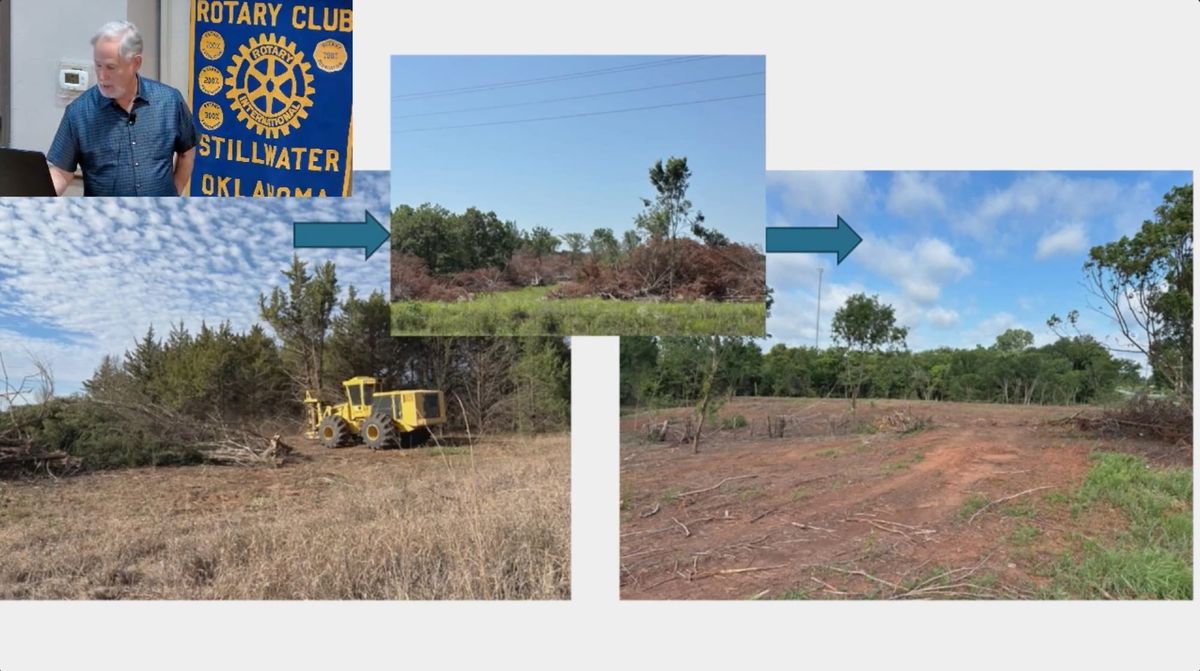
Work funded through the program is underway near Stillwater. Engle described a 300-foot buffer being cleared along a corridor near 19th Street and Country Club Road, close to Stillwater fire station no. 4. He credited City Manager Brady Moore with helping identify the buffer boundaries.
"They're out there doing that right now," Engle said.


Eastern red cedar lines W. 19th Ave. in a Google Street View image from June 2024, left, while cut cedars cure along the roadside before being chipped and hauled off during active clearing near the same corridor, center and bottom left; a slide from Dr. David Engle's June 11, 2026 Stillwater Frontier Rotary Club presentation shows aerial and buffer maps of the clearing area just south of Stillwater Fire Station No. 4, prepared by the Payne County Conservation District, right. The clearing is part of a 300-foot fuel-reduction buffer funded through the Oklahoma Conservation Commission's Invasive Woody Species Cost-Share Program. – Photos by Chris Peters/The Stillwegian and Google Street View
Engle also described volunteer-led red cedar removal on a three-acre common area inside the Boulder Creek neighborhood, funded with $5,000 from the homeowners association for hauling and chipping costs. About a half-dozen volunteers donated labor and chainsaws. Engle said the project not only reduced fire risk but improved growing conditions for mature oak trees that red cedar had been suppressing.
For homeowners, Engle outlined several steps to reduce risk. He warned against volatile ornamental plants near structures, including switchgrass and many common nursery plants that remain green in winter and burn intensely. He recommended cutting ornamental grasses to the ground before winter. He said mulch around homes will ignite and should be watered regularly during dry periods. He emphasized keeping garage doors closed during an approaching fire, citing a Boulder Creek home that burned from the inside out after firebrands entered through a partially open door.
He also pointed to wood privacy fences as a primary ignition path in the March fire — and in other Oklahoma wildfires — and encouraged homeowners to consider noncombustible alternatives.
"Your best option is to reduce your risk," Engle said. "In a wildfire — especially these horrendous wildfires."

He pointed residents to the Firewise USA program, administered by the National Fire Protection Association, which offers guidance on home hardening ranging from no-cost behavioral steps to structural improvements. He also referenced the Oklahoma Cooperative Extension Service, which has a local position opening soon that he said would become a primary resource for public and private land management.
Adam Ray, a coordinating wildlife biologist with Quail Forever and a specialist in prescribed fire, also participated in the session. Engle was introduced by a Rotary member Scott Petty who said the presentation grew from a conversation with Engle and Ray after the March 14 fire, which led to a subsequent meeting with city, county, and state officials.
Engle closed with a direct challenge to the assumptions many residents may be carrying.
"If you think it won't happen again," Engle said, "you are fooling yourself."
A message from Visit Stillwater
Summer in America’s Friendliest College Town is full of live music, kids’ camps, livestock shows, art, and so much more. Explore everything happening this month in The Original Home of Red Dirt Music!
A path to becoming a Firewise community
Dr. David Engle told Rotary members that beyond hardening individual homes, the Boulder Creek neighborhood is exploring becoming a Firewise community — building on the volunteer cedar removal already taking shape on the neighborhood's common areas.
The National Fire Protection Association's Firewise USA program, created in 2002, gives neighborhoods a four-step framework for organizing that kind of work. It addresses risk on private property, where most wildfire losses occur, and is built on the principle that home ignition zones overlap, so neighbors have to act together to be effective.
Get organized: Residents form a volunteer board or committee with a designated resident as the point of contact, a role an existing homeowners association can fill. The community sets its boundaries, which must contain between eight and 2,500 dwelling units, and obtains a wildfire risk assessment that is updated at least every five years.
Make a plan: Using the risk assessment, the group creates a three-year action plan that identifies and prioritizes the work to be done each year, from common-area fuel reduction to homeowner education.

Do the work: The community completes the actions in its plan and hosts at least one wildfire-risk-reduction education event annually. Each site must invest the equivalent of one volunteer hour per dwelling unit each year, or the monetary equivalent of costs incurred. The volunteer cedar clearing on Boulder Creek's three-acre common area — donated labor and chainsaws, plus $5,000 from the homeowners association for hauling and chipping — is the kind of effort that counts toward that investment.
Report it: The resident leader registers the community through the Firewise USA portal and submits an application to the state program liaison. Sites renew their recognition each year by reporting their activity.
More information is at nfpa.org/firewise.
📺 Watch the full presentation